
“The Animal-Cruelty Syndrome” by Charles Siebert
July 14, 2010
On a late May afternoon last year in southwest Baltimore, a 2-year-old female pit bull terrier was doused in gasoline and set alight. A young city policewoman on her regular patrol of the neighborhood of boarded-up row houses and redbrick housing developments turned her squad car onto the 1600 block of Presbury Street and saw a cloud of black smoke rising from the burning dog. She hopped out, ran past idle onlookers and managed to put out the flames with her sweater. The dog, subsequently named Phoenix, survived for four days with burns over 95 percent of her body, but soon began to succumb to kidney failure and had to be euthanized.
For the complete article, go here.
This is a long article in The New York Times Magazine by Charles Siebert and deals with the issue of animal cruelty, focusing on dogs. Reading parts of this almost made me sick to my stomach; it is not for the squeamish but I consider it Must-Reading for anyone who cares about this issue. I hope that Siebert will put this material in book format so that it can stand alone as testimony to the horrible things humans are capable of and the efforts of those who seek to stop the abuse.
PETA Kills 97% of Dogs & Cats Brought in 2009 for a total of 2,301 — Adopts Out Only 8!
July 8, 2010
It’s no secret that I’m no fan of PETA and believe their operation borders on being a cult. They are quite clear in their core message, no animal should be used by any human for any purpose; not for medical research, not for food and not as pets.
But many people think of them as the ‘good guys’ fighting for animal rights and support them without really understanding where their money is going. Would you send them $25 if you knew that they kill almost every dog and cat that is surrendered to them?
“It’s whoring itself out for media coverage,” David Martosko, director of research at the Center for Consumer Freedom, said of PETA. “They’ll do the ridiculous stuff, but they won’t put an ad in the Norfolk press saying, ‘We have puppies and kittens, come adopt one.'”
For the complete article go to the Care 2 website here.
Help for Dog Owners with Problem Behaviors is Just a Click Away
July 2, 2010
Here are three great resources I was recently referred to that seem to have the right approach to dealing with problem behaviors in dogs (and other pets, as well).
The American Society for the Prevention of Cruelty to Animals has a Virtual Pet Behaviorist that offers a searchable database of bad behaviors and possible solutions on how to deal with them at www.aspcabehavior.org
The Certification Council for Professional Dog Trainers offers help on teaching basic obedience skills at www.ccpdt.org They also have referrals to licensed classes and puppy trainers in all 50 states.
A site run by a group of veterinarians, biologists and animal behaviorists www. certifiedanimalbehaviorist.com can give you expert advice on your problems. The members all have at least a master’s degree in their field and are said to specialize in dealing with “tricky behaviors” and hard to solve issues.
How Does My Prius Work, Really?
June 23, 2010
I’ve been driving a Toyota Prius for 5 years now and have had nothing done other than scheduled maintenance and the replacement of one headlight bulb. So I’m a satisfied customer and feel sorry about all the bad press the company has gotten this year.
The only unintended acceleration I’ve experienced has been the result of my own lead-foot driving. I experimented once and found that simply by observing the posted speed limit in my town I was able to achieve 59 MPG! Though, of course, I could never drive like that in real life.
But when asked to explain precisely how my car works I’ve mumbled around a few general principles and jargon, like “regenerative braking.” Now I’ve found where to direct people who are genuinely interested in this topic, a series of linked articles on the How Stuff Works? web site. For specific info on the Prius, go here.
Men can “laugh women into bed” according to new research
June 15, 2010
I’ve known this to be true for a long time, based on personal experience. I was not blessed with rugged good looks, a hefty bank account nor did I ever drive a ‘cool’ car. I wasn’t on any athletic team and would’ve been safely placed in the geek-freak category by most people who knew me in adolescence. Yet I had a very active social life during the dating phase of my life (high school, college and post-college).
Part of this was certainly due to the time period, the 1970s and the pre-AIDS, pre-political correctness ethos of that time. Just as a young person coming of age in the 1920s would have a very different experience than someone coming of age in the 1930s. Still it remains a cliché of all those dating/mating sites, and their print precursors, that women value and seek men with a “good sense of humor.” Now a British study reported in the UK Telegraph shows that what women are actually seeking is intelligence, which they believe is correlated with that GSOH.
The opposite appears to be untrue however. Men are generally not attracted to funny ladies. Sarah Silverman may be the exception that proves this rule. I can’t think of any other genuinely funny (sorry, Chelsea Handler) female stand-up who’s appeared in Maxim or Playboy.

Flash vs. HTML5 for video: Will the Designers Decide?
June 9, 2010
I agree with Steve Job’s position on Adobe’s Flash (see his Thoughts on Flash) primarily because of its resource hogging nature, long load times, vulnerability to malicious code explaoits and the fact that it causes my browser to hang or crash.
The other reason is because I believe that Content is King and I always skip the whiz-bang Flash intro’s to web sites whenever I have that option. If I want animation, I’ll go to Pixar and Disney.
H+Jobs clearly favors HTML5 and here’s a nice page of Demos and Examples.
But clearly there is room for debate here. Peter Wayner of InfoWorld makes the case for Flash gives 7 good reasons why developers will stick with it, despite the word from On High out of Cupertino.
He positions the discussion differently than most who have weighed in on this debate by identifying the user base as the most important element in the continued use of Flash on the web: “The real battle,” he writes, “is in the hearts and eyes of the artists who are paid to create incredibly beautiful objects in the span of just a few hours. The designers will make the final determination. As long as Flash and its cousins Flex and Shockwave remain the simplest tools for producing drop-dead gorgeous Websites, they’ll keep their place on the Internet.”
‘Tip of the Tongue’ Experiences Explained
June 3, 2010
I first read about the research on ‘Tip of the Tongue’ experiences back in the 1980s in The Psychology of Anomalous Experience: A Cognitive Approach by Graham F. Reed.
The fascinating aspect to me was that clearly one part of our brain knew the correct answer because we’re almost always able to reject the incorrect suggestions. When we try and remember the name of that great Southern food restaurant on Great Jones Street we may be certain that it’s one word and starts with an “A” but we’ll know that Alias, Arno, Abbott’s, Apache, etc. are not correct. (The answer is Acme).
So it’s clear that our brain can store information that is (temporarily) unavailable to us and be able to tell us when we guess wrong. New research on this phenomenon is described in this article the LiveScience site where it’s been found that people who use American Sign Language experience a similar ‘tip of the fingers’ effect. Go here to read about this latest study.
Tim Berners-Lee, Linked Open Data and a Bag of Potato Chips
May 28, 2010
Sir Tim Berners-Lee, who created the web while working at CERN, is someone we should listen to when he talks about the future development of the Internet.
What he’s hot on right now is something called Linked Open Data, something he believes will be the next evolutionary step for web development. He uses the information on a bag of potato chips to illustrate this concept:
The outside of the bag contains different sets of information, each using a different vocabulary and coming from a different source, Berners-Lee explained.
The front of the package displays the name of the brand and the company’s own marketing claim that the chips are crunchy. The back of the package has nutritional information, such as calories and vitamins, defined by terms generated by the U.S. Food and Drug Administration (FDA). Finally, there is a Universal Product Code (UPC) bar code on the bottom of the package, which is not understood by humans at all but rather is recognized by scanning machines globally as the moniker for the item.
In other words, this single package of information actually is a collection of data and attributes that have been developed by multiple parties, not just Utz.
For the rest of the article, go here at IT World.
Chuck Klosterman on Fame, from “Eating the Dinosaur”
May 24, 2010
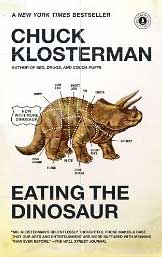 “I do not know how much money Britney Spears earned last year. However, I do know that it’s not enough for me to want her life, were I given the option to have it. Everyday random people use Britney’s existence as currency; they talk about her public failures and her lack of talent as a way to fill the emptiness of their own normalcy. She — along with Lindsay Lohan and Paris Hilton and all those androids from The Hills — are the unifying entities within this meta era. In splintered society, they are the means through which people devoid of creativity communicate with each other. They allow Americans to understand who they are and who they are not; they allow Americans to unilaterally agree on something they never needed to consciously consider.”
“A person like Britney Spears surrenders her privacy and her integrity and the rights to her own persona, and in exchange we give her huge sums of money. But she still doesn’t earn a fraction of what she warrants in a free-trade cultural economy. If Britney Spears were paid $1 every time a self-loathing stranger used her as a surrogate for his own failure, she would out earn Warren Buffet in three months. This is why entertainers (and athletes) make so much revenue but still are wildly underpaid: We use them for things that are worth more than money. It’s anew kind of dehumanizing slavery — not as awful as they literal variety, but dehumanizing nonetheless.”
— Chuck Klosterman, Eating the Dinosaur
Buy the book here on Amazon
This is the first collection of Chuck Klosterman’s work that I’ve read though it won’t be the last. I think he’s really nailed something important about how fame, celebrity and media work today in the excerpt above. Especially when he writes, “We use them for things that are worth more than money.” Scary. But true, I think.
Colorful Currency Worldwide from COLOURlovers
May 21, 2010

I’ve pulled your coat to the good folks at COLOURlovers before and here’s a wonderful selection of world currency employing a rainbow of color palettes, click here to see them all.