
“Magic and Sadism” — George Orwell on Comic Books, July 21, 1945
January 11, 2010
Recently a friend of mine in America sent me a batch of ten-cent illustrated papers of the kind that are known generically as “comics” and consist entirely of coloured strip cartoons. Although bearing such titles as Marvel Comics or Famous Funnies, they are, in fact, mainly given over to “scientifiction” — that is, steel robots, invisible men, prehistoric monsters, death rays, invasions from Mars, and such-like.
Seen in the mass these things are very disquieting. Quite obviously they tend to stimulate fantasies of power, and in the last resort their subject matter boils down to magic and sadism. You can hardly look at a page without seeing somebody flying through the air (a surprising number of the characters are able to fly), or somebody socking somebody else on the jaw, or an under-clad young woman fighting for her honour — and her ravisher is just as likely to be a steel robot or a fifty-foot dinosaur as a human being. The whole thing is just a riot of nonsensical sensationalism, with none of the genuine scientific interest of the H.G. Wells stories from which this class of fiction originally sprang.
Who reads these papers is uncertain. Evidently they are intended primarily for children, but the advertisements and the ever-present sex appeal suggest that they are read by adults as well.
— George Orwell, July 21, 1945, Leader Magazine
In Search of Memory — documentary film of Eric Kandel’s life work
January 11, 2010
We’ve written before about memory scientist Eric Kandel here and are thrilled to learn that a documentary about his life and work has been made. Read A. O. Scott’s review in the New York Times, “Total Recall: A Journey from Vienna to Brooklyn and the Center of the Brain” here. I look forward to seeing it and will report on it as soon as I do.
NY Times review of “The Faith Instinct” by Nicholas Wade
January 2, 2010
Judith Shulevitz’s review of The Faith Instinct: How Religion Evolved and Why It Endures by Nicholas Wade in the New York Times had three sentences that, for me, captured the essence of the debate over religion:
Why are our gods always equipped with recognizably human minds, even when they’re animals? How do sacred stories differ, if they do, from fairy tales, or from novels? What are holiness, impurity and ritual, exactly, and are they religious in essence, or categories implicated in everything we think and do?
She also references cognitive anthropologist Pascal Boyer’s excellent Religion Explained. Amazon says of it, “Readers who can lay aside their biases will find great rewards here; Boyer’s wide scholarship and knack for elegant writing are reasons enough for reading his book.” I found his approach to a very divisive subject to be patient and methodical. (In stark contrast to the combative assault of The God Delusion by Richard Dawkins, another highly recommended work).
Boyer looks at both the psychology and the evolution of religion. When he does his comparative religion analysis he points out that there are patterns to religious belief. For example, no culture has conceived or, if you prefer, recorded interaction with a god that is all knowing who forgets everything he knows every 5 minutes (like the memory damage suffered by the protagonist in the film Memento).
He also looks at the transmission of religious belief from one generation to the next in a way that suggests Dawkin’s concept of the ‘meme,’ a discrete bit of information (a ritual, a catch phrase, a concept) that successfully multiples in the culture. Think of the ‘viral videos’ on You Tube and the endless stream of alleged ‘jokes’ and ‘weird pictures’ that flood your email inbox.
Of course, there are many who will reject the notion of any analysis of religion on grounds that the supernatural is verboten to rational investigators. Think ‘mystery,’ think ‘faith,’ think ‘it’s not for us to understand the mind of god, whether Odin, Zeus or Muhammad.’ God as Fu Manchu: inscrutable. . .
That gods and spirits are construed very much like persons is probably one of the best-known traits of religion. Indeed, the Greeks had already noticed that people create gods in their own image. . . All this is familiar, indeed so familiar that for a long time anthropologists forgot that this propensity requires an explanation. Why then are gods and spirits so much like humans? — Pascal Boyer
Can I also ask, why do ghosts wear clothes? I have a soul, supposedly. Alright, it was free and, in my case, very low maintenance. It’s immortal, cool! I can come back and annoy the living, double- cool! But do my jeans and sneakers have souls too? Why does my T-shirt come with me in the After Life?
BEFORE ROMERO: Joe Simon & Jack Kirby’s zombies from All Winners #1, Summer 1941
December 28, 2009
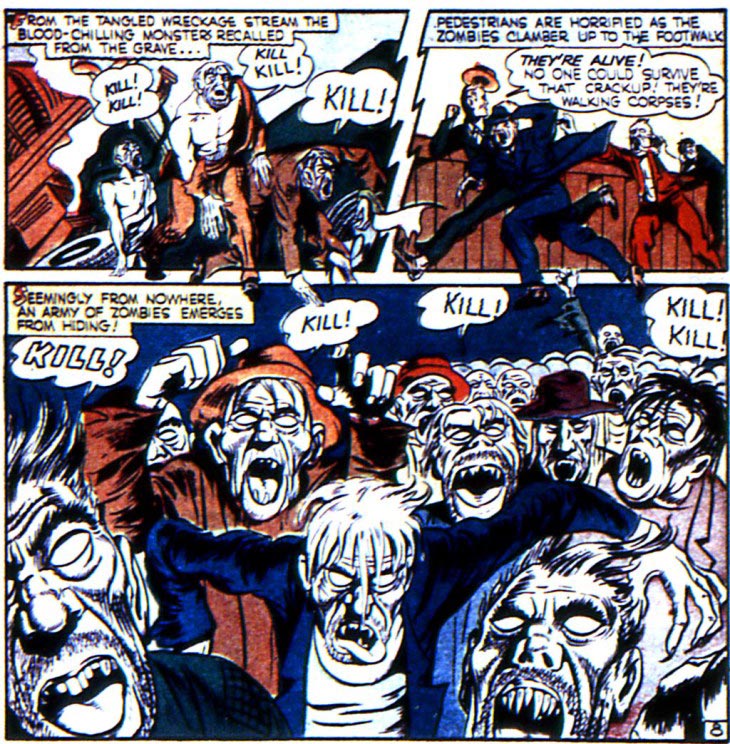
Click on image for larger size. The bottom 2/3 of page 8 of Captain America and the Case of the Hollow Men.
“How to kill a dead man? That was the horrible problem which CAPTAIN AMERICA and BUCKY had to solve before they could defeat the hideous menace who was the lord of death . . .”
Dog Books Worth Reading
December 28, 2009
The Year in Space Photography 2009
December 23, 2009

The attitude this holiday season is very much anti-Big Government (whatever that even means in a country of 308 million people). There’s a widespread doctrine today that says the gummit cain’t never do nuthin right. So here’s something that, I think, Big Government is doing well: taking pictures of our amazing, astounding universe.
The shot above is a Hubble false-color image of glowing gas and dark dust clouds in a star-forming region in the constellation Cassiopeia just over 6,000 light-years away. Click on image for larger size.
There’s a great selection of images at the Telegraph UK site here, taken in 2009 from the Hubble Space telescope, the Chandra X-Ray telescope, and the Spitzer Space telescope. Your tax dollars at work.
I always find these images of the vasty deep sky humbling. In one way they seem to be the ultimate rebuke to religion. Oh yeah, obviously the folklore and superstition of a Bronze Age desert tribe is the best way to filter and interpret our knowledge of the Universe. For sure.
I’m no good at being noble, but it doesn’t take much to see that all the problems of our little planet don’t amount to a hill of beans in this crazy Universe. Someday you’ll understand that. Here’s looking at you, Cassiopeia.
“Time to Eat the Dog: The Real Guide to Sustainable Living” — The environmental cost of pets
December 22, 2009

Time to Eat the Dog? The Real Guide to Sustainable Living by Robert and Brenda Vale published this year in England raises the thorny question of whether or not you can justify the carbon foot print of your pet.
I’ve posted an excerpt of Thorstein Veblen’s thoughts on the extravagance of dogs here on the Cynodictis Project page. Veblen’s governing principle was that every expenditure about subsistence was “conspicuous consumption” a purchase whose real aim is to communicate something about the buyer. Owning a dog says to the world, in effect, I have so much income I can afford to waste a portion of it feeding and caring for a non-productive member of the household.
I’ve always thought of this concept in terms of useless rooms in houses. I grew up, at least part of the time, in a house which had a living room that was for show purposes only. The furniture wasn’t wrapped in thick plastic but no one used the room. It was understood. The dog was not allowed in there either, under any circumstances. The living room was for entertaining on a certain level. Evidently did not circulate with the other A-listers because our living room was used once a year or less.
But should we really eat our dogs as the Vales suggest? Even if we are feeling a bit peckish?
They calculate that a medium size dog eats around 360 pounds of meat and 210 pounds of cereal annually. They equate this with the energy consumption of driving a 4X4 SUV 6,200 miles a year, including the energy required to build the car. I don’t suppose that since our family owns only a single car, a Prius at that, it comes close to offsetting our two ravenous Labradors.
But that’s not the only negative impact our dogs have on the environment.
The Vales claim that dogs decrease the biodiversity in the areas they are walked. Why would the presence of a domesticated animal in a suburban environment (where most companion dogs live) decrease the local biodiversity? How much of a decrease and what’s the impact of that? I’d like to see and understand the science behind this contention.
They also say that dog feces are responsible for high bacterial levels in rivers and streams, ultimately killing off aquatic life. Again, this statement exists in a vacuum. Surely the run off of excrement from our present method of factory farming, especially chicken and pig farming, are a much greater factor in the fecal pollution of our waterways?
New Scientist magazine had an independent expert calculate the environmental costs of dog ownership and he came to the same conclusions as the Vales: “Owning a dog really is quite an extravagance, mainly because of the carbon footprint of meat.”
Obviously, someone like me is going to question the specific degree to which pet owning contributes to our use of limited resources. Every expenditure has costs. The point of this provocatively titled book is that every decision we make has an environmental impact.
For most of us this isn’t part of our calculation when considering a purchase, the way we wash our clothes or burial options. For example, I didn’t know that the biggest “cost” of clothes is in our continually washing them.
So I don’t think that anyone really wants you to consider eating your (probably delicious) dog. It makes for a grabber of a title, though.
Dali 3D Painting from 1977
December 10, 2009
 Click on image for larger size.
Dali’s Hand drawing Back the Golden Fleece in the Form of a Cloud to Show Gala the Dawn, Completely Nude, Very, Very Far Away Behind the Sun
Two stereoscopic panels, oil in canvas, 1977, 23.5 X 23. 5 inches
Kids, Don’t Try this at Home! Professional Drivers on Closed Course! 3 Versions of “Cocaine Blues”
December 5, 2009
Another artist who combines historic levels of drug abuse, runs of startling creative energy and great longevity like the subject of my previous post, Anita O’Day is Keith Richards. Here’s Keith — without his famous band mates — performing one of the first blues he learned to play “properly.”
Hey, baby, come here quick / This old cocaine’s making me sick.
Cocaine Blues, a traditional blues classic, was originally recorded in 1927 by Luke Jordan. But perhaps the most influential early version is the one below, by the Reverend Gary Davis. Almost all other modern versions owe a debt to this one.
Cocaine — running all around my brain.
Cocaine’s for horses, it’s not for men / They say it’ll kill you, but they don’t say when.
It takes a full minute of screen time — wait for it — until they get down to playing but when they finally do Jackson Browne and David Lindley knock out an awesome duet version of Cocaine Blues on guitar and violin. Lindley also famously handles the falsetto at the end of Browne’s hit, The Load Out/Stay.
Anita O’Day: Jezebel of Jazz or the Greatest White Female Jazz Vocalist Ever?
November 28, 2009
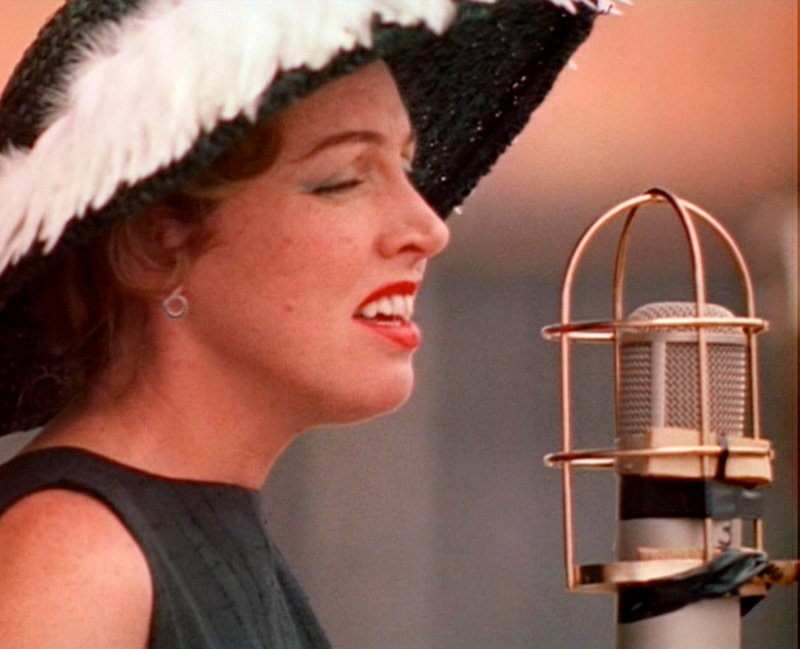 Encountering Anita O’Day and delving deep in her recordings was, for me, a transformative experience. It was like the first time I heard Patsy Cline. I knew I was in the presence of a great talent. Then I read about her high life and hard times and my respect for her grew. She was the Keith Richards of jazz canaries. Click on image for larger size.
Leaving home at 14, Anita spent her teenage years hustling (and singing a little) in the Depression-era dance marathons captured so magnificently in They Shoot Horses, Don’t They? The first phase of her career was as a songbird in Gene Krupa‘s big band beginning in 1941.
This association produced her first big hit Let Me Off Uptown. It was a novelty number with spoken dialogue between the young white female singer and jazz trumpet great Roy Eldridge, who happened to be black. “Well, c’mere Roy and get groovy!” she invites him, and introduces his solo by exhorting, “Well, blow Roy, blow!” Racy stuff for the 1940s. These were the war years and a more permissive stance in entertainment, and music especially, held sway. This jazz duo famously did not get along because Roy always felt Anita was upstaging him by dancing during his solos.
After Gene Krupa’s marijuana bust in 1943 Anita sang with Woody Herman and Stan Kenton. When Krupa reformed his band in 1945 Anita reunited with him for almost a year. In 1947 and gain in 1952 it was Anita’s turn to take marijuana possession busts.
In March of 1953 she was arrested for possession of heroin and did six months in jail. She and her long-time drummer John Poole, who introduced her to smack, were ‘hype buddies’ traveling the jazz club circuit across the country in the 50’s and 60’s, working diligently at the craft of jazz and just as diligently to score and maintain their mutual habit.
“We were spending 10 to 12 hours a day looking for it and playing games,” she writes in her autobiography, High Times, Hard Times. Note the long sleeved gloves in this 1963 concert appearance on Japanese TV.
It was during this period that Anita O’Day reinvented herself as a solo female vocalist. She recorded what many consider her best work for the Verve label between 1952 and 1962 and under the influence of heroin. Think Keith Richards during the Exile on Main Street sessions. She was also, at this time, Big in Japan, just like Tom Waits.
Dig the drum-and-vocal-only intro to Sweet Georgie Brown filmed by photographer and documentary filmmaker Bert Stern at the Newport Jazz Festival in 1958, released as Jazz on Summer’s Day (1960).
If this song doesn’t send you like it does me, brother, I can’t dig ya’ ’cause you must be dead.
After a near fatal OD in 1968 Anita cleaned up — by withdrawing on a Hawaiian beach — and became a fixture on the Jazz Festival circuit. Call this the third great phase of her career as she continued singing and recording into her late 80s. In 2006 she released a new album, Indestructible and finally left all of us cool cats and kittens behind when she died on November 23, 2006 at age 87.