
Dogs have Ethics, “a nuanced moral system” say natural historian Jake Page and animal behavorist Marc Bekoff
May 29, 2009
“Dogs have souls, but you already knew that” was the headline in the May 16, 2009 Seattle Times.
It’s unfortunate that the headline writer chose the word “soul.”
I find the evidence that I have a soul unconvincing, much less an immortal, indestructible spirit residing in each of our Labradors. And what Jake Page and Marc Bekoff are really talking about here are emotions and ethics, empathy and compassion, not spooks in the night.
One point on which I definitely agree is that dogs have a rich, interior emotional life.
Bekoff , co-author of Wild Justice: The Moral Lives of Animals, contends that:
• Dogs have a sense of fair play. They dislike cheaters. They experience joy in play. They delight in friends. Big dogs handicap themselves in games with little dogs.
• Dogs get jealous when a rival gets more or better treats or treatment. They are resentful, unnerved or saddened by unfair behavior. They are made anxious by suspense. They get afraid.
• They are embarrassed when they mess up or do something clumsy. They feel remorse or regret when they do something wrong. They seek justice. They remember the bad things done to them, but sometimes choose to forgive.
• Dogs have affection and compassion for their animal and human friends and family. They defend loved ones. They grieve their losses. They have hope.
I think I have observed every one of the behaviors that Bekoff lists here, as I’m sure would most dog-owners. Another less tangible variable, every dog I’ve ever known had what I believed to be a unique personality. Likes, dislikes, behaviors, food preferences, choice of games or toys, the list goes on and on.
Jake Page shows evidence that dogs actually do laugh. The same areas of the brain light up in laughing humans as in dogs that are happy, or enjoying themselves when viewed under a fMRI scanner (functional Magnetic Resonance Imaging).
I don’t doubt there is a relationship here, but I’m not certain that’s actually evidence of canine laughter.
The vocalization of a dog’s laugh, according to Page, is a rhythmic pant. By that definition, I’m not sure I’ve ever seen a non-animated dog laugh.
My 3 year old black Lab Luna does a lot of rhythmic panting after she’s been chasing her ball for 15 or 20 minutes, but I don’t think she’s laughing, just hyper-ventilating.
Back to that headline. Bekoff invites it, of course, when he refers to the “spiritual unity” between humans and canines. I have to quibble with that qualifier. Why not just say “unity”?
I mean, I’ve known some dogs who had soul (they were funky and down in the groove dogs) but not a soul. As in a personality that would persist after brain death? I’m not seeing the data here.
Yet there’s also no doubt in my mind that dogs have long term memory and an active dream life.
Maybe that is implicit in Bekoff’s observations, some of the above would be impossible without memory. And dreaming has been tied in some studies to processing the information of the past 12 hours. It has been shown that by interrupting REM sleep in humans you adversely affect the learning process.
There’s a deep connection between all the members of my pack and I think of it as concrete and real. It isn’t a religious feeling for me and it has nothing to with a traditionally defined “soul.” Can’t an atheist love, and be loved by, one good dog? One with liver treats?
________________________________________________________________
For the complete article at the Seattle Times site, go here.
Do Dogs Laugh?: Where Dogs Come From, What We Know About Them, and What They Think About Us by Jake Page, available at Amazon.

Wild Justice: The Moral Lives of Animals by Marc Bekoff and Jessica Pierce.
Yellow Mug software’s SnapNDrag – A better, free screen grab utility for OS X
May 29, 2009

The good folks at Yellow Mug software have a great little shareware screen-grab utility called SnapNDrag for Mac OS X. It improves on Grab with a better interface, more options and improverd functions (you can more easily capture timed screens).
Sometimes it’s the little things that add productivity to your day. Highly recommended!

“The New Yorker” cover finger-painted with iPhone App Brushes
May 29, 2009

Apple’s super-duper iPhone and an app called Brushes were used to create the June 1, 2009 cover for The New Yorker magazine by artist Jorge Colombo, who stood for an hour outside Madame Tussaud’s Wax Museum in Times Square drawing it with his fingers.
For more on this story, and a amazing short video that shows the cover being crafted stroke- by-stroke (the undo’s are eliminated from the animation), go here.
Zombie-Alert for Williamsburg, Brooklyn, NY on Sunday, May 31st
May 18, 2009

This just in — the Centers for Deceased Control & Prevention has announced a Z-Alert for Brooklyn, NY on Sunday, May 31st.

Photo from drivenbyboredom.com. NOTE: Not all photos on Drivenbyboredom.com are SFW.
Recently analyzed data suggest that the outbreak will begin at The Charleston, located at 174 Bedford Avenue, between North 7th and 8th Streets in Williamsburg.
“We have information that leads us to believe there will be a Zombie infestation somewhere in Brooklyn that afternoon, specifically mid-afternoon around 2:00 p.m.,” said Amber MacArthur, spokesperson for the CDC.
The CDC is making a special request to the 3D community: all NYC-area stereo photographers and videographers are being asked to document the activities of the Zombie horde and make these images available for later study.
“Of course, we’d like to be on the scene ourselves,” said Ms. MacArthur, “but our resources are stretched rather thin right now, as you might imagine. We feel that examining the 3D images will be almost as good as being there.”
Citizens are urged to approach Zombies with caution, although due to their slow, shambling gait it is believed that most active New Yorkers will be able to outdistance the undead, should that become necessary.
As a precaution the CDC recommends that you wash your hands thoroughly (a minimum of 20 seconds or so) should you have any contact with a Zombie, to avoid spreading the contagion.
“Preparing people for emerging health threats is one of CDC’s overarching goals,” MacArthur explained. “We handle everything from bio-terrorism to pandemics, so it was obvious that we needed to bring our expertise to bear on the emerging Zombie problem.”
FOR UPDATED INFORMATION, GO TO www.nyczombiecrawl.com
One Nation Under Dog — Great New Book on Contemporary Canine Culture
May 16, 2009
 Michael Schaffer’s new book One Nation Under Dog: Adventures inthe New World of Prozac-Popping Puppies, Dog-Park Politics and Organic Pet Food should find a place beside Jon Katz’ 2004 classic The New Work of Dogs for anyone wishing to bring themselves up to speed on the recent cultural changes involving Man’s Best Friend. Click image for larger size.
It’s an enjoyable romp through a dense array of topics; a tribute to Schaffer’s skill at packing these pages with a wealth of information. No other book I’m aware of covers so much territory in just 257 pages. This is up-to-the-minute reporting delivered with style and humor.
Of course, a good portion of the material deals with the extreme high-end of the canine services market as his first chapter “The $43 Billion Dollar Fur Baby” indicates. Collectively, Americans are spending more on their dogs and pets than ever before, notwithstanding the current economic crisis that’s lead to the rise of over-whelmed shelters and the new category of “foreclosure dogs.”
A case can be made that part of this spending is derived from the decade-long credit binge Americans have been on and this trend may moderate over the next few years. And the truth is that the over-whelming majority of dog owners are not now, nor ever will shell out $28 for 8.45 oz. of Isle of Dogs’ formula number 12, Veterinary Grade Evening Primrose Oil Shampoo as part of their “Canine Grooming System.” There’s always a high-end in any market and their extravagance always make good copy. [A personal disclosure: I buy Suave shampoo, $1.99 for 22.5 oz. at Walgreen’s, as part of my Primate Grooming System].
Where Schaffer makes his most telling points are in chapters devoted to breeding — including the well-documented horrors of Pennsylvania puppy mills, advances in canine health care and nutrition, the on-going battles for public space between dog lovers and the rest of society, pet funerals and breavement counciling, the myth of the $100,000 a year dog walker, and the exploding market for ever-new and improved dog toys.
I also got to catch up with Sue Sternberg, author of Successful Pet Adoption and learn about her recent work with Jane Kopelman creating the Training Wheels Program where they bring their Lug Nuts weight-pull events to inner city neighborhoods in an attempt to replace illegal dog-fighting. The weight-pulls allow men and boys to exhult in the competition of powerful breeds like Pit Bulls without combat or bloodshed. Sternberg operates the Rondout Valley Kennels/Animals for Adoption, a shelter in upstate New York and was the subject of a controversial 2003 documentary, Shelter Dogs by Cynthia Wade.
Near the end of Schaffer’s book he goes into a topic that I’ve spent a lot time pondering: how do we justify the fact that Americans dogs have a better standard of living than millions of humans sharing the same planet? There are no pat or easy answers here. He compares the person who spends $3,000 on a flat screen TV to the person who spends an equal amount for a year’s worth of organic dog food and suggests that in neither case would this individual be likely to claim that — if not for this purchase — they would be sending an equal amount to a human food bank.
“If we’re going to start enumerating immoral consumer choices, I’d argue that spending money to care for a pet would rank near the bottom of the list,” Schaffer writes. Peter Singer, however, might argue that point. Still, you could make far worse consumer spending decisions than buying One Nation Under Dog. Those whose ethics are more advanced can check it out from their local library.
“Glow in the Dark” Puppies – World’s First Transgenic Dogs
May 15, 2009

New Scientist announced that a cloned beagle named Ruppy — short for Ruby Puppy — is one of four successful live births of dogs that produce a fluorescent protein that glows red under ultraviolet light. Click on the image for larger size.
The red fluorescent gene responsible for this was taken from a variety of sea anemones. This was the result of work by Byeon-Chun Lee of Seoul National University, South Korea who was part of the team that produced the first cloned dog, Snuppy in 2005.
What is significant about this is not the Glow in the Dark aspect, rather the fact that this is the world’s first transgenic dog.
Transgenic is a term that applies to any organism that has had a foreign gene deliberately inserted into it genome using recombinant DNA methodology. Other DNA sequences are also inserted so that the new gene can be incorporated in the DNA of the host so that it will be expressed correctly by the cells of the host.
Previously, this technique has been used to make sheep and goats that express foreign proteins in their milk.This could ultimately result in an efficient way to produce proteins for medical research and the treatment of human disease.
Cloning is still a very difficult, time-consuming process that has a high failure rate. Byeon-Chun Lee’s team began with 344 embryos implanted into 20 dogs that resulted in only 7 pregnancies, only 4 of which survived. That’s a success rate of just 1.7 %.
For the complete article, go here.
Miggs Burroughs Lenticular Art: Fairfield Public Library, April 16—June 14, 2009
May 14, 2009
 Please mouse over the image if it is not animating automatically.
Migg Burroughs is a well-known CT-based artist and graphic designer who has recently been working with lenticular images. While this show does not feature 3D lenticulars, Burroughs certainly proves that this imaging technique can produce fine art in the right hands.
The heart of this show (called Journeys) is a series of nine 18 X 18 inch lenticular portraits that use a period photo combined with a contemporary one taken in the same style to achieve their effect. The image reproduced above is of Burrough’s mother. He used a photograph from her high school days along with an image he shot making a two image lenticular that fades from the young woman to the senior citizen. While this idea may not sound revolutionary, seeing these portraits in person was surprisingly moving.
Burroughs offers a bit of history in his text explaining that it was a French painter Bois-Clair that invented the lenticular concept by taking narrow vertical strips of two paintings, reassembling them and folding them like an accordian. Burrough’s process begins with two digital images and the software necessary to divide them 30 stripes to an inch. He then laminates the digital output with optical lenticualr plastic that has a corresponding 30 grooves to the inch.
One of the highlights of the show is a piece called Political Ties (18 X 18 X 36 inches). Burroughs uses 7 square images joined together to form a simple chair. In the images we alternately see a young man sitting in a chair with a white shirt and red tie, looking much like the fellow working away in the cubicle next to yours. The alternate image has the same young man in a black T-shirt, roped to the chair with his red tie used as a blind fold. You can walk completely around this piece and watch the transformation from every angle.
This show is well worth the trip to Fairfield, CT. All the work is for sale and Burroughs does commissions, too. It was all I could do not to break the bank and buy one of his smaller works on the spot.
There’s one of a local movie house, The Community Theater, (20 X 16 inches) that presents the same view from day to night with an old-fashioned neon movie marque as its focus. Simply beautiful. And for $450 it could hang in your home.
For Miggs Burroughs’ website, go here.
For gallery information on Journeys, go here.
Zombie Novel as a Work of Art? Tony Burgess’ “Pontypool Changes Everything”
May 13, 2009
When I hear the word culture. . .I reach for my gun.* So perhaps I’m not the ideal critic to proclaim a Zombie novel as a work of art. But I will say that Tony Burgess’ Pontypool Changes Everything is a ripping yarn, a great read and feels more like an indie-art novel than your typical Zombie thriller. Click on image for larger size.
A film version is due out this year, but it’s hard for me to imagine how any 2 hour movie could capture more than a fragment of what goes on in these densely packed 280 pages. I literally could not put this book down — it arrived on a Saturday afternoon and within 24 hours I finished it. It grabbed me from the first page and would not let go.
I’m going to excerpt a paragraph from the middle of the book as I think this will give you a sense of the quality of Burgess’ prose. It’s damning with faint praise to say that this is the best Zombie novel ever written. This is just a great novel, period.
In this little patch of land, a sort of smudge at the edge of a new drawing, a doomed population of wildlife was living out its final generation in manic friendlessness. Snakes copulated on the drying scalp of the terrain. A fox scrambled back and forth along an unearthed concrete conduit. A million mites lived on the rust from a single bard of wire. At night their eyes shone and their microscopic faces vibrated with insanity. Migrating birds that had made this a rest spot for hundreds of years now sensed that something was terribly wrong. They lit on the backs of barrels in the fat brown river, and when their young looked hungrily at a suicided worm or a grinning minnow, they clicked their beaks, sadly, “No.” At night a faint popping sound could be heard up and down the river, as weak heart valves in the young owl population strained to sustain life until morning.
________________________________________________
*“When I hear the word culture. . .I reach for my gun” is a phrase associated with the Nazi leadership in WWII. It’s adapted from a play written in 1933 by Hanns Johst, a pro-Nazi writer and member of the Waffen SS. The play, Schlageter, a biography of the proto-Nazi martyr Albert Leo Schlageter was first performed on Hitler’s birthday to celebrate his election.
The line is actually, “When I hear the word culture. . .I release the safety on my Browning!”
This is a reference to the Browning Hi-Power Automatic Pistol, preferred by some Germans over the native Luger (the Browning held 13 shots, the Luger just 8).
What’s This? A Brain-Bending, Eyeball Twisting Photo Quiz
April 29, 2009

Use the skills you’ve gained, America, from countless hours of watching police forensic procedurals (click on image for larger view).
I will give you only the following clues: it’s a common house-hold object, no bigger than a bread box, most people use one every day, some people say it is 99 and 44/100ths pure.
This space will substitute for the musical interlude which limits your time to consider the question to, oh, just about. . . now!
Give up? It’s a Labrador Soap Carving by our three year old black female, Luna. Number two, of an unlmited edition.
Are you Schizophrenic? If Not, Then Why Do All Your Friends Say You Are? The Hollow Mask Illusion
April 23, 2009
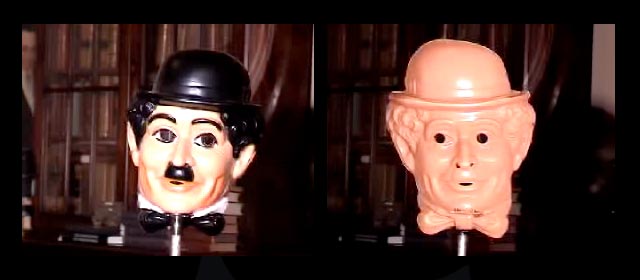
A standard plastic Halloween mask of Charlie Chaplin [click for larger image, above] is rotated on a short pole. When the inside, or back of the mask comes into view, you should be seeing a sunken-in face, the opposite of the front view, the reverse of normal.
But the face recognition module that you have in your brain is so strong that it immediately re-interprets the features into a normal-looking face, a positive image. Here’s a clear example of the top-down processing over-ruling the input.
See the video, here courtesy of Britain’s Your Amazing Brain.org.
Apparently though, if you are ill with schizophrenia or on certain drugs, (cannabis, for example) this part of the brain malfunctions and you don’t perceive this illusion. You see, correctly in this instance, the reverse of a normal face with a nose sinking inward.
So if you can’t see the Hollow Mask Illusion, you’re probably a crazy schizo! Hah! Either that, or you’ve got yourself some righteous weed, dude.