
The $10,000 Dog – www.SearchDogsUSA.org
September 13, 2008
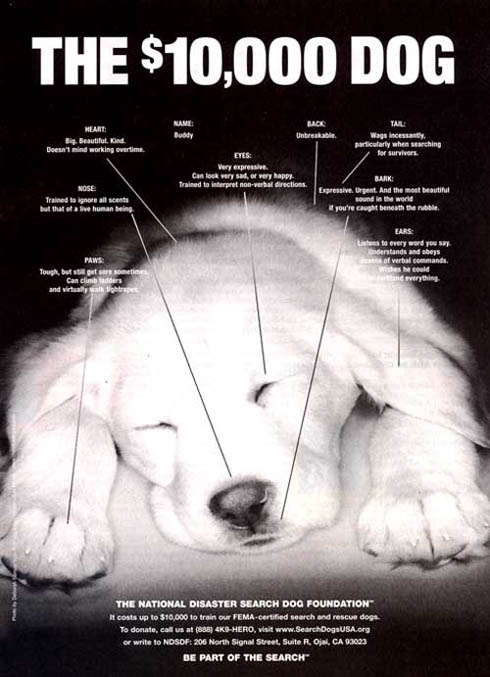
The $10,000 Dog
Name: Buddy
Heart: Big. Beautiful. Kind. Doesn’t mind working overtime.
Nose: Trained to ignore all scents but that of a live human being.
Eyes: Very expressive. Can look very sad, or very happy. Trained to interpret non-verbal directions.
Back: Unbreakable.
Tail: Wags incessantly, particularly when searching for survivors.
Bark: Expressive. Urgent. And the most beautiful sound in the world if you’re caught beneath the rubble
Ears: Lisitens to every word you say. Understands and obeys dozens of verbal commands. Wishes he could understand everything.
Paws: Tough, but still get sore sometimes. Can climb ladders and virtually walk tightropes.
It costs up to $10,000 to train our FEMA-certified search and rescue dogs.
The National Disaster Search Dog Foundation
www.SearchDogsUSA.org
A great ad for a worthy cause, IMO. If you’ re swimming in dough, splash a drop or two their way.
Get your Fix of British & Irish Accents via Internet Radio
August 30, 2008
I’ll admit to some Anglophilia if you’ll cop to the fact that you don’t use your car’s directional signals as often as you know you should.
Here’s a free way to listen to those delightful accents via Internet radio broadcasts.
Just Go Out and Play? Not for Today’s Kids
August 28, 2008
Rosa Brooks in the Los Angeles Times makes the case that kids’ lives today are over-structured and micro-managed. I agree completely.
Increasingly, American children are in a lose-lose situation. They’re forced, prematurely, to do all the un-fun kinds of things adults do (Be over-scheduled! Have no downtime! Study! Work!). But they don’t get any of the privileges of adult life: autonomy, the ability to make their own choices, use their own judgment, maybe even get interestingly lost now and then.
Here’s the complete article.
Site-Specific Conditioning Can Cause Fatal Drug Overdose
August 17, 2008
There is some evidence that drug addicts can die from using their usual dosage of drugs in a novel setting. There is a conditioned tolerance that develops from using an addictive drug like heroin in a familiar place. But taking that same dose elsewhere might kill you. Here’s a link to the original research in Pub Med from the Harm Reduction Journal.
While I’m a severe critic of almost all complimentary and alternative medicine, here is a case study that adds support for a negative placebo effect based on setting and expectation. The brain’s ability to affect our health is a topic that’s often abused by CAM practitioners when they sell their techniques to the public. But that doesn’t mean there’s not a demonstrated effect. Most people don’t understand the placebo effect and how many CAM procedures operate only at the level of a placebo. Clearly the mind does influence how chemicals react in our bodies. . .
The idea of the placebo in modern times originated with H. K. Beecher. He evaluated 15 clinical trials concerned with different diseases and found that 35% of 1,082 patients were satisfactorily relieved by a placebo alone (“The Powerful Placebo,” 1955). Other studies have since calculated the placebo effect as being even greater than Beecher claimed. For example, studies have shown that placebos are effective in 50 or 60 percent of subjects with certain conditions, e.g., “pain, depression, some heart ailments, gastric ulcers and other stomach complaints.”* And, as effective as the new psychotropic drugs seem to be in the treatment of various brain disorders, some researchers maintain that there is not adequate evidence from studies to prove that the new drugs are more effective than placebos.
from The Placebo Effect, The Skeptic’s Dictionary: A Collection of Strange Beliefs, Amusing Deceptions, and Dangerous Delusions by Robert Todd Carroll
George Orwell diaries online in blog format
August 3, 2008

George Orwell (Eric Arthur Blair) was one of the greatest writers and thinkers of the 20th century. If you don’t agree, then get the hell out. To my mind he’s in that select group of authors whose work can be profitably read and re-read. (Who else is on that list? For me, it includes A.J. Liebling, Aldous Huxley, Raymond Chandler, Dorothy Parker and Dashiell Hammett).
Now from the Orwell archive at University College in London comes material from his diaries in blog format. The NY Times did an article on it and you can connect directly to the diaries at orwelldiaries.wordpress.com.
More High Quality FREE Word Press themes
July 23, 2008
21 good-looking, premium FREE Word Press themes from Smashing Apps.
Slife – Free Software Tracks How You Really Spend Your Time per Project
July 14, 2008
Automatic Time Management — Thousands of designers, architects, consultants , developers, writers and many others use Slife to bill clients and keep track of time on projects.
Free Software from www.slifelabs.com (requires Mac OS 10.5)
 |
|
How to Communicate with a Dog
July 9, 2008
Dog Trainer Diane Canafax says many people intimidate dogs without even knowing it.
- The mistakes made are natural to the way people communicate face-to-face; however, canines, which are ventrally oriented, communicate with body language.
- For example, when people meet they look each other in the eye and shake hands or embrace. People take this same approach to meeting dogs, often leaning over to pet them, trying to show affection.
- “When you watch dogs, they approach each other from the side or back,” she said. “Direct eye contact is a challenge to them. When a dog leans forward they are insinuating an attack.”
The best way to approach a dog is to turn to the side with a hand outstretched and let the dog approach you, she said.
Physical differences also play into how dogs communicate.
- Canines, which are more than four times as sensitive to sound than people are, can hear 80 feet away. People on average can only hear at a 20-foot radius, she said.
- Canafax said when a dog doesn’t respond right away it could be tuning in to something outside of peoples’ hearing range.
- Because of this yelling at a dog can lead to fear, while a whisper or high pitched “baby-talk” can insight a playful will-do attitude.
Sometimes Canafax will even put her forearms on the ground, copying her dogs “play bow” to get him to come.
“I use it as recall and communicate on their level,” she said. “It works beautifully.”
Need to Measure or Convert Anything? Use EZ-Calculator
June 20, 2008
EZ-Calculator This minimalist site offers one thing and one thing only: free, online calculators to solve most everyone’s measuring or conversion needs.
How often have you been trying to figure out your driving distance to Smertz, New Mexico, at the same time attempting to convert your Swedish krona into Algerian dinars, while you correlate your auto loan payments and the Consumer Price Index from 1974. If I only had a nickel for all the times it happened to me. . .
Now EZ-Calculator enables you to speed through this jumble of numbers, arrive at the proper answer and leave you with more time to enjoy the sights and smells of Smertz, NM.
Dorothy Parker’s Dogs
June 14, 2008

Dorothy Parker in April 1953 with Misty,
photographed by Roy Schatt at his Murray Hill studio, NYC.
(from the book, A Journey into Dorothy Parker’s New York by Kevin C. Fitzpatrick)
I love Dorothy Parker. I once had a hard drive named for her (Dot). A friend’s wife dismissed her by complaining that there was too little Parker to read.
I countered and said there’s just enough Dorothy Parker to suit me. Putting down Mrs. Parker because her output has not deforested the nation like Stephen King’s made me suspect every judgment made by my friend’s wife. (They divorced).
Here is a partial list of dogs owned by Dorothy Parker:
- Amy—mutt
- Bunk—Boston terrier
- C’est Tout—poodle
- Cliché—poodle
- Cora—Bedlington terrier
- Daisy—Scottish terrier
- Flic—Boxer
- Fraulein—dachshund
- Jack—dalmation
- Limey—poodle
- Misty—poodle
- Nogi—Boston terrier
- Poupée—poodle
- Rags—Boston terrier
- Robinson—dachshund
- Scrambles—mutt
- Timothy—Dandie Dinmont terrier
- Troy, aka Troisiéme—poodle
- Wolf—Bedlington terrier
- Woodrow Wilson—Boston terrier