Pet Food: A Dog’s Breakfast – Canadian TV documentary
February 7, 2008
–from the CBC web site

Do we really know what we’re feeding our pets? In the Spring of 2007, pet owners across North America were devastated when upwards of 50,000 of their beloved pet dogs and cats fell seriously ill after eating tainted pet food. Many of the animals died. Menu Foods of Toronto, the manufacturer, initiated the biggest recall of pet food in North American history.
In the wake of the scandal, the trust pet food makers so carefully nurtured with pet lovers has been severely shaken, and the $16 billion dollar pet food industry has come under public scrutiny as never before. Pet owners and governments are asking: Is pet food both nutritious, and safe? Does it live up to the claims of its makers? Is the industry adequately regulated?
Yap films’ new documentary, PET FOOD: A DOG’S BREAKFAST, investigates, and discovers that a ‘dog’s breakfast’ may be just that.
This exposé takes viewers inside the world of pet food manufacturing and is essential viewing for every pet owner.
PET FOOD: A DOG’S BREAKFAST features critics of the industry, foremost among them Dr. Elizabeth Hodgkins, a California vet, and insider who used to work in the pet food industry. She says the recall of food made by Menu Foods of Toronto is a sign of larger problems. “Unfortunately the pet food industry is cutting corners, is not doing the testing it says it’s doing, is not using the quality of ingredients it wants pet owners to believe are in that bag and can, and is not forthcoming with pet owners about those facts. It is not a truthful industry.”
PET FOOD: A DOG’S BREAKFAST profiles three pet owners who say their pets have been made ill or died as a result of eating tainted food. They are plaintiffs in class action lawsuits seeking to recover not only money spent on vet bills, but also compensation for the emotional trauma they have suffered. One of the owners, Jovanna Kovacevic of Toronto, says, “You get very close to a cat. It’s not just an animal, it’s a member of your family. One of her cats died after eating food that was later recalled. Another is still sick and needs ongoing, and ruinously expensive, veterinary care. “It’s not my fault”, she says, “so you want them to pay for their mistakes. You’re angry.”
As Vancouver class action lawyer Lucianna Brasil explains, the claim for emotional damages indicates how our view of pets has changed over the past decades. Animals used to be thought of as companions. Now they are more like members of the family – like substitute children. In fact, about two thirds of pet owners are childless. Even though under the current law, pets are considered ‘property’, the pet food industry strongly promotes the view that pets are family members and markets its products on that basis.
Critics also say there is a big gap between how the companies want consumers to perceive their product and what it actually is. Pet food commercials and labels show fetchingly presented ingredients that humans would be happy to eat. The pet food industry often refers to its products as “human grade’. But Elizabeth Hodgkins says this kind of marketing is misleading. “I think many pet owners would be very surprised to learn about the ingredients that are actually going into the can or the bag of food that they’re feeding to their pet. They would be shocked.” Hodgkins goes into the kitchen to reveal the secrets of what’s actually in your pet’s food and how it’s made.
Dr. Meg Smart, of the Western College of Veterinary Medicine in Saskatoon, says that expensive pet foods labelled ‘premium’ are often no better or different than cheaper food. The program tests that assertion in a feed testing lab. And Smart also brews a strange concoction, made of old leather boots, wood shavings and motor oil, which in theory could pass one of the minimum standards for pet food, even though it’s inedible. Smart – an educator of veterinarians – also warns that many vets don’t know as much about pet food as consumers think they do. The program offers advice for those wondering what they should be feeding their pets.
As seen in PET FOOD: A DOG’S BREAKFAST, there is a growing call among consumer activists for greater regulation that will bring the pet food industry to heel. Your pet’s life may depend on it.
PET FOOD: A DOG’S BREAKFAST is produced by yap films in association with the Canadian Broadcasting Corporation
EXIF.org
February 7, 2008
EXIF stands for Exchangeable Image File Format, and is a standard for storing interchange information in image files, especially those using JPEG compression. Most digital cameras now use the EXIF format. The format is part of the DCF standard created by the Japanese Electronics and Information Technology Industries Association to encourage interoperability between imaging devices.
Go to their site and find specs, programs that make use of EXIF data and a forum to discuss EXIF related issues with other photographers.
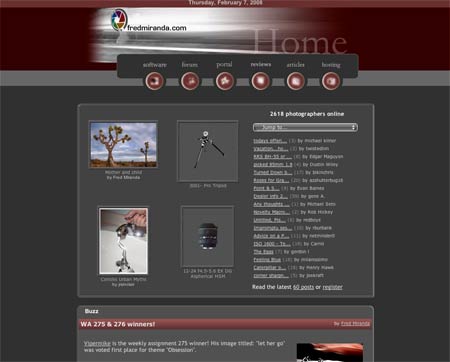
Fred Miranda.com: A Great Place for Photographers
February 7, 2008
FredMiranda.com is a great forum for photographers of all skill levels. Reviews, forums, articles, weekly photo assignments and great, reasonably priced software plug-ins and actions for a wide range of digital cameras. Check it out and tell ’em necessity sent ya’!
Free, On-line Tutorials: Photoshop, Flash, CSS, PHP, Illustrator, Javascript and more
February 6, 2008
When I was a kid in the fifth grade my teacher, Mrs. Simpson told me that when I grew up education was going to be a life-long enterprise since, unlike previous generations, I would need to continually learn new skills in order to make a living.
As Mrs. Simpson was paid to socialize and indoctrinate our fifth grade class and turn us into good American consumers, useful knowledge was not on the curricula. However, in spite of that, she actually was right about that life-long education thing.
Dang.
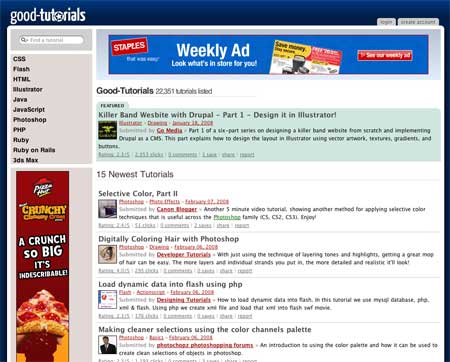
Here’s a great spot to find free tutorials on a wide variety of software, the skilled use of which, will help you make the bread to become a good consumer. Remember, if a day goes by without you buying something, the terrorists win. Don’t let that happen. Go here www.good-tutorials.com and check out their collection of over 22 thousand tutorials.
Real World Color Management
February 5, 2008
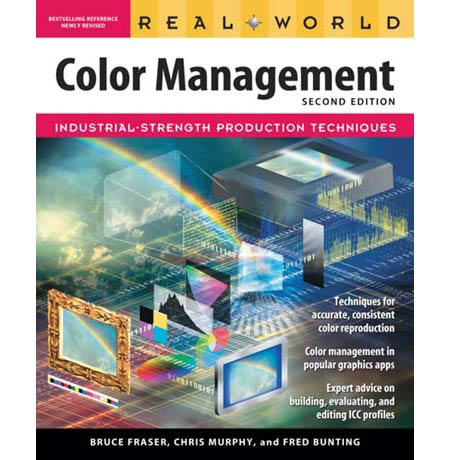
Who you gonna call when you need a Macbeth Color Checker? Or a CMYK ramp? Why, you’re gonna call Bruce Fraser, Chris Murphy and Fred Bunting, authors of Real World Color Management. They’ll even tell you how (and when) to use them. Look, this book is recommended by Design Tools Monthly’s Jay Nelson. What more do you require?
In their book you’ll learn to:
• Assess the components of your color management system for easy troubleshooting and optimal results
• Build fool-proof display, input, and output ICC profiles using the latest hardware and software solutions
• Evaluate and edit existing ICC profiles
• Implement the ideal color-management workflow for your environment
• Take advantage of color-management services built into your operating system
• Refine color-management practices used in popular graphics and publishing applications
“Bruce Fraser, Chris Murphy, and Fred Bunting have created a scientifically accurate, designer-friendly, and completely practical resource for anyone wanting to understand how color works or simply to get predictable color from their particular workflow.”
—Jay Nelson, Design Tools Monthly
“This is the best—absolute best—book on managing color I’ve ever seen!”
—Peter Bauer, Photoshop User magazine
In Search of Memory by Eric R. Kandel
February 5, 2008
I’ve been fascinated by memory since, oh, I can’t remember when. One of the best books on the subject I’ve ever read was Daniel Schacter’s Searching for Memory: The Brain, the Mind, and the Past from 1997. I would still recommend that book as a great place to start exploring this field. The sad truth is that the primary way in which researchers learn about memory is by studying people who for various reasons have memory deficits. Their personal stories can be heartbreaking, aside from the scientific information we can glean from their tragic situations.

Now, a decade later there’s another phenomenal book that deals with the discovery of the molecular basis for memory by Eric Kandel, In Search of Memory. Everything that make you, YOU is tied into memory: personality, emotions, skills, our likes and dislikes. Without that continuous chain of memory that stretches back to our infancy how could we know who we are, what we are capable of?
And don’t be afraid that this is one dense slog through a lot of mind-numbing statistics, experiments and discoveries. Kandel’s book is filled with hot sex, Hollywood orgies, porn stars, suburban exhibitionism and perverse, though intriguing, variations on intercourse.
OK, that last part I made up.
But don’t let the lack of sensationalism deter you. This is essential reading if you want to know how your mind works.
Kandel, who received the Nobel Prize in 2000, traces advances in understanding learning and memory. His own groundbreaking findings showed that learning produces changes in behavior by modifying the strength of connections between nerve cells. He conveys his immense grasp of the science beautifully, but it is his personal recollections that make the book especially compelling. He begins with his searing childhood memories of the German annexation of Austria and his family’s escape to the U.S. when he was nine. And he ends with a conference he organized in Vienna to examine the strange reluctance of Austria (unlike Germany) to acknowledge its role in the Holocaust. One comes away in awe of the scientific advances—and of a life well and fully lived.
–from Scientific American
VistaPrint – Fast, Cheap and Sometimes Great
February 4, 2008
If you haven’t already heard of VistaPrint you should definitely get out more. Their prices are very hard to beat and they frequently run specials where a $20 fee is reduced to $2. Once you’ve got an account with them you’ll get regular email offers for ridiculous price reductions.

Of course, in order to achieve these low, low prices VistaPrint gang prints your job with a skillion others so color adjustments are done for the total average image. Which may suit your image or not.
One thing I’ve found them very good at is reprinting a batch that’s clearly gone too red or too blue or too dark. This can play havoc with a tight deadline, so factor that in while you enjoy these deep dish discounts on your printing jobs.
That scold Jakob Nielsen and his 10 Weblog Design Mistakes
February 4, 2008
This was written back in the pre-history of blogging (October of 2005) but, as usual, the man makes some very sound points.
You may love him or you may hate him, Jakob Nielsen can be a polarizing figure in web design circles. But his work always makes you think and reconsider your position. Here’s the short list of 10 Weblog Design Mistakes and the link to read the entire article here.
- 1. No Author Biographies
2. No Author Photo
3. Nondescript Posting Titles
4. Links Don’t Say Where They Go
5. Classic Hits are Buried
6. The Calendar is the Only Navigation
7. Irregular Publishing Frequency
8. Mixing Topics
9. Forgetting That You Write for Your Future Boss
10. Having a Domain Name Owned by a Weblog Service
Photoblogs.org: a Guide to 30,000 Photoblogs
February 4, 2008
Photoblogs.org is a guide to close to 30,000 photoblogs.
What’s a photoblog? Well, it’s another one of those ‘frankenwords’ that ‘net users like to create: a mash-up of photos and web logs. You can think of it as a blog whose primary currency is images, not text plus pictures like many traditional blogs. Photoblogs consist almost exclusively of images.
There’s a lot of interesting work out there being posted as photoblogs and this site is one of the best ways to begin exploring that world. . .
Sending Large Files via the Web
February 4, 2008
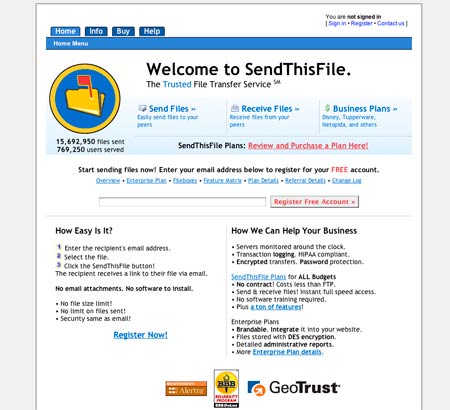
There are a skillion of these on the ‘net but I’ve found this is a good place to get a free account to send those large files via FTP through a web interface. It’s especially nice when you are dealing with clients sending revisions on large files and would prefer not to give them FTP access to your own server.
I mean, clients, we all need them but do we really want them to have direct access to our digital data? I don’t think so.