
Incredible realistic miniature model landscapes by Matthew Alabanese
January 26, 2010
In stereo photography there is a term, hyper-stereo which means taking two images with a lens separation greater than the normal interocular of about 2.5 inches. Ortho-stereo refers to images taken with a lens separation that approximates the normal human-sized view of the world. Hyper-stereo images are what it might be like to view the world from a giant’s perspective, or even greater.
Two cameras can be set up several feet or even many yards apart to take a landscape view like one of the Grand Canyon. The depth effect is very pronounced but it makes it appear as if we are looking at a miniature model of the Grand Canyon.
None of this has anything to do with the amazing miniature landscapes created out of ordinary materials like sugar, corn syrup, paprika and tile grout by model builder and photographer Matthew Albanese. Except that they remind me of many hyper-stereo views I’ve seen over the years.
Below are two samples of his work showing a Martian landscape and how he achieves a realistic cloud effect with just lighting and cotton wool. For the complete gallery at the Telegraph UK go here. Click on images for larger size.


The Evolutionary Roots of Depression—Scientific American
January 18, 2010
There’s an intriguing story from Scientific American here that raises the possibility that depression should not be thought of as a disorder, but rather an adaptation, “a state of mind which brings real costs, but also brings real benefits.”
The benefit? Deep rumination and thoughtful analysis that may confer a cognitive advantage. Here’s an excerpt:
Analysis requires a lot of uninterrupted thought, and depression coordinates many changes in the body to help people analyze their problems without getting distracted. In a region of the brain known as the ventrolateral prefrontal cortex (VLPFC), neurons must fire continuously for people to avoid being distracted. But this is very energetically demanding for VLPFC neurons, just as a car’s engine eats up fuel when going up a mountain road. Moreover, continuous firing can cause neurons to break down, just as the car’s engine is more likely to break down when stressed. Studies of depression in rats show that the 5HT1A receptor is involved in supplying neurons with the fuel they need to fire, as well as preventing them from breaking down. These important processes allow depressive rumination to continue uninterrupted with minimal neuronal damage, which may explain why the 5HT1A receptor is so evolutionarily important.
How might this impact on therapies and treatment for depression?
. . .depression is nature’s way of telling you that you’ve got complex social problems that the mind is intent on solving. Therapies should try to encourage depressive rumination rather than try to stop it, and they should focus on trying to help people solve the problems that trigger their bouts of depression. (There are several effective therapies that focus on just this.)
Huxley vs. Orwell: Whose Vision of the Future Are We Living In?
January 18, 2010
Aldous Huxley is one of the few writers whose entire published output I’ve read. (Others include A.J. Liebling, Dorothy Parker, Raymond Chandler & Dashiell Hammett). I’ve also read a good deal, though not all of, the work of Eric Blair (George Orwell).
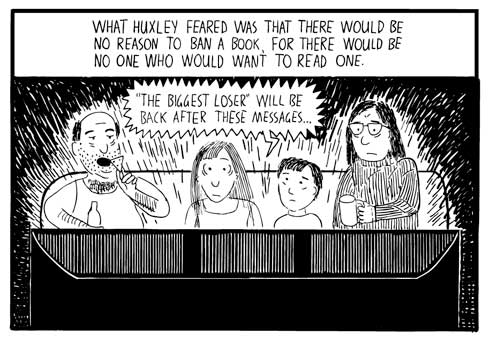
Between them Orwell and Huxley wrote the two classic dystopian novels of the last century, 1984 and Brave New World. As much as I admire Orwell, I believe that Huxley came much closer to being prescient as this cartoon piece, “Amusing Ourselves to Death” by Stuart McMillen shows. This is Neil Postman’s argument (from his book of the same name) given graphic form.

Why a High IQ May Not Correlate with “Intelligence”
January 18, 2010
I took an I.Q. test 30 years ago and was flattered to learn that I scored 140 points. But in all honesty, if I look back over those three decades I must admit to making some pretty foolish decisions. How could that be, doesn’t that number prove I’m supposed to be “smart”?
New Scientist has a fascinating article by Michael Bond that explains this apparent paradox, Clever Fools: Why a High IQ Doesn’t Mean You’re Smart.
“Think of our minds as searchlights. IQ measures the brightness of the searchlight, but where we point it also matters. Some people don’t point their searchlights at the other side of the case much, for many reasons – entrenched ideas, avoidance of what might be disturbing, simple haste. A higher wattage searchlight in itself is no protection against such follies.” — David Perkins, Professor of Teaching and Learning at the Harvard Graduate School of Education
“Even the super-intelligent are not immune,” writes Bond. “A survey of members of Mensa (the High IQ Society) in Canada in the mid-1980s found that 44 per cent of them believed in astrology, 51 per cent believed in biorhythms and 56 per cent believed in aliens.”
So how can we avoid making foolish decisions? Bond offers these six maxims:
- Clear Your Mind
- Don’t Fall Foul of Spin
- Don’t Let Emotions Get in the Way
- Be Fact Based
- Think Carefully About the Long-Term Consequences
- Look Beyond the Obvious Solution
These may all seem like plain common sense. But if we examine the financial decisions that led to the current Great Recession it’s easy to see that a great many people failed to use these very practical principles. Proving again that there is nothing common about common sense.
The Tech That Failed
January 18, 2010
Dan Tynan had a nice piece in InfoWorld here detailing six technologies that were once widely touted to “change everything” but have failed to live up to their hype. This illustrates the stubborn tendency of humans to make predictions even though the evidence for our ability to do this accurately is abysmal. Tynan’s Top 6 are:
- Artificial Intelligence
- Computer-aided software engineering
- Thin client computing
- Enterprise resource planning systems
- Business to Business Internet Marketplaces
- Enterprise Social Media
Ken Auletta’s recent book, Googled: The End of the World as We Know It, may be redundant given the number of books already published on the subject; it certainly has one of the most short-sighted titles ever given a business biography. It’s as if Mr. Auletta equates a search-engine based Web 2.0 company with the discovery of fire, or perhaps electricity.
Every business book writer today aspires to be Malcolm Gladwell and this sort of title inflation is, I think, a symptom of that understandable desire.
But his conclusion — in the form of the classic journalistic thumb-sucker “on the one hand this, on the other hand that” — dovetails nicely with Mr. Tynan’s analysis.
“Google appears to be well positioned for the foreseeable future, but it is worth remembering that few companies maintain their dominance. At one point, few thought the Big Three auto companies would ever falter — or the three television networks or AT&T, IBM or AOL. For companies with histories of serious missteps — Apple, IBM — it was difficult to imagine that they’d rebound, until they did.”
In my view Opinions and Predictions are among the least productive of all human imaginings and I predict that in 2011 everyone will come to agree with my opinion on this.
Rare Color Photo of Beatles, circa 1957
January 18, 2010

Click on image for larger size.
“Magic and Sadism” — George Orwell on Comic Books, July 21, 1945
January 11, 2010
Recently a friend of mine in America sent me a batch of ten-cent illustrated papers of the kind that are known generically as “comics” and consist entirely of coloured strip cartoons. Although bearing such titles as Marvel Comics or Famous Funnies, they are, in fact, mainly given over to “scientifiction” — that is, steel robots, invisible men, prehistoric monsters, death rays, invasions from Mars, and such-like.
Seen in the mass these things are very disquieting. Quite obviously they tend to stimulate fantasies of power, and in the last resort their subject matter boils down to magic and sadism. You can hardly look at a page without seeing somebody flying through the air (a surprising number of the characters are able to fly), or somebody socking somebody else on the jaw, or an under-clad young woman fighting for her honour — and her ravisher is just as likely to be a steel robot or a fifty-foot dinosaur as a human being. The whole thing is just a riot of nonsensical sensationalism, with none of the genuine scientific interest of the H.G. Wells stories from which this class of fiction originally sprang.
Who reads these papers is uncertain. Evidently they are intended primarily for children, but the advertisements and the ever-present sex appeal suggest that they are read by adults as well.
— George Orwell, July 21, 1945, Leader Magazine
In Search of Memory — documentary film of Eric Kandel’s life work
January 11, 2010
We’ve written before about memory scientist Eric Kandel here and are thrilled to learn that a documentary about his life and work has been made. Read A. O. Scott’s review in the New York Times, “Total Recall: A Journey from Vienna to Brooklyn and the Center of the Brain” here. I look forward to seeing it and will report on it as soon as I do.
NY Times review of “The Faith Instinct” by Nicholas Wade
January 2, 2010
Judith Shulevitz’s review of The Faith Instinct: How Religion Evolved and Why It Endures by Nicholas Wade in the New York Times had three sentences that, for me, captured the essence of the debate over religion:
Why are our gods always equipped with recognizably human minds, even when they’re animals? How do sacred stories differ, if they do, from fairy tales, or from novels? What are holiness, impurity and ritual, exactly, and are they religious in essence, or categories implicated in everything we think and do?
She also references cognitive anthropologist Pascal Boyer’s excellent Religion Explained. Amazon says of it, “Readers who can lay aside their biases will find great rewards here; Boyer’s wide scholarship and knack for elegant writing are reasons enough for reading his book.” I found his approach to a very divisive subject to be patient and methodical. (In stark contrast to the combative assault of The God Delusion by Richard Dawkins, another highly recommended work).
Boyer looks at both the psychology and the evolution of religion. When he does his comparative religion analysis he points out that there are patterns to religious belief. For example, no culture has conceived or, if you prefer, recorded interaction with a god that is all knowing who forgets everything he knows every 5 minutes (like the memory damage suffered by the protagonist in the film Memento).
He also looks at the transmission of religious belief from one generation to the next in a way that suggests Dawkin’s concept of the ‘meme,’ a discrete bit of information (a ritual, a catch phrase, a concept) that successfully multiples in the culture. Think of the ‘viral videos’ on You Tube and the endless stream of alleged ‘jokes’ and ‘weird pictures’ that flood your email inbox.
Of course, there are many who will reject the notion of any analysis of religion on grounds that the supernatural is verboten to rational investigators. Think ‘mystery,’ think ‘faith,’ think ‘it’s not for us to understand the mind of god, whether Odin, Zeus or Muhammad.’ God as Fu Manchu: inscrutable. . .
That gods and spirits are construed very much like persons is probably one of the best-known traits of religion. Indeed, the Greeks had already noticed that people create gods in their own image. . . All this is familiar, indeed so familiar that for a long time anthropologists forgot that this propensity requires an explanation. Why then are gods and spirits so much like humans? — Pascal Boyer
Can I also ask, why do ghosts wear clothes? I have a soul, supposedly. Alright, it was free and, in my case, very low maintenance. It’s immortal, cool! I can come back and annoy the living, double- cool! But do my jeans and sneakers have souls too? Why does my T-shirt come with me in the After Life?
BEFORE ROMERO: Joe Simon & Jack Kirby’s zombies from All Winners #1, Summer 1941
December 28, 2009
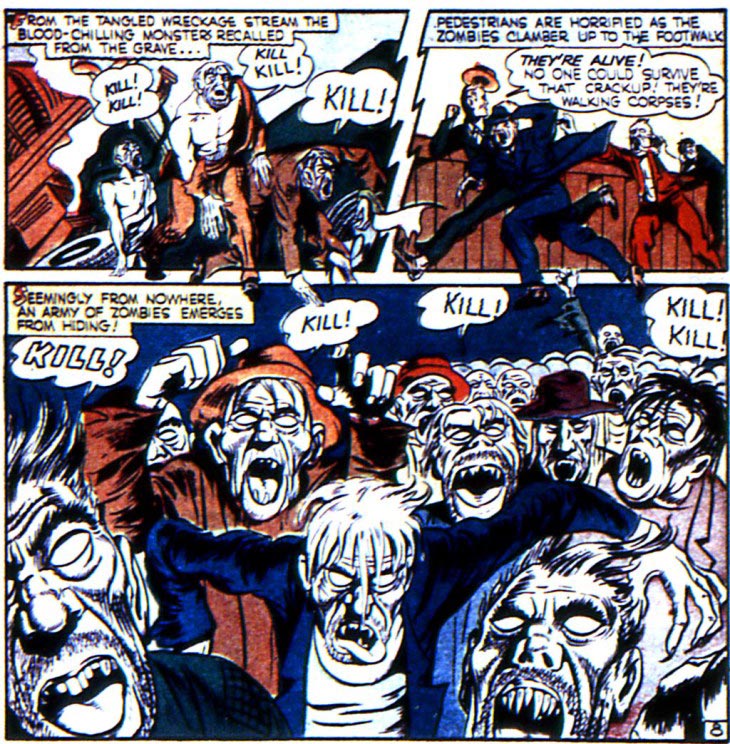
Click on image for larger size. The bottom 2/3 of page 8 of Captain America and the Case of the Hollow Men.
“How to kill a dead man? That was the horrible problem which CAPTAIN AMERICA and BUCKY had to solve before they could defeat the hideous menace who was the lord of death . . .”