
Hubble Space Telescope – Your Tax Dollars at Work
May 8, 2011

Click image for larger size.
Most people know about the Hubble Space Telescope but not the man who is honored by its name. Just as many New Yorkers believe that the Holland Tunnel was a gift of the Dutch to New York City. (It’s actually named after its chief architect, Clifford Milburn Holland). I first read about astronomer Edwin Powell Hubble while reading a biography of Aldous Huxley; they were friends during Huxley’s California years.
Hubble is probably most noted for discovering the ‘red shift’ of light of from distant stars and galaxies, proving they are moving away from us at a constant rate. In 1929 Hubble’s Law proved the universe was expanding and gave us a way to determine its age. In 1931 Hubble was visited by Albert Einstein who thanked him for his discovery. Einstein had previously staked his position out for a static, immobile universe. This puts Hubble into that exceedingly small group of scientists personally thanked by Einstein for correcting him.
The main Hubble site has an incredible archive of images, this link takes you to a subset of particularly beautiful photos.
Everyone complains about their taxes; everyone feels their taxes are too high; everyone believes the government wastes the money that they collect. . .but the Hubble Space Telescope is a project that no one can seriously claim has not been worth the cash spent on it.
Jello Cube Bouncing at 6,200 Frames Per Second
May 5, 2011
This video comes to you courtesy of Modernist Cuisine: The Art and Science of Cooking by Nathan Myhrvold, Chris Young and Maxime Bilet, a six-volume, 2,400 page set that using science-inspired techniques for cooking food.
Designed for serious foodies and scientists with highly developed taste buds, the set retails for a whopping $625! It’s been hailed as “the most important book in culinary arts since Escoffier” by Tim Zagat, who surely knows a thing or two about good eats. Check out their listing on Amazon.com here for more info and a look at some beautiful sample pages.
It highly unlikely that I’ll ever own this set (or adopt its cutting edge cooking techniques). But I’ll always remember them fondly for this high frame rate video of a bouncing Jello cube.
TV Eyes 3D Glasses. Watch regular TV in 3D. Guaranteed! Right. . .
May 4, 2011
“TV Eyes 3D Glasses. Watch regular TV in 3D. Guaranteed!
No 3D movies or special electronics needed. NEW!”
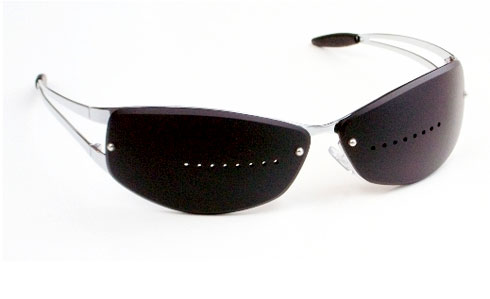
But wait! – these 3D glasses are not stereoscopic 3D, the only kind of 3D that actually exists.
“Caution: This is not stereoscopic 3-D. It will not turn your TV into a hologram. Objects will not jump out of the screen at you. That effect requires special filming techniques that regular movies don’t use.”
This, I feel, is a case where the classic Tom Waits line applies: “The large print giveth and the small print taketh away.”
Note: all text in blue is from the eBay seller of the above item, a $25 pair of 3D glasses that are not, in fact, 3D glasses. They’re something revolutionary and new! When you hear those words, you should know to hold your wallet tightly.
The TV Eyes 3D Glasses are better than the red-blue (or red-cyan) anaglyph process:
“TV Eyes does not use different colored lenses so it has none of the color distorting effects of the old red/blue 3-D glasses. Colors come through clear and vivid.”
It’s not that old, normal 3D 90% of you see every day as you negotiate our tri-dimensional world. It’s an entirely new type of 3D:
“This is an entirely new type of 3D effect that most people have never seen before. It doesn’t look exactly like the 3D you’d see at the theater, because that type of 3D only works on specially filmed 3D movies. TV Eyes 3D works on everything else!”
When you don’t have science supporting your claims, just throw out science. Science is only something we believe because we’re taught it. Education am bad:
“Simple. We don’t rely on stereopsis. There is an assumption that the only way to view a 3-D image is with two eyes and two angles. We’ve been taught this, and we believe. But our eyes see depth and form in many different ways. Stereopsis is only one.”
The ‘new’ discovery is so important we can’t even tell you the name of the process or who developed it (and where and why):
“It was recently discovered that arranging apertures in just the right way created an amazing new optical effect. Normal 2-D images looked more 3-D. TV Eyes glasses are based on this new discovery.”
Oh, it’s not a single process about arranging apertures, it’s a multi-effect engine that combines stuff to make a new, imaginary form of 3D:
“TV Eyes 3-D creates several different optical effects, that when viewed together create a unique new form of 3-D.”
And then let’s toss in a really neat term “atmospheric perspective” and misuse it. Atmospheric or aerial perspective makes distant objects look lighter in color, lower in contrast and (generally) bluer than nearer objects. Not what he said:
“TV Eyes 3-D increases the atmospheric perspective in a picture. This is the sense that ‘air’ or ‘atmosphere’ exists between objects. This sense is what creates the illusion of solid objects placed in an environment.”
A while ago on the New York Stereoscopic Society’s site I had a back-and-forth with an eBay seller offering something similar, glasses with small holes in them designed to give a 3D effect to movies and TV not actually filmed in 3D. You can follow the links below to see how that went.
TV Eyes Glasses: revolutionary new process or tired, old rip-off?
Update on TV Eyes Glasses: Pinholes from Pie Holes? Or Just Another Sonic Transducer?
Second Update on “TV Eyes Glasses” – Pinholes it is!
TV Eyes 3D Glasses: the Manufacturer Responds
TV Eyes 3D Glasses: the Manufacturer Responds Again. . .and We’re Still Not Convinced!!
No Discernable Difference Between Cheap and Expensive Wines?
April 30, 2011

Is there some Night Train, Thunderbird or Richards Wild Irish Rose in your future? vefore you answer, consider the following. Slash/Food has a nice report on something that has been established with beers, whiskeys, vodkas and many other refined spirits: Blind Tasters Can’t Tell Cheap Wines from Expensive. The results of the survey of 578 drinkers at the Edinburgh International Science Festival hovered around 50% – the same results you would expect to get from chance, e.g. simply guessing.

Milking a Tuscan: Amazon Customer Humor from David Pogue
April 30, 2011

OK, I know that I’m hard to please when it comes to Internet humor but these ‘reviews’ posted by Amazon.com customers made me spit Tuscan Whole Milk out my nose. Read an overview by my favorite tech writer David Pogue in the New York Times here and scroll down for some examples.
Book Reviews of Hgiyiyi
“As good as Jhjykyk, maybe better. The highly-anticipated sequel to Jhjykyk keeps you on the edge of your seat from the very first paragraph. Hgiyiyi picks up right where Jhjykyk left off. It both answers your lingering questions and creates so many new ones. That is the genius of jjjj, who is not only a unique writer, but who also translates his books himself! I’m on the edge of my seat waiting for the third book to come out. After reading Hgiyiyi, I know you will be too.”
“I know, I know, I’ve heard it before . . . you think that goat milk is just too strongly flavored, and that prejudices you against anything that isn’t cow milk. But Tuscans aren’t even related to goats. They’re actually akin to gerbils, although they’re a bit smaller. Their milk is very mild and sweet. It’s also amazingly high in butterfat content, so it’s wonderfully rich and creamy. Milking a tuscan is a dying art (they do tend to bite, which makes the process a bit tricky).
“One is immediately drawn to this vintage by the colour, which is an elegant, pale straw hue with an appealing peachy fruit on the nose. It has an incredibly effervescent bead — the whole glass teams with bubbles — culminating in a frothy layer at the head. The palate has panache, with a firm, mineral acidity that cuts through a rather elegantly styled, poised meaty presence. . .Even though it has a rather short and crisply defined finish, I still believe this has the composition and acidity to age well in the cellar of any self-respecting urine connoisseur.”
“Like many suburban homeowners, I like to kill and eat the wild animals that populate my backyard. To keep it sporting, I hunt naked, with my teeth and long sharpened fingernails as my only weapons.”
“The quality of this Uranium is on par with the stuff I was buying from the Libyans over at the mall parking lot, but at half the price! I just hope the seller does not run out, because I have many projects on my list including a night vision sasquatch radar, an electromagnetic chupakabra cage, a high velocity, aerial, weighted Mothman net and super heated, instant grill cheese sandwhich maker.”
Encyclopedia of American Loons
April 23, 2011

I like to describe myself as someone who was born skeptic and a half-century of life has made a cynic. I’ve been a subscriber to The Skeptical Inquirer for over 25 years and I never miss the weekly podcast The Skeptics’ Guide to the Universe. I’ve been reading about the false claims of alternative and complimentary medicine for more than half my life.
How does this affect my day-to-day interactions with the world? Well, when I took my 9 year old Labrador Retriever to a highly renowned and respected canine orthopedic surgeon to evaluate X-rays of his hips and lower back, the first “treatment” he recommended was acupuncture.
He told me he had a lot of anecdotes of owner’s reporting good results with this “therapy.” I couldn’t quite believe my ears. I replied, “OK, but why don’t we try voodoo first. That also uses pins and needles and has the same amount of scientific support.” He looked blankly at me. I continued. “You’re a surgeon and a man of science. Do I have to explain to you that the plural of anecdotes is not data?” You can imagine how well the rest of that appointment went.
On the topic of skepticism and those whose claims should be examined quite critically, I was delighted to find Fredrik Haraldsen who runs an interesting blog, the Encyclopedia of American Loons.
You’ve got to love his take on former Saturday Night Live comedienne Victoria Jackson: “[She] is a former semi-celebrity who is clinically unable to process information, distinguish an argument from a random string of letters (or none), reason, or string words together in a sentence expressing a coherent thought.”
Here’s an example of straight Jackson quoted by Haraldsen:
“ [Until the age of 40] I didn’t vote for anyone. I didn’t know how. I didn’t know where to go. I never saw a sign that said, ‘Vote Here.’ I didn’t know how to ‘register’ or even that I had to register. I didn’t know what the candidates stood for or how to find out. Word of mouth I guess, but no one I hung out with talked about politics, ever.”
Today, perhaps more than ever, we need someone to keep track of all the nonsense (and those who spout it) that clutters our 24/7 media cycle.
Thank you, Frederik Haraldsen. Unfortunately, I don’t think you’ll ever run out of material. But that makes it all the more important that you keep adding entries to your encyclopedia.
Demand Media, Content Farms and the End of Journalism?
February 23, 2011
Know who Demand Media is? Ever visit a Content Farm? (No, but isn’t that where my parents said they were sending my hyperactive puppy?).
Think the decline in American journalism is an irreversible slide into screaming pundits, extremism, the rise of citizen-journalists spewing their Idiot Wind across the InterWebs, then being aggregated by the Huff-Po, as if it all mattered?
Will news become 1% content and 99% commentary? And just how many rhetorical questions can I crowd into a single post?
The following infographic, designed and illustrated by Ricky Linn, will answer all your Demand Media questions. . .
Make Halloween Shrunken Heads from Apples
February 9, 2011

Of course, IT WOULD BE WRONG to use authentic South American Jívaro tribal methods to actually decapitate and shrink the head of the person most annoying you AT THIS VERY MOMENT. The finished shrunken head is called a tsantsas and if you follow the link above you’ll find the process easy and enticing. Really, just a perfect weekend project and the tools needed are rudimentary. So simple. So satisfying. BUT IT WOULD BE WRONG. Click on image above for larger size.
However, we can safely and, without committing felony murder, satisfy this urge by making a Shrunken Head Apple Halloween Decoration. Isn’t Halloween great? It’s my favorite holiday. I’d never even considering decapitating anyone. Honest.

Fake Science
January 18, 2011
While its my firm belief that nothing ever sent by a ‘friend’ via email that’s meant to be a ‘laff riot’ is even mildly amusing (unless your threshold for entertainment includes shiny objects and the concept of object permanence (‘peek-a-boo’) is new to you) the InterWebs are not a completely humor-free zone. Unlike, say, the Humor bookshelves in most chain bookstores.
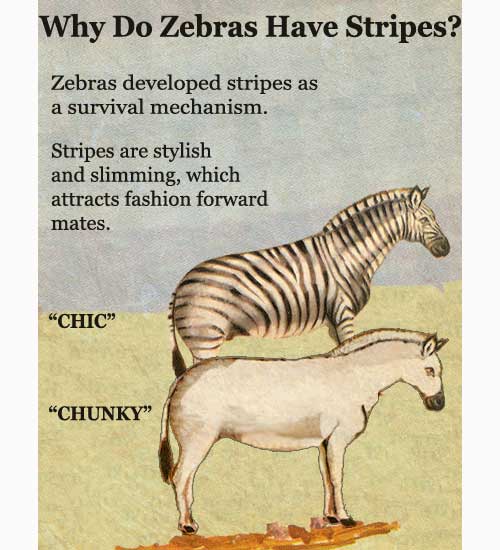
There is funny material on the web that is not just video clips of The Daily Show, The Colbert Report, Conan O’Brian or David Letterman. For proof of this argument I offer you Fake Science. Below are a few examples. If you don’t find these funny, then simply head back to LOLCATS and knock yourself out. And yes, you can has cheezburger.


Sleights of Mind: What the Neuroscience of Magic Reveals About Our Everyday Deceptions
January 15, 2011
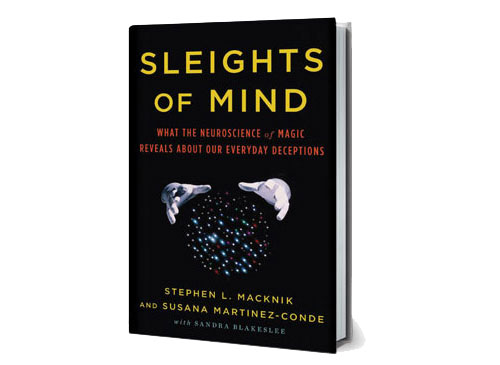
I’ve just finished a wonderful, extremely original book, Sleights of Mind: What the Neuroscience of Magic Reveals About Our Everyday Deceptions that combines magic and cutting-edge cognitive neuroscience that explains not only the ‘secrets’ behind some unusual magic tricks but why the work, given how our brains process information.
You’ll learn why techniques like ‘the illusion of choice’ work on stage with a deck of cards, with sales people at your local mall and in the arguments made by political commentators. Once you understand how we perceive the world, you’ll see the shortcuts and tricks that can be used by anyone to focus our attention just where it will be most profitable (or entertaining). The old saw, ‘the hand is quicker than the eye’ is simply not true: magic, like all deception, is based on how poorly (for the most part) our brains process information.
Husband and wife authors Stephen L. Macknik and Susana Martinez-Conde, along with science writer Sandra Blakeslee, have put together a great deal of information in a thoroughly engaging way. I think no one who’s read it would argue that it’s the most entertaining way to learn about brain science between two covers.
(I would also highly recommend Phantoms in the Brain: Probing the Mysteries of the Human Mind by V.S.Ramachandran and Sandra Blakeslee and The Body Has a Mind of Its Own: How Body Maps in Your Brain Help You Do (Almost) Everything Better by Sandra Blakeslee and Matthew Blakeslee.
To read an excerpt and learn more on the subject, there’s no better place to go then the Sleights of Mind website, www.sleightsofmind.com.