
How Does My Prius Work, Really?
June 23, 2010
I’ve been driving a Toyota Prius for 5 years now and have had nothing done other than scheduled maintenance and the replacement of one headlight bulb. So I’m a satisfied customer and feel sorry about all the bad press the company has gotten this year.
The only unintended acceleration I’ve experienced has been the result of my own lead-foot driving. I experimented once and found that simply by observing the posted speed limit in my town I was able to achieve 59 MPG! Though, of course, I could never drive like that in real life.
But when asked to explain precisely how my car works I’ve mumbled around a few general principles and jargon, like “regenerative braking.” Now I’ve found where to direct people who are genuinely interested in this topic, a series of linked articles on the How Stuff Works? web site. For specific info on the Prius, go here.
Men can “laugh women into bed” according to new research
June 15, 2010
I’ve known this to be true for a long time, based on personal experience. I was not blessed with rugged good looks, a hefty bank account nor did I ever drive a ‘cool’ car. I wasn’t on any athletic team and would’ve been safely placed in the geek-freak category by most people who knew me in adolescence. Yet I had a very active social life during the dating phase of my life (high school, college and post-college).
Part of this was certainly due to the time period, the 1970s and the pre-AIDS, pre-political correctness ethos of that time. Just as a young person coming of age in the 1920s would have a very different experience than someone coming of age in the 1930s. Still it remains a cliché of all those dating/mating sites, and their print precursors, that women value and seek men with a “good sense of humor.” Now a British study reported in the UK Telegraph shows that what women are actually seeking is intelligence, which they believe is correlated with that GSOH.
The opposite appears to be untrue however. Men are generally not attracted to funny ladies. Sarah Silverman may be the exception that proves this rule. I can’t think of any other genuinely funny (sorry, Chelsea Handler) female stand-up who’s appeared in Maxim or Playboy.

‘Tip of the Tongue’ Experiences Explained
June 3, 2010
I first read about the research on ‘Tip of the Tongue’ experiences back in the 1980s in The Psychology of Anomalous Experience: A Cognitive Approach by Graham F. Reed.
The fascinating aspect to me was that clearly one part of our brain knew the correct answer because we’re almost always able to reject the incorrect suggestions. When we try and remember the name of that great Southern food restaurant on Great Jones Street we may be certain that it’s one word and starts with an “A” but we’ll know that Alias, Arno, Abbott’s, Apache, etc. are not correct. (The answer is Acme).
So it’s clear that our brain can store information that is (temporarily) unavailable to us and be able to tell us when we guess wrong. New research on this phenomenon is described in this article the LiveScience site where it’s been found that people who use American Sign Language experience a similar ‘tip of the fingers’ effect. Go here to read about this latest study.
Tim Berners-Lee, Linked Open Data and a Bag of Potato Chips
May 28, 2010
Sir Tim Berners-Lee, who created the web while working at CERN, is someone we should listen to when he talks about the future development of the Internet.
What he’s hot on right now is something called Linked Open Data, something he believes will be the next evolutionary step for web development. He uses the information on a bag of potato chips to illustrate this concept:
The outside of the bag contains different sets of information, each using a different vocabulary and coming from a different source, Berners-Lee explained.
The front of the package displays the name of the brand and the company’s own marketing claim that the chips are crunchy. The back of the package has nutritional information, such as calories and vitamins, defined by terms generated by the U.S. Food and Drug Administration (FDA). Finally, there is a Universal Product Code (UPC) bar code on the bottom of the package, which is not understood by humans at all but rather is recognized by scanning machines globally as the moniker for the item.
In other words, this single package of information actually is a collection of data and attributes that have been developed by multiple parties, not just Utz.
For the rest of the article, go here at IT World.
Chuck Klosterman on Fame, from “Eating the Dinosaur”
May 24, 2010
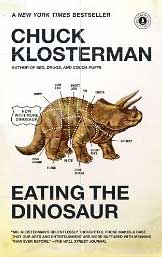 “I do not know how much money Britney Spears earned last year. However, I do know that it’s not enough for me to want her life, were I given the option to have it. Everyday random people use Britney’s existence as currency; they talk about her public failures and her lack of talent as a way to fill the emptiness of their own normalcy. She — along with Lindsay Lohan and Paris Hilton and all those androids from The Hills — are the unifying entities within this meta era. In splintered society, they are the means through which people devoid of creativity communicate with each other. They allow Americans to understand who they are and who they are not; they allow Americans to unilaterally agree on something they never needed to consciously consider.”
“A person like Britney Spears surrenders her privacy and her integrity and the rights to her own persona, and in exchange we give her huge sums of money. But she still doesn’t earn a fraction of what she warrants in a free-trade cultural economy. If Britney Spears were paid $1 every time a self-loathing stranger used her as a surrogate for his own failure, she would out earn Warren Buffet in three months. This is why entertainers (and athletes) make so much revenue but still are wildly underpaid: We use them for things that are worth more than money. It’s anew kind of dehumanizing slavery — not as awful as they literal variety, but dehumanizing nonetheless.”
— Chuck Klosterman, Eating the Dinosaur
Buy the book here on Amazon
This is the first collection of Chuck Klosterman’s work that I’ve read though it won’t be the last. I think he’s really nailed something important about how fame, celebrity and media work today in the excerpt above. Especially when he writes, “We use them for things that are worth more than money.” Scary. But true, I think.
Josh Woodward – “Chainsaw”
May 17, 2010
I first heard this darkly comic folk song by Josh Woodward on the Radio Free Oz podcast hosted by one-half of the legendary Firesign Theatre, Peter Bergman and David Ossman. The sweet beauty of Woodward’s guitar makes a sharp contrast with the twisted lyrics. You can download 150 free MP3s as well as purchase his CDs here. Support this talented singer-songwriter, you won’t regret it.
Amazing new images of the Sun from NASA on CNET
April 23, 2010

Here’s a series of stunning new images on CNET of the Sun, paid for by your tax dollars and taken by NASA‘s SDO, or Solar Dynamic Observatory.
The SDO was launched on February 11, 2010 and is just beginning its five year mission: to explore strange new worlds; to seek out new life and new civilizations; to boldly go where no man has gone before. Now where have I heard that before. . .?
Above is an an extreme ultraviolet, false-color image of the Sun taken on March 30. The colors indicate different gas temperatures. Reds are cool (about 60,000 Kelvin, or 107,540 degrees Fahrenheit) and the blue green end of the spectrum is hot (at more than 1 million Kelvin, or 1,799,540 degrees Fahrenheit).
Rainbow Roses: Are they Real or are they Photoshopped?
March 19, 2010

I know that the above image looks like a classic Photoshop-manipulated picture but according to Reuters these are actual roses created by Dutch grower Peter van de Werken by injecting natural dyes into their stems. For more photos and video go here.
What Makes Up Happy? — The Atlantic
March 3, 2010

Is there a formula—some mix of love, work, and psychological adaptation—for a good life? For 72 years, researchers at Harvard have been examining this question, following 268 men who entered college in the late 1930s through war, career, marriage and divorce, parenthood and grandparenthood, and old age. Here, for the first time, a journalist gains access to the archive of one of the most comprehensive longitudinal studies in history. Its contents, as much literature as science, offer profound insight into the human condition—and into the brilliant, complex mind of the study’s longtime director, George Vaillant.
I found this account of the Harvard study fascinating, though I believe there’s no universal answer to the question posed, as you may find suggested here. For example, the answer for me includes a liberal application of Labrador which may not work for you. Still, this piece is well worth reading.
Sick, Nervous, Discouraged. Then, 18 Bottles Later: “I am Feeling Fine.”
February 21, 2010

This is a leading hack.
This is a leading hack.
Order us a case of what Mrs. Cora Love, 3722 S. Wigger Street, Marion, Ind is drinking. . .