
Inside Denver’s “Pit Bull Row”
January 18, 2010

Denver has had a breed-specific ban on pit bulls since 1992. In that time 5,286 pit bulls have been impounded and an estimated 3,497 have been destroyed. Shelters in Denver cannot put pit bulls up for adoption; they must try and find room for them in other Colorado cities.
See the photo essay by Joe Tone in Denver Westworld here.
Click on image for larger size.
Dog Books Worth Reading
December 28, 2009
“Time to Eat the Dog: The Real Guide to Sustainable Living” — The environmental cost of pets
December 22, 2009
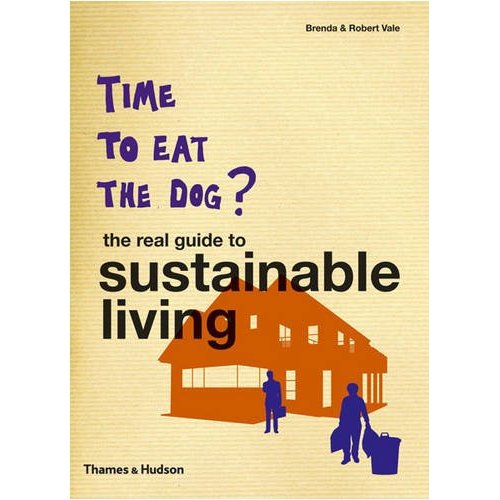
Time to Eat the Dog? The Real Guide to Sustainable Living by Robert and Brenda Vale published this year in England raises the thorny question of whether or not you can justify the carbon foot print of your pet.
I’ve posted an excerpt of Thorstein Veblen’s thoughts on the extravagance of dogs here on the Cynodictis Project page. Veblen’s governing principle was that every expenditure about subsistence was “conspicuous consumption” a purchase whose real aim is to communicate something about the buyer. Owning a dog says to the world, in effect, I have so much income I can afford to waste a portion of it feeding and caring for a non-productive member of the household.
I’ve always thought of this concept in terms of useless rooms in houses. I grew up, at least part of the time, in a house which had a living room that was for show purposes only. The furniture wasn’t wrapped in thick plastic but no one used the room. It was understood. The dog was not allowed in there either, under any circumstances. The living room was for entertaining on a certain level. Evidently did not circulate with the other A-listers because our living room was used once a year or less.
But should we really eat our dogs as the Vales suggest? Even if we are feeling a bit peckish?
They calculate that a medium size dog eats around 360 pounds of meat and 210 pounds of cereal annually. They equate this with the energy consumption of driving a 4X4 SUV 6,200 miles a year, including the energy required to build the car. I don’t suppose that since our family owns only a single car, a Prius at that, it comes close to offsetting our two ravenous Labradors.
But that’s not the only negative impact our dogs have on the environment.
The Vales claim that dogs decrease the biodiversity in the areas they are walked. Why would the presence of a domesticated animal in a suburban environment (where most companion dogs live) decrease the local biodiversity? How much of a decrease and what’s the impact of that? I’d like to see and understand the science behind this contention.
They also say that dog feces are responsible for high bacterial levels in rivers and streams, ultimately killing off aquatic life. Again, this statement exists in a vacuum. Surely the run off of excrement from our present method of factory farming, especially chicken and pig farming, are a much greater factor in the fecal pollution of our waterways?
New Scientist magazine had an independent expert calculate the environmental costs of dog ownership and he came to the same conclusions as the Vales: “Owning a dog really is quite an extravagance, mainly because of the carbon footprint of meat.”
Obviously, someone like me is going to question the specific degree to which pet owning contributes to our use of limited resources. Every expenditure has costs. The point of this provocatively titled book is that every decision we make has an environmental impact.
For most of us this isn’t part of our calculation when considering a purchase, the way we wash our clothes or burial options. For example, I didn’t know that the biggest “cost” of clothes is in our continually washing them.
So I don’t think that anyone really wants you to consider eating your (probably delicious) dog. It makes for a grabber of a title, though.
Luna is Thankful for Her Ball — 3D
November 26, 2009
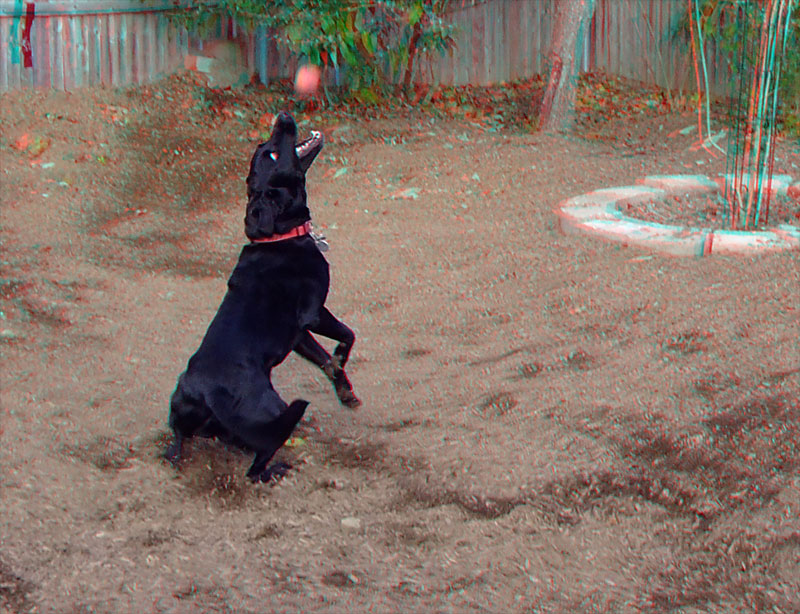
This anaglyph shows what I believe is Luna at her happiest. Click on image for larger size.
Doggie Lover Doll, A Sex Toy for Dogs — Is this Necessary?
October 31, 2009
The answer to the question posed in the title is obviously (repeat after me) No, a sex toy is not necessary for your un-neutered male dog.*

As Thorstein Veblen explained almost a century ago everything above survival level is abundance. He coined the phrase “conspicuous consumption” to describe the resources we spend/waste on showing how far above survival level our income is. Merely owning and maintaining a dog, in the strictest sense, sends the message that you have enough resources that you can support a non-essential animal. Click image for larger size.
In 2007 Business Week reported that Americans spent $41 billion on pets and pet care. Clearly, with a market this large there will be excesses. In 2007 the object of some (deserved) media derision was the product Neuticles, artifical testicles implanted in male dogs after neutering ” to let people restore their pets to anatomical preciseness” according to inventor Gregg A. Miller.
Now from Miami, Florida and São Paulo, Brazil comes the DoggieLoverDoll. Here’s the essential pitch from PetSmiling company’s web site. Their product is
A female canine manufactured in soft rubber with a silicone vagina and an easy to clean reservoir. The product also comes with a tube of water-based intimate lubricant, to increase the useful life of the doll.
This doll comes in three sizes: small, medium and large, to satisfy all existing races. “I had the idea to make this doll when my Maltese started to grab everybody’s legs. I did some research and couldn’t find anything like it, anywhere in the world. I decided to make it!”, reveals Marco Giroto, owner of the PetSmiling company, responsible for this worldwide novelty.
When a dog tries to hump legs, stuffed animals and other objects, he cannot reach an ejaculation. With the DoggieLoverDoll he can. Human beings have their hands to masturbate themselves, now the domestic animals, which have practically no contact with females in heat, can alleviate themselves with a toy designed specifically for them. Dogs have a great sexual appetite and this novelty, surely will better their lives.
If anyone determines that this is a well-executed hoax I would greatly appreciate your letting us all in on the gag.
 The tiny footprint of the parent site is just one reason my Spidey-sense is whispering Fake! in my ear. There doesn’t seem to be any retailer I can find on the web offering it for sale. And you can’t purchase it from the PetSmiling web site; there’s no order form, just an email contact. Curiouser and curiouser. If anyone spots this item for sale anywhere, please post a comment with details (and links). Click image for larger size.
________________________________________________________________
*And, if you are not a dog breeder and your dog is a companion, not a working dog, you should seriously consider spaying your female dog and neutering your male dog. There are numerous benefits and the biggest hurdle (usually) is over-coming the projected anxiety of male humans who own dogs.
Get over it.
Help reduce the dog population explosion we’ve had for the past century: too many good dogs chasing after too few good homes.
Harmony Farms Dog Food — a new arrival at my market
September 25, 2009
Last week I went cruising down the pet food aisle in my local SUPER Stop & Shop. They are in the midst of renovating the entire store — we just got the all new rolling shopping carts with a gun metal gray finish instead of the standard chrome! Some people will tell you progress is an illusion. Don’t you believe it.
Normally, the dog food brands that are carried in a super market are of middle to low quality, in terms of ingredients. You’ll find lots of corn on the ingredient lists, along with lots of wheat, soy, glutens and, worst of all, by-product meals. These ‘meat meals’ cover a great multitude of sins. These chicken, beef or simply labeled ‘meat by-products’ include all the parts of an animal that are left over after the meat has been stripped off. Lungs, spleens, kidneys, hearts, brain, blood and more.
It was the genius idea of grinding up cow by-products and adding that as a protein to cow feed that led to the mass outbreaks of Mad Cow Disease (bovine spongiform encephalitis). This involves a scary little thing called a prion — a folded, infectious bit of protein that attacks the brain and neural structure — every disease prions cause is both untreatable and fatal.
The ‘meat meal’ in your dog food could consist of the euthanized bodies of dogs and cats from shelters, roadkill, diseased or injured “downer cattle”, or zoo animals. Remember that the protein sludge created this way uses the whole animal: heart , brain, hoof and paw, coat and fur.
The take away is stay away from by-products and meals, especially, when choosing dog food.
I stop in the newly revamped dog food section and notice that for the first time the bags if kibble are separated by a divider with a limited selection of premium brands on one side. There is also a small refrigerator section with whole raw foods designed for dogs. I’m impressed. Raw and refrigerated food is too expensive for my budget; I also have some doubts over its perceived value and actual benefit to our dogs.
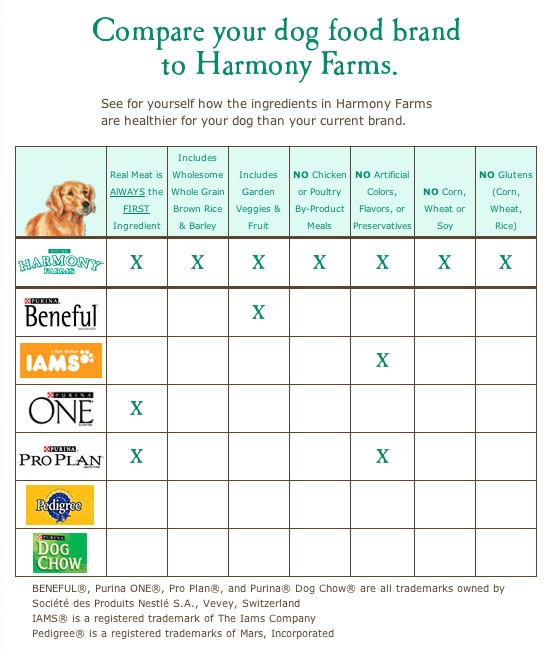
Back in the kibble I find a brand that’s new to me Harmony Farms. Meat is always the number one ingredient in their dog food. Their foods have no corn, wheat, soy, glutens or artificial coloring, flavoring or ingredients. Click on the chart below to see how their ingredients stack up against Beneful, IAMS, Pedigree and Purina.
Price Comparison by the Pound
$1.30 lb. Harmony Farms (17.5 lb. bag)
$1.23 lb. Hill’s Science Diet (40 lb. bag)
$1.17 lb. Evolve (30 lb. bag)
$1.45 lb. Solid Gold (33 lb. bag)
$1.46 lb. Innova (30 lb. bag)
$1.80 lb. Newman’s Own Organic (25 lb.)
$1.88 lb. Natural Balance Organic (25 lb.bag)
Of course, there’s some wiggle room in the above numbers since not every kibble sold was packaged at the same weight. Hill’s Science Diet comes across cheapest, in part, because it’s sold in the largest size, a 40 lb. bag. So use this only as a rough guide.
So I’m trying out Harmony Farms for our two Labradors. It is convenient not to make a second trip to a specialty store to buy my kibble.
And being Labradors I’m fairly assured that they’ll eat whatever is placed in their bowls; palatability is never an issue with this breed.
If any of you out there have any comments or information about your experience with Harmony Farms Pet Foods, we’d love to hear from you!
World’s Most Expensive Dog? At $600,000, it may just be.
September 25, 2009
 The New York Daily News reports that a Chinese woman has paid 4 million yuan (approximately $600,000) for an 18 month old black Tibetan mastiff named Yangtze River Number Two. For the complete article, go here.
Of course, given today’s world wide economic climate and the heartbreak of “foreclosure dogs” in this country, spending on this scale for a single canine is hard to justify. But then the excesses of the wealthy leisure class are hard to rationalize even when everyone is housed and fed (and employed with health coverage). The price paid for Yangtze River Number Two would fund half the construction of an animal shelter where I live.
The market that supports this kind of transaction between a breeder and a buyer is tiny and disconnected from the ordinary world of dog owners, that’s the main reason a story like this becomes “news.”
The great leveler here is the dog; he’s doesn’t measure his value in dollars or yen. Nor does he love his new owner more devoutly than that rescued mutt from the pound curled up on your living room floor.
3D Photography: Pumpkin Carving, Dogs and Fire
September 24, 2009
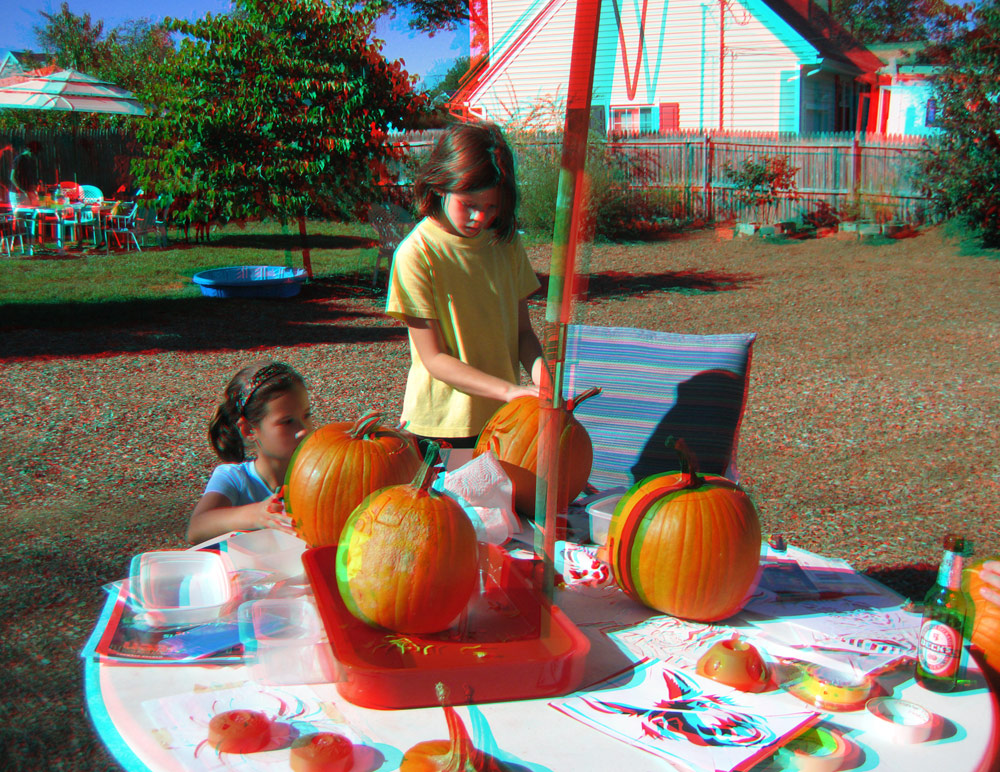
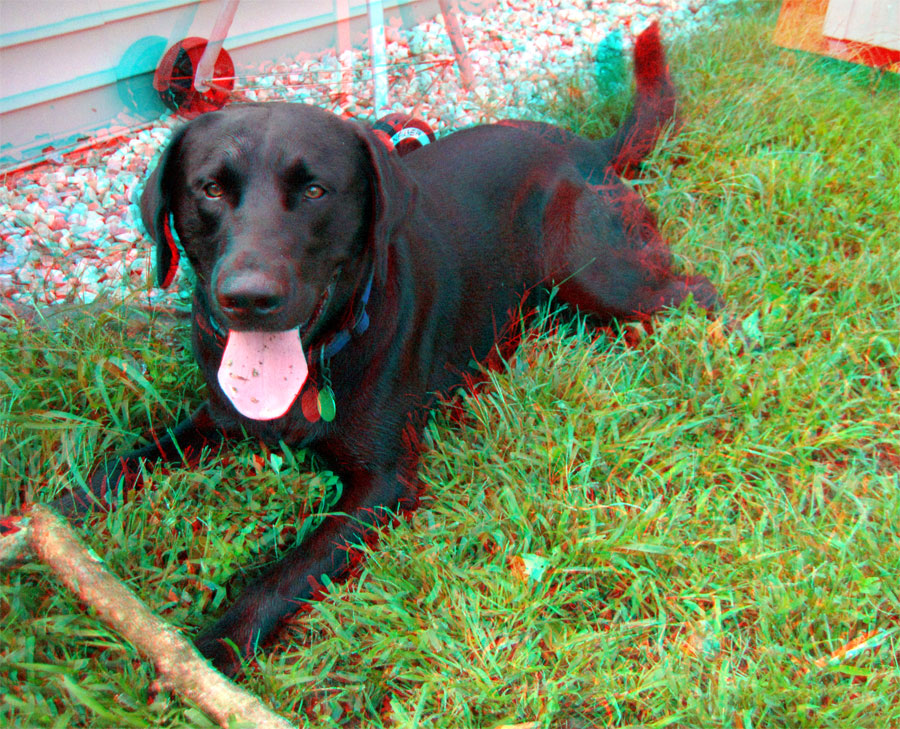
For 3D viewing, use red–blue (or red–cyan) anaglyph glasses. Click on images for larger size.
Top to Bottom: Pumpkin Carving in New England; Harley, Yellow Lab age 7; Deezey, Black Lab age 3; evening campfire on Russian Beach.


Bad Science, Bad Dog Writing — “Paws & Effect, The Healing Power of Dogs” by Sharon Sakson
August 30, 2009
I have a problem with some dog writers.
In fact, I have a problem with a lot of dog writers.
They want so fervently to extoll the virtues and abilities of dogs that they’ll accept the most ridiculous idea so long as it’s wrapped up in a colorful and heartwarming anecdote. This does a disservice to both dogs and man. Here’s a recent example.
The following excerpt comes from Paws & Effect, The Healing Power of Dogs by Sharon Sakson. The dog in question is named Kyle, a Scottish Terrier whose owner claims that he watched TV, comprehended what he saw and even deduced the guilt of murderer Scott Petersen before any human knew he had killed his wife Laci.
“He became more and more aware of what was going on in the programs. My husband was watching The Sopranos. Kyle watched with him, but he would get really upset when people got killed. Or even if there was something harsh, like hitting another guy with a baseball bat or driving into someone with a car, He hated PBS, documentaries, or any educational like that, the kind of things I like to watch. He would give me a look like, ‘Change the channel!’”
Kyle also liked news programs, but Russie [his owner] noticed that he seemed to hate one particular person who was appearing on the screen a lot that winter. It was Scott Petersen, the husband who was eventually found guilty of killing his wife, Laci. “From the first time he ever saw him on television, he would bark and go crazy and try and bite the screen, And this was just during the time that Laci had disappeared, and they had no idea who did it. Kyle knew!”
Anyone familiar with the Clever Hans effect can tell you precisely what is going on here, since the science tells us that dogs cannot comprehend televised images due to the fact that their flicker-fusion rate differs from humans. It’s impossible for your dog to see the flashing images as you do, in a continuous stream of motion and decipher them as depicting Italian mobsters from New Jersey and duplicitous, murderous husbands.
Kyle, like Clever Hans, the amazing horse who was believed to be able to do mathematics, is taking his cue from the humans around him. It’s an engaging story and just a side light to the healing power Sakson attributes to Kyle but after reading this chapter I had to put the book down. This is a fairy tale, no matter how fervently Kyle’s owners believe it and how credulously Sakson reports it.
Ye, Paws & Effect is blurbed by respected authors like Temple Grandin, Stanley Coren, Elizabeth Marshall Thomas and Ted Kerasote. Of course, becoming a best selling author says nothing about the writers’ knowledge of basic canine science.
Once upon a time there were a class of beings known as fact-checkers who would comb through a manuscript and spot such errors and bring them to a publisher’s attention.
However, when it comes to popular dog books, it’s like Carelton Young said in the 1962 John Ford classic, The Man Who Shot Liberty Valence: “This is the West, sir. When the legend becomes fact, print the legend.”
Dogs Watching TV & Film: Or Why There is No Canine Roger Ebert
August 28, 2009
 Alexandra Horowitz, assistant professor of psychology at Barnard College has written a new book, Inside of a Dog: What Dogs, See, Smell & Know and was interviewed by BARk magazine. Here she explains why dogs could not see broadcast TV:
“It has to do with how we process light. specialized cells in the eyes of mammals translate light waves into neural activity by changing the pigment in the cells. In the milliseconds that the pigment is changing, the cell can’t receive any more light. This leads to what is called the ‘flicker-fusion’ rate: essentially, the number of snapshots of the world that the eyes can process each second. Our flicker-fusion rate is about 60 images per second. The images on old TVs and film is really a sequence of still shots sent quickly enough to fool our eyes into seeing a continuous stream. Given our flicker-fusion rate, the films needs to be only slightly faster than 60 still images a second to trick our eyes into seeing motion. Dogs, though, have a faster flicker-fusion rate—about 70 or 80 stills per second. When watching film, they can actually detect the individual frames as well as the dark spaces between them. With the recent conversion to entirely digital television broadcasts, thought, the flicker-fusion rate is no longer relevant, since digital TV works differently. So dogs can, in theory, watch TV—though it is still not very olfactorily interesting!”
Please support Professor Horowitz’s outstanding work and buy her book. Also, if you are a dog-lover and you don’t already subscribe to BARk, what are you waiting for?