
Can Dogs Talk? The short answer: No. But They Study Your Behavior All the Time.
June 24, 2009
Scientific American ran a piece recently, Fact or Fiction: Dogs Can Talk. The answer that’s obvious to anyone with even a little knowledge of canine anatomy is certainly not, they don’t have the lip and tongue control to form the sounds necessary for human speech.
This makes them ‘dumb’ animals, a phrase I frequently hear misused. People tell me about complex behaviors they observe in their dogs and comment at the end of their story, ‘And they say that dogs are just dumb animals!’ This confuses the meaning of the word ‘dumb’ in the sense that dogs are speechless, not stupid. Verbal communication skills are so ingrained in our expectation of intelligence that it’s a very common mistake.
Think about all those ads you’ve heard over the years for improving your vocabulary. The implication is that your intelligence is being judged every time you speak, which is probably true. The appeal of these ads is to your intellectual insecurity as well as the quick-fix mentality of so many Americans. You can sound just like a graduate of an Ivy League school without having to complete the crushing amount of course work or pay the enormous tuition costs.
However, an extensive vocabulary does not always equal intelligence. We’ve all known people who are extremely glib and well-spoken but not especially intelligent or insightful, they just sound like they are. This is common among those for whom public speaking is a key part of their job, like politicians, teachers, preachers and salesmen.
So we have to work against our prejudice that spoken words are the lone indicator of intelligence. To me it’s clear that dogs are intelligent, though mute. Dogs are trainable, cats are not. I invite any cat lovers to inundate the comments section with tales of cats rescuing people by alerting them to danger, or the existence of drug and/or bomb sniffing cats, or guide cats for the blind, etc. I think you can make a strong case that cats are not even truly domesticated animals, certainly not in the way that dogs are.
One important fact that most dog owners seem to overlook is that they are constantly being studied by their companion animals. Dogs are alert to the inflections in our voices and every movement we make.
Most of us don’t realize how much information we are sending to our dogs by our posture, our tone of voice, all of our physical actions. This leads to behavior that some would like to construe as “psychic”* like a dog “knowing” when its owner is about to arrive at home. For example, I have a 7 year old Labrador Retriever who seems to “know” when I’m leaving the house whether or not I’m taking him with me.
When he’s coming with me, he follows me to the door and waits for his leash. When I’m not taking him, he goes and lays down in his crate. From my perspective, I’m not doing anything differently in either case until I am near the door and grab the leash. But long before I get there, he’s already made his determination about whether he’s coming or not.
I’ve puzzled over this for a very long time. While I love my dog and feel a deep connection with him, I can’t accept the theories about non-material communication. I’m convinced that I am doing something subtly different that cues my dog to my intention, non-verbally.
I’ll give you another example that supports this contention. When my older dog and our new rescued dog are curled up in the floor in my office, every time I change my position in my chair, Luna, the younger dog, leaps to her feet in expectation that I’m getting up and that this action concerns her. Are we going outside? Are we getting a treat? Will you be paying attention to me, instead of that stupid glowing screen on your desk? Huxley, on the other hand, has been around longer and knows better. He won’t move until he actually sees me get up from my chair.
Luna at 3 is certainly more reactive, in general, than Huxley at 7. It will interesting to see if, over time, she begins to understand that every move I make at my desk is not predictive of a walk, a treat or a romp outside.
I’ve had the privilege of working with several dogs (my own and fosters) with the great trainer Ken Picciuto, who says that training is always going on between you and your dog. The question is who is training who? If your dog begs at the table and you reward her with a scrap off your plate, she’s learned that begging works and this reinforces the behavior. She is training you.
So asking whether or not dogs can talk seems to me to be the wrong question. Intelligence and communication are clearly going on with our dogs, despite the fact that only we can talk.
To turn this around, every dog owner believes that they can tell you a great deal about what their dog is thinking or feeling, all based on non-verbal cues. Huxley, for example, prefers sitting in front of the fireplace watching a fire than watching anything on Showtime, Bravo or HBO, hi-def or not. For my money, that’s a good argument for his intelligence right there.
*Full Disclosure: I’m a long time skeptic about all paranormal subjects (including religious belief) and complimentary and alternative medicine. If you’re going to worship a god, how do you choose among the thousands that have been worshiped throughout history? Why is the Judeo-Christian God more likely to exist than Thor or Zeus? For the best available discussion of this, please see Richard Dawkins’ excellent book The God Delusion.
The evidence does not support UFOs, Ghosts, Accupuncture, Astrology, etc. despite all the programming on the History Channel. The plural of anecdotes is not data. There are no haunted houses, just haunted people as James Randi says. And, of course, extraordinary claims require extraordinary proof, in the late Carl Sagan’s words.
So I hereby issue a challenge to all ghosts, spooks, space aliens and interdimensional beings of all stripes: come on down! I don’t have to list my address here, surely you’ll all know how to find me. I promise I will faithfully report to my audience your arrival and whatever wisdom or warnings you bring with you. I do however, object to any anal probing you might wish to perform. I already have a gastroenterologist who does that for me every 3 to five years.
Extreme Variation of Anatomy and Behavior Unique to the Domestic Dog
June 21, 2009
Extreme variation in anatomy and behavior is unique to the domestic dog. If humans were an equally anomalous species, we’d weigh between 20 and 650 pounds and range in height from three to 10 feet. In dogs, adaptations change with such speed that scientists suspect there may be a clue in the canine genome that could reveal how evolution works.
— from Jane Brackman, PhD, “Can DNA Decipher the Mix? Unraveling the genetic tapestry provides clues to breeds and their mixes” The Bark
Mirror Neurons in your Brain and Prick-eared Dog Breeds
June 15, 2009
Speaking of Dogs
Your mirror neuron system may possibly even jump species. Think about domestic dogs. Dogs are highly social, intelligent animals. We have been able to integrate these deadly carnivores into our homes because evolution has endowed them with instincts for fitting into a socially stratified yet cohesive and cooperative pack. Now, if you look at one of those prick-eared breeds such as the German shepherd, it is amazing how much emotional expressiveness there is in those fuzz-covered triangular ears. Whether they are erect, relaxed, swiveled forward, tilted out or pulled flat against the skull, they are eloquent advertisers of the dog’s mood and inclination. A dog’s ear posture combines with its other facial and body language—mouth smiling or snarling; eye brow nubs set to convey helplessness, confidence, or innocence; neck high or low; tail wagging, up, flat or between the haunches—to express an impressive range of moods. Even a floppy-eared beagle can tell you what it’s thinking! Remarkably, we are able to read this alien body language with ease. After all, we are primates; our ears are totally immobile and purely ornamental. But thanks to our mirror neurons and homuncular flexibility, we easily become “bilingual,” if you will, in canine body language.
Now that you’ve read the above, I’ll bet you’re dying to know what mirror neurons are, aren’t you? What exactly does homuncular flexibilty have to do with your daily life? To learn the answers to those questions and learn a great deal more, you’ll simply have to buy Sandra Blakeslee & Matthew Blakeslee book, The Body Has a Mind of its Own: How body maps in your brain help you do (almost) everything better
3D Dog Photography
June 8, 2009
This is Huxley, our chocolate Labrador, 7 years old, and Luna, a Lab-mix rescue, approx. 3 years old. Click on images for larger size.


Note: These are anaglyphic 3D pictures. You’ll need a pair of red-blue, or red-cyan glasses to experience the 3D. If you don’t have access to any, I’ll send you a pair free. Just shoot an email with a mailing address to cynodictis@gmail.com
Dogs have Ethics, “a nuanced moral system” say natural historian Jake Page and animal behavorist Marc Bekoff
May 29, 2009
“Dogs have souls, but you already knew that” was the headline in the May 16, 2009 Seattle Times.
It’s unfortunate that the headline writer chose the word “soul.”
I find the evidence that I have a soul unconvincing, much less an immortal, indestructible spirit residing in each of our Labradors. And what Jake Page and Marc Bekoff are really talking about here are emotions and ethics, empathy and compassion, not spooks in the night.
One point on which I definitely agree is that dogs have a rich, interior emotional life.
Bekoff , co-author of Wild Justice: The Moral Lives of Animals, contends that:
• Dogs have a sense of fair play. They dislike cheaters. They experience joy in play. They delight in friends. Big dogs handicap themselves in games with little dogs.
• Dogs get jealous when a rival gets more or better treats or treatment. They are resentful, unnerved or saddened by unfair behavior. They are made anxious by suspense. They get afraid.
• They are embarrassed when they mess up or do something clumsy. They feel remorse or regret when they do something wrong. They seek justice. They remember the bad things done to them, but sometimes choose to forgive.
• Dogs have affection and compassion for their animal and human friends and family. They defend loved ones. They grieve their losses. They have hope.
I think I have observed every one of the behaviors that Bekoff lists here, as I’m sure would most dog-owners. Another less tangible variable, every dog I’ve ever known had what I believed to be a unique personality. Likes, dislikes, behaviors, food preferences, choice of games or toys, the list goes on and on.
Jake Page shows evidence that dogs actually do laugh. The same areas of the brain light up in laughing humans as in dogs that are happy, or enjoying themselves when viewed under a fMRI scanner (functional Magnetic Resonance Imaging).
I don’t doubt there is a relationship here, but I’m not certain that’s actually evidence of canine laughter.
The vocalization of a dog’s laugh, according to Page, is a rhythmic pant. By that definition, I’m not sure I’ve ever seen a non-animated dog laugh.
My 3 year old black Lab Luna does a lot of rhythmic panting after she’s been chasing her ball for 15 or 20 minutes, but I don’t think she’s laughing, just hyper-ventilating.
Back to that headline. Bekoff invites it, of course, when he refers to the “spiritual unity” between humans and canines. I have to quibble with that qualifier. Why not just say “unity”?
I mean, I’ve known some dogs who had soul (they were funky and down in the groove dogs) but not a soul. As in a personality that would persist after brain death? I’m not seeing the data here.
Yet there’s also no doubt in my mind that dogs have long term memory and an active dream life.
Maybe that is implicit in Bekoff’s observations, some of the above would be impossible without memory. And dreaming has been tied in some studies to processing the information of the past 12 hours. It has been shown that by interrupting REM sleep in humans you adversely affect the learning process.
There’s a deep connection between all the members of my pack and I think of it as concrete and real. It isn’t a religious feeling for me and it has nothing to with a traditionally defined “soul.” Can’t an atheist love, and be loved by, one good dog? One with liver treats?
________________________________________________________________
For the complete article at the Seattle Times site, go here.
Do Dogs Laugh?: Where Dogs Come From, What We Know About Them, and What They Think About Us by Jake Page, available at Amazon.

Wild Justice: The Moral Lives of Animals by Marc Bekoff and Jessica Pierce.
One Nation Under Dog — Great New Book on Contemporary Canine Culture
May 16, 2009
 Michael Schaffer’s new book One Nation Under Dog: Adventures inthe New World of Prozac-Popping Puppies, Dog-Park Politics and Organic Pet Food should find a place beside Jon Katz’ 2004 classic The New Work of Dogs for anyone wishing to bring themselves up to speed on the recent cultural changes involving Man’s Best Friend. Click image for larger size.
It’s an enjoyable romp through a dense array of topics; a tribute to Schaffer’s skill at packing these pages with a wealth of information. No other book I’m aware of covers so much territory in just 257 pages. This is up-to-the-minute reporting delivered with style and humor.
Of course, a good portion of the material deals with the extreme high-end of the canine services market as his first chapter “The $43 Billion Dollar Fur Baby” indicates. Collectively, Americans are spending more on their dogs and pets than ever before, notwithstanding the current economic crisis that’s lead to the rise of over-whelmed shelters and the new category of “foreclosure dogs.”
A case can be made that part of this spending is derived from the decade-long credit binge Americans have been on and this trend may moderate over the next few years. And the truth is that the over-whelming majority of dog owners are not now, nor ever will shell out $28 for 8.45 oz. of Isle of Dogs’ formula number 12, Veterinary Grade Evening Primrose Oil Shampoo as part of their “Canine Grooming System.” There’s always a high-end in any market and their extravagance always make good copy. [A personal disclosure: I buy Suave shampoo, $1.99 for 22.5 oz. at Walgreen’s, as part of my Primate Grooming System].
Where Schaffer makes his most telling points are in chapters devoted to breeding — including the well-documented horrors of Pennsylvania puppy mills, advances in canine health care and nutrition, the on-going battles for public space between dog lovers and the rest of society, pet funerals and breavement counciling, the myth of the $100,000 a year dog walker, and the exploding market for ever-new and improved dog toys.
I also got to catch up with Sue Sternberg, author of Successful Pet Adoption and learn about her recent work with Jane Kopelman creating the Training Wheels Program where they bring their Lug Nuts weight-pull events to inner city neighborhoods in an attempt to replace illegal dog-fighting. The weight-pulls allow men and boys to exhult in the competition of powerful breeds like Pit Bulls without combat or bloodshed. Sternberg operates the Rondout Valley Kennels/Animals for Adoption, a shelter in upstate New York and was the subject of a controversial 2003 documentary, Shelter Dogs by Cynthia Wade.
Near the end of Schaffer’s book he goes into a topic that I’ve spent a lot time pondering: how do we justify the fact that Americans dogs have a better standard of living than millions of humans sharing the same planet? There are no pat or easy answers here. He compares the person who spends $3,000 on a flat screen TV to the person who spends an equal amount for a year’s worth of organic dog food and suggests that in neither case would this individual be likely to claim that — if not for this purchase — they would be sending an equal amount to a human food bank.
“If we’re going to start enumerating immoral consumer choices, I’d argue that spending money to care for a pet would rank near the bottom of the list,” Schaffer writes. Peter Singer, however, might argue that point. Still, you could make far worse consumer spending decisions than buying One Nation Under Dog. Those whose ethics are more advanced can check it out from their local library.
“Glow in the Dark” Puppies – World’s First Transgenic Dogs
May 15, 2009

New Scientist announced that a cloned beagle named Ruppy — short for Ruby Puppy — is one of four successful live births of dogs that produce a fluorescent protein that glows red under ultraviolet light. Click on the image for larger size.
The red fluorescent gene responsible for this was taken from a variety of sea anemones. This was the result of work by Byeon-Chun Lee of Seoul National University, South Korea who was part of the team that produced the first cloned dog, Snuppy in 2005.
What is significant about this is not the Glow in the Dark aspect, rather the fact that this is the world’s first transgenic dog.
Transgenic is a term that applies to any organism that has had a foreign gene deliberately inserted into it genome using recombinant DNA methodology. Other DNA sequences are also inserted so that the new gene can be incorporated in the DNA of the host so that it will be expressed correctly by the cells of the host.
Previously, this technique has been used to make sheep and goats that express foreign proteins in their milk.This could ultimately result in an efficient way to produce proteins for medical research and the treatment of human disease.
Cloning is still a very difficult, time-consuming process that has a high failure rate. Byeon-Chun Lee’s team began with 344 embryos implanted into 20 dogs that resulted in only 7 pregnancies, only 4 of which survived. That’s a success rate of just 1.7 %.
For the complete article, go here.
What’s This? A Brain-Bending, Eyeball Twisting Photo Quiz
April 29, 2009
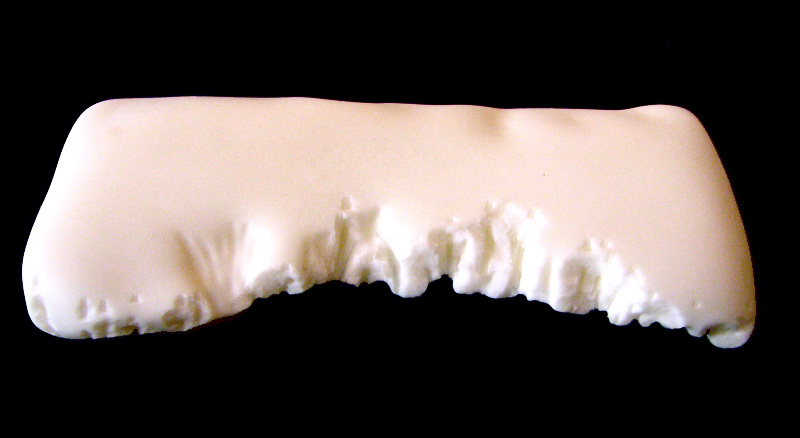
Use the skills you’ve gained, America, from countless hours of watching police forensic procedurals (click on image for larger view).
I will give you only the following clues: it’s a common house-hold object, no bigger than a bread box, most people use one every day, some people say it is 99 and 44/100ths pure.
This space will substitute for the musical interlude which limits your time to consider the question to, oh, just about. . . now!
Give up? It’s a Labrador Soap Carving by our three year old black female, Luna. Number two, of an unlmited edition.
Pet Airways: Pet Only Airline Travel
April 23, 2009
 from their site, Petairways.com: Welcome to Pet Airways, a pet-only airline dedicated to pet-friendly travel. With Pet Airways, your pet will be safe and comfortable flying in the main cabin — not in cargo! Give your pet a first-class travel experience today!
We promise to transport your pet with lots of love, care, safety, and comfort in the main cabin.
Pet Airways is the first airline exclusively dedicated to pets – no humans please – and we take the job of providing a comfortable experience for pets very seriously.
We’ll do everything in our power to make sure your pets get the best care during their journey because we’re committed to taking care of our pet “pawsengers” as if they were our own.
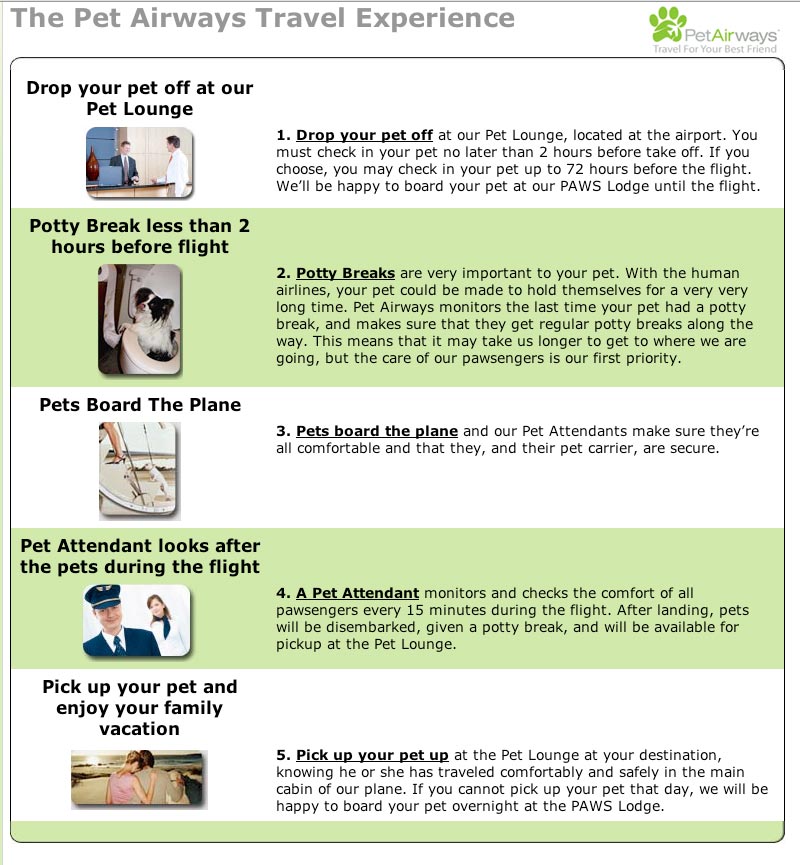
Click on the image below for an explanation of the Pet Airways Travel Experience.
BigDog Quadraped Robot
April 23, 2009
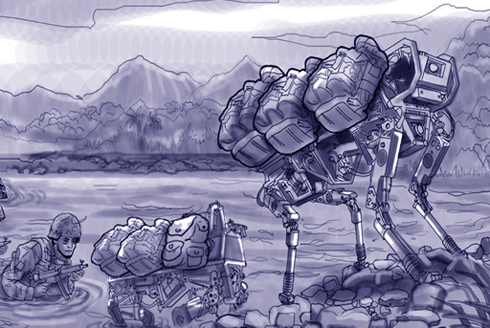 Boston Dynamics has created the prototype for a military robot, the BigDog, revisiting the old concept of two legs good, four legs better. Check out a pretty cool video here and the Boston Dynamic site here.