
Free Public Domain Images from your pal, the Government
January 5, 2009
Thanks to the great guys at Design Tools Monthly for this wonderful list of free image resources that you’ve already paid for with your tax dollars. Save the money you’d normally spend on quality pictures for your design projects and spend it on non-essentials like food, gas and shelter in 2009.
http://phil/cdc.gov/Phil/home.asp
www.loc.gov/rr/print/catalog.html
www.defenselink.mil/multimedia/multimedia.aspx
www.nps.gov/pub_aff/imagebase.html
www.photolibrary.fema.gov/photolibrary
www.nih.gov/about/nihphotos.htm
“A Natural History of Seeing” by Simon Ings
December 3, 2008
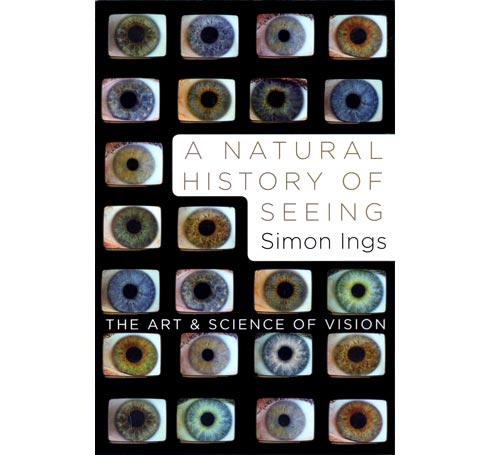
Light hits a rod in my eye, and bleaches pigment within. A cascade of chemical events shuts down the rod’s ‘ion channels’ — proteins that pass an electrical current around the cell. With its ion channels shut down, production of a chemical, glutamate, is stopped. This sudden chemical ‘silence’ excites a neighbouring nerve sell and sets it chattering. News passes from neighbour to neighbour, from nerve cell to nerve cell: the beginning of vision.
Novelist and science writer Simon Ings has produced a phenomenal book on vision, one that contains gems of information on every page. This is selling science to the public at the highest level; one that is as engaging and compellingly readable as any commercial thriller starring a government assassin named Bourne or Bond. Everyone with eyes should read this book. Get your copy here.
Here’s one example: below is a reproduction of Alfred Yarbus’ record of eye movements while studying a picture of a girl’s face. The jittery line drawing on the right shows how frantic our eye movements are, even when we believe we are taking in an object ‘at a glance.’
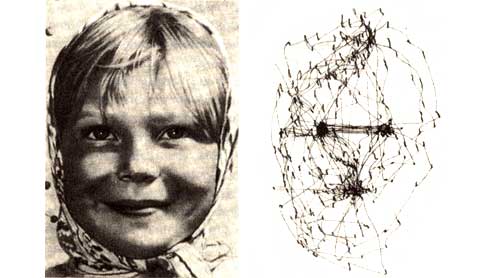
“. . .in reality my eyes are never still. Every third of second they jolt or ‘saccade’ moving my gaze from one part of an object to another. My single ‘glance’ is a multitude of little fixations, not unlike the twitching of an insect’s antennae, or a mouse’s whiskers. . .”
LIFE magazine photo archives to go online via Google
November 21, 2008
Google announced on Nov. 18 that it will undertake one of the largest scanning projects ever proposed: putting over 10 million images from the archives of LIFE magazine online.
What’s really striking about this is that 97 per cent of these images have never been seen by the public. So that means that LIFe magazine which was for over four decades America’s pictorial view of the world only used 3 per cent of the work submitted by their photographers. Among the iconic image makers who worked for LIFE are photographers like Alfred Eisenstaedt, Margaret Bourke-White, Gordon Parks, and W. Eugene Smith.
For more information about this amazing project, go here.
Product Shoots
March 10, 2008
Please click on the thumbnails for larger images
Photo Gallery – Outside
March 9, 2008
Please click on thumbnails for larger image.
Coney Island Mermaid Parade
March 9, 2008
Please click on thumbnails for larger image.

“The Wonderful World of Early Photography” on Neatorama
February 25, 2008
There’s an excellent overview of the fascinating early days of photography on the Neatorama blog.
From the camera obscura to the first human portrait, the first color photograph, the first underwater photo, to the first American woman to be photographed with her eyes open (in 1839), you’re certain to learn something about the development of photography that will surprise you.
[The distinction about being the first American woman photographed with her eyes open comes about due to the early practice of funeral photography of the recently deceased.]
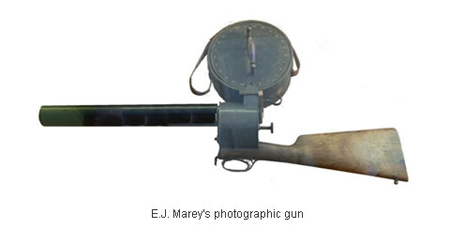
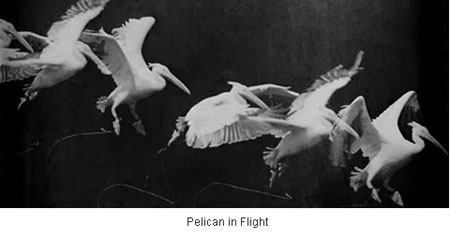
“In the 1880s, French scientist Étienne-Jules Marey wanted to learn how birds fly, so he invented a photographic gun, which uses a rotating glass plate to take 12 consecutive pictures per second.”
EXIF.org
February 7, 2008
EXIF stands for Exchangeable Image File Format, and is a standard for storing interchange information in image files, especially those using JPEG compression. Most digital cameras now use the EXIF format. The format is part of the DCF standard created by the Japanese Electronics and Information Technology Industries Association to encourage interoperability between imaging devices.
Go to their site and find specs, programs that make use of EXIF data and a forum to discuss EXIF related issues with other photographers.
Fred Miranda.com: A Great Place for Photographers
February 7, 2008
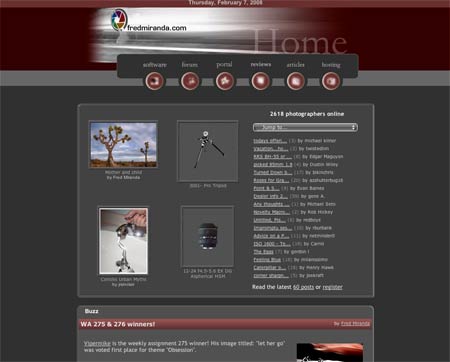
FredMiranda.com is a great forum for photographers of all skill levels. Reviews, forums, articles, weekly photo assignments and great, reasonably priced software plug-ins and actions for a wide range of digital cameras. Check it out and tell ’em necessity sent ya’!
Photoblogs.org: a Guide to 30,000 Photoblogs
February 4, 2008
Photoblogs.org is a guide to close to 30,000 photoblogs.
What’s a photoblog? Well, it’s another one of those ‘frankenwords’ that ‘net users like to create: a mash-up of photos and web logs. You can think of it as a blog whose primary currency is images, not text plus pictures like many traditional blogs. Photoblogs consist almost exclusively of images.
There’s a lot of interesting work out there being posted as photoblogs and this site is one of the best ways to begin exploring that world. . .