
Four Color Process – Adventures Deep Inside the Comic Book
May 11, 2011
Click image for larger size.
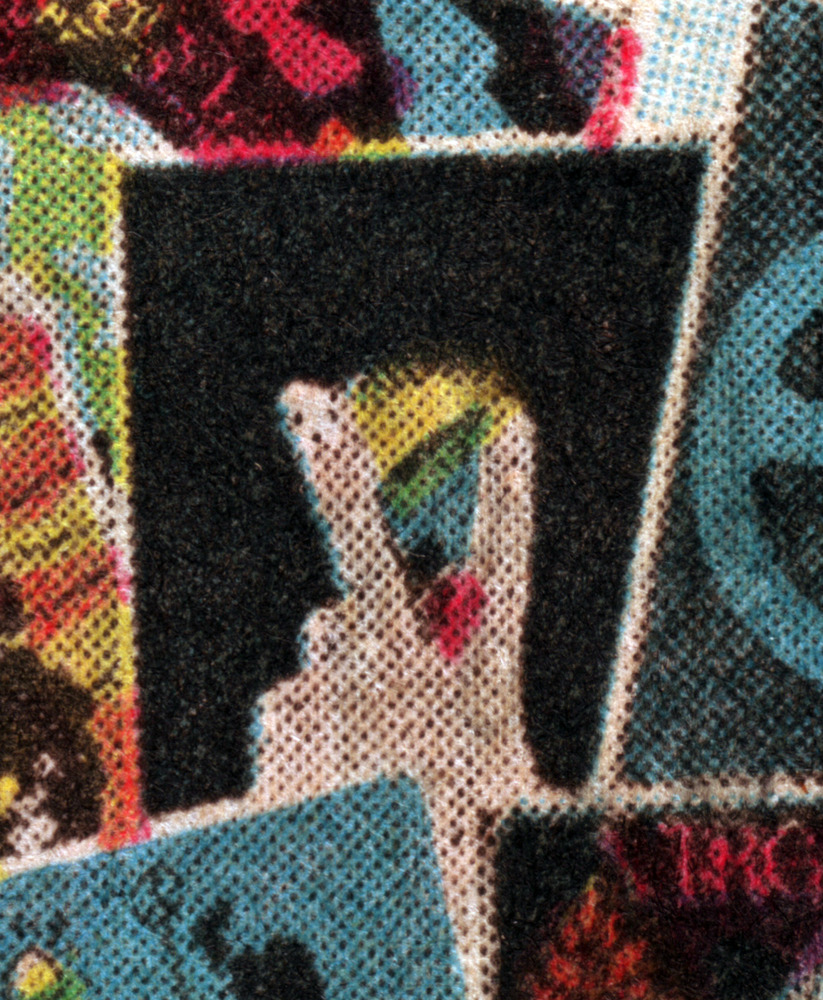
John Hilgart’s Four Color Process gallery at Posterous accurately lives up to its sub-head, “Adventures Deep Inside the Comic Book.” You’ll find a year’s worth of posts that feature close-up scans of sections of comic book panels. They vary from the recognizable to the abstract. One feature in common is that they all feature a visible dot pattern from the four color printing process.
The idea was akin to Pointillism in painting. Use patterns of dots in four colors (Cyan, Magenta, Yellow & Black) that combined to create a multitude of colors. If not the 16 million colors of computer screens today, the resulting combinations worked, if somewhat garishly and imprecisely.
As the Hearst papers claimed in 1896, “Eight Pages of Iridescent Polychromous Effulgence That Makes The Rainbow Look Like A Lead Pipe!”
Registration errors abound where the printed color of the object spills over the black holding lines of the artist’s inking job. I remember having a fair tolerance for these slips when I was reading 12 cent comic books on pulp paper.
Some of Hilgart’s selections exist in the visual area where images break down into pattern. (Hey, it worked when Roy Lichtenstein swiped from Joe Kubert and hung the result in Leo Castelli’s gallery.) Click image for larger size.
 Improved printing processes, digital work flows and better paper stock have made this earlier comic book work appear somewhat crude. But the distinctive look of four color printing on pulp stock is also one of it’s charms. It helps set the image in time.
For about a century this four color process was used for mass market publications. During their WWII heyday a popular comic book would sell a million or more copies a month. Nowadays a comic book whose sales are measured in tens of thousands is considered a hit.
So please check out 4CP and explore the ‘hidden’ art of the comic book panel.
War Dogs – from Christopher Columbus to Osama Bin Laden
May 8, 2011
 I’m not much of a reader of Foreign Policy magazine but I must say I’m knocked out by Roberta Frankel’s selection of images for her piece War Dogs. See the entire article here.
We’re on about the subject today because of Cairo, a Belgian Malinois war dog that was used by the Navy SEALS during Operation Neptune Spear, the raid that killed Osama Bin Laden.
Cairo the dog was, of course, named after Peter Lorre’s character in the film of The Maltese Falcon, Joel Cairo. The SEALS are well known to be huge Dashiell Hammett fans, while the Marines have always preferred the hard-boiled poetry of Raymond Chandler. I don’t know what the grunts in the Army read.
But even Elmore Leonard could tell you that shortly after their domestication dogs were put to use as weapons of war. During the Viet Nam War, scout dogs are credited with saving 10,000 troops. Too bad that when we pulled out, these same dogs were classified as ‘surplus material’ and left behind (where their efficiency earned them a bounty from the Viet Cong).
After he sailed the ocean blue Columbus used mastiff-sized dogs to help him conquer the Indigenous Peoples of the Americas. It’s reported that his men would give a native each night to their war dogs to devour as dinner. The Romans had entire units composed of dogs with spiked collars and metal armor. More recently the Russians used 40,000 dogs during WWII in various roles, including anti-tank weapons. The dogs were kept hungry and fed only under Soviet tanks. The first idea was that the dog would release a bomb then return to its handler who would detonate it remotely.
This training program had very mixed results so they decided to kept it simple and stupid. Now there was an 8 inch wooden lever sticking up from the top of the pack the dog was wearing. When the dog went under the chassis of the tank, this lever would strike the bottom of the tank and detonate. But even this didn’t work because to save fuel and ammunition most dogs were trained under parked Soviet tanks without gunfire.
Plus the Soviet tanks were diesel and the German tanks gasoline so the dogs had a tendency to run towards the familiar-smelling Soviet tanks.
And if a dog wasn’t wounded or killed in the battlefield they, of course, ran back to the home front where the explosives destroyed them along with their two-legged co-combatants. So any dog returning would have to be shot by its own troops and some soldiers rebelled against this instance of killing during wartime. Nazi propaganda made much of the desperation that drove the Soviets to this inefficient tactic.
Today’s war dogs are both highly trained mission specialists and expensive tech. They are treated like members of the team, not four-legged bomb delivery systems.

While DC Comics character Sgt. Rock has always maintained that WAR IS HELL (and I believe him), there’s just no place we won’t bring our dogs.
Hubble Space Telescope – Your Tax Dollars at Work
May 8, 2011

Click image for larger size.
Most people know about the Hubble Space Telescope but not the man who is honored by its name. Just as many New Yorkers believe that the Holland Tunnel was a gift of the Dutch to New York City. (It’s actually named after its chief architect, Clifford Milburn Holland). I first read about astronomer Edwin Powell Hubble while reading a biography of Aldous Huxley; they were friends during Huxley’s California years.
Hubble is probably most noted for discovering the ‘red shift’ of light of from distant stars and galaxies, proving they are moving away from us at a constant rate. In 1929 Hubble’s Law proved the universe was expanding and gave us a way to determine its age. In 1931 Hubble was visited by Albert Einstein who thanked him for his discovery. Einstein had previously staked his position out for a static, immobile universe. This puts Hubble into that exceedingly small group of scientists personally thanked by Einstein for correcting him.
The main Hubble site has an incredible archive of images, this link takes you to a subset of particularly beautiful photos.
Everyone complains about their taxes; everyone feels their taxes are too high; everyone believes the government wastes the money that they collect. . .but the Hubble Space Telescope is a project that no one can seriously claim has not been worth the cash spent on it.
Jello Cube Bouncing at 6,200 Frames Per Second
May 5, 2011
This video comes to you courtesy of Modernist Cuisine: The Art and Science of Cooking by Nathan Myhrvold, Chris Young and Maxime Bilet, a six-volume, 2,400 page set that using science-inspired techniques for cooking food.
Designed for serious foodies and scientists with highly developed taste buds, the set retails for a whopping $625! It’s been hailed as “the most important book in culinary arts since Escoffier” by Tim Zagat, who surely knows a thing or two about good eats. Check out their listing on Amazon.com here for more info and a look at some beautiful sample pages.
It highly unlikely that I’ll ever own this set (or adopt its cutting edge cooking techniques). But I’ll always remember them fondly for this high frame rate video of a bouncing Jello cube.
TV Eyes 3D Glasses. Watch regular TV in 3D. Guaranteed! Right. . .
May 4, 2011
“TV Eyes 3D Glasses. Watch regular TV in 3D. Guaranteed!
No 3D movies or special electronics needed. NEW!”
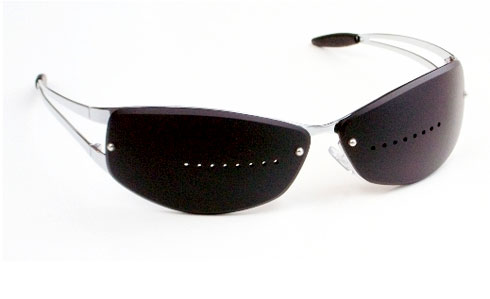
But wait! – these 3D glasses are not stereoscopic 3D, the only kind of 3D that actually exists.
“Caution: This is not stereoscopic 3-D. It will not turn your TV into a hologram. Objects will not jump out of the screen at you. That effect requires special filming techniques that regular movies don’t use.”
This, I feel, is a case where the classic Tom Waits line applies: “The large print giveth and the small print taketh away.”
Note: all text in blue is from the eBay seller of the above item, a $25 pair of 3D glasses that are not, in fact, 3D glasses. They’re something revolutionary and new! When you hear those words, you should know to hold your wallet tightly.
The TV Eyes 3D Glasses are better than the red-blue (or red-cyan) anaglyph process:
“TV Eyes does not use different colored lenses so it has none of the color distorting effects of the old red/blue 3-D glasses. Colors come through clear and vivid.”
It’s not that old, normal 3D 90% of you see every day as you negotiate our tri-dimensional world. It’s an entirely new type of 3D:
“This is an entirely new type of 3D effect that most people have never seen before. It doesn’t look exactly like the 3D you’d see at the theater, because that type of 3D only works on specially filmed 3D movies. TV Eyes 3D works on everything else!”
When you don’t have science supporting your claims, just throw out science. Science is only something we believe because we’re taught it. Education am bad:
“Simple. We don’t rely on stereopsis. There is an assumption that the only way to view a 3-D image is with two eyes and two angles. We’ve been taught this, and we believe. But our eyes see depth and form in many different ways. Stereopsis is only one.”
The ‘new’ discovery is so important we can’t even tell you the name of the process or who developed it (and where and why):
“It was recently discovered that arranging apertures in just the right way created an amazing new optical effect. Normal 2-D images looked more 3-D. TV Eyes glasses are based on this new discovery.”
Oh, it’s not a single process about arranging apertures, it’s a multi-effect engine that combines stuff to make a new, imaginary form of 3D:
“TV Eyes 3-D creates several different optical effects, that when viewed together create a unique new form of 3-D.”
And then let’s toss in a really neat term “atmospheric perspective” and misuse it. Atmospheric or aerial perspective makes distant objects look lighter in color, lower in contrast and (generally) bluer than nearer objects. Not what he said:
“TV Eyes 3-D increases the atmospheric perspective in a picture. This is the sense that ‘air’ or ‘atmosphere’ exists between objects. This sense is what creates the illusion of solid objects placed in an environment.”
A while ago on the New York Stereoscopic Society’s site I had a back-and-forth with an eBay seller offering something similar, glasses with small holes in them designed to give a 3D effect to movies and TV not actually filmed in 3D. You can follow the links below to see how that went.
TV Eyes Glasses: revolutionary new process or tired, old rip-off?
Update on TV Eyes Glasses: Pinholes from Pie Holes? Or Just Another Sonic Transducer?
Second Update on “TV Eyes Glasses” – Pinholes it is!
TV Eyes 3D Glasses: the Manufacturer Responds
TV Eyes 3D Glasses: the Manufacturer Responds Again. . .and We’re Still Not Convinced!!
Add Canned Salmon to Your Dog’s Kibble – A Great Inexpensive Supplement
May 4, 2011
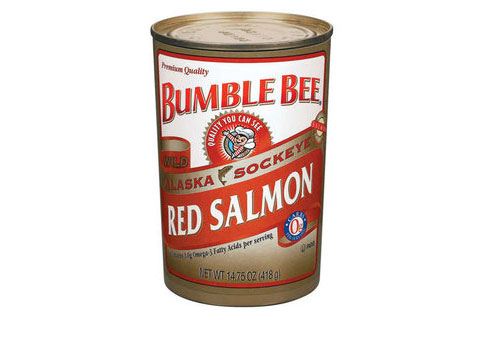
Want a relatively inexpensive way to greatly supplement your dog’s diet? Try adding the oil and some fish from a can of Bumble Bee Alaska Sockeye Red Salmon. Pet nutritionists call this ‘top-dressing’ your kibble and it’s an easy way to start give your dog some less processed nutrition.
We regularly give our two Labradors a couple of tablespoons of whole milk yogurt (for both its probiotics and gas-emission reduction qualities); raw eggs, baby carrots, banana and other fruits and veggies, along with table scraps mixed in with their meals.
We used to buy an expensive Grizzly Salmon Oil All-Natural Dog Food Supplement that retails for $40 for 32 oz.
Now we’ve been adding this Sockeye Red Salmon that we get at our local B.J.’s, 2 cans for $9 for 29.5 oz. of fish and oil. We get more than just the salmon oil at a much lower price. We give it to them 3 to 4 times a week. Our dogs just love it.
Of course, they loved having their kibble drizzled with the Grizzly Salmon Oil, too. In no way do I want to knock that product. If you’ve got the cash, go out and buy a bottle right now. But in today’s economy, we’re looking to stretch every dollar we have to spend on our dogs.
By feeding them a quality kibble we know that they’re getting a balanced diet. By adding salmon as a supplement (or top-dressing) we know they’re getting all the benefits of the Omega 3 and Omega 6 fatty acids that add ouster to their coats as well as supporting their hearts and immune systems.
The take-away: this is a relatively inexpensive way to add significant health benefits to the food you’re already using. Give it a try.
No Discernable Difference Between Cheap and Expensive Wines?
April 30, 2011

Is there some Night Train, Thunderbird or Richards Wild Irish Rose in your future? vefore you answer, consider the following. Slash/Food has a nice report on something that has been established with beers, whiskeys, vodkas and many other refined spirits: Blind Tasters Can’t Tell Cheap Wines from Expensive. The results of the survey of 578 drinkers at the Edinburgh International Science Festival hovered around 50% – the same results you would expect to get from chance, e.g. simply guessing.

Adobe adopts HTTP Live Streaming for iOS
April 30, 2011
 Chris Foresman at Ars Technica has a nice piece about the ongoing conflict between Apple and Adobe over Flash. Read the complete piece here Adobe throws in towel, adopts HTTP Live Streaming for iOS
“In other words, instead of trying in vain to persuade Apple to build Flash into iOS, or losing potential Flash Media Server customers to some other iOS-compatible solution, Adobe seems to be implicitly acknowledging that content publishers need Flash-free video streaming. It’s also worth noting that HTTP Live Streaming will also be served to compatible clients on non-iOS platforms, including Safari on Mac OS X. Apple recently began selling its portable computers without Flash pre-installed, and we discovered that running Safari without Flash seemed to increase battery life of the latest MacBook Air as much as 33 percent.”
Milking a Tuscan: Amazon Customer Humor from David Pogue
April 30, 2011

OK, I know that I’m hard to please when it comes to Internet humor but these ‘reviews’ posted by Amazon.com customers made me spit Tuscan Whole Milk out my nose. Read an overview by my favorite tech writer David Pogue in the New York Times here and scroll down for some examples.
Book Reviews of Hgiyiyi
“As good as Jhjykyk, maybe better. The highly-anticipated sequel to Jhjykyk keeps you on the edge of your seat from the very first paragraph. Hgiyiyi picks up right where Jhjykyk left off. It both answers your lingering questions and creates so many new ones. That is the genius of jjjj, who is not only a unique writer, but who also translates his books himself! I’m on the edge of my seat waiting for the third book to come out. After reading Hgiyiyi, I know you will be too.”
“I know, I know, I’ve heard it before . . . you think that goat milk is just too strongly flavored, and that prejudices you against anything that isn’t cow milk. But Tuscans aren’t even related to goats. They’re actually akin to gerbils, although they’re a bit smaller. Their milk is very mild and sweet. It’s also amazingly high in butterfat content, so it’s wonderfully rich and creamy. Milking a tuscan is a dying art (they do tend to bite, which makes the process a bit tricky).
“One is immediately drawn to this vintage by the colour, which is an elegant, pale straw hue with an appealing peachy fruit on the nose. It has an incredibly effervescent bead — the whole glass teams with bubbles — culminating in a frothy layer at the head. The palate has panache, with a firm, mineral acidity that cuts through a rather elegantly styled, poised meaty presence. . .Even though it has a rather short and crisply defined finish, I still believe this has the composition and acidity to age well in the cellar of any self-respecting urine connoisseur.”
“Like many suburban homeowners, I like to kill and eat the wild animals that populate my backyard. To keep it sporting, I hunt naked, with my teeth and long sharpened fingernails as my only weapons.”
“The quality of this Uranium is on par with the stuff I was buying from the Libyans over at the mall parking lot, but at half the price! I just hope the seller does not run out, because I have many projects on my list including a night vision sasquatch radar, an electromagnetic chupakabra cage, a high velocity, aerial, weighted Mothman net and super heated, instant grill cheese sandwhich maker.”
Pet Dog Ownership to be Banned in Iran
April 25, 2011
According to the Daily Mail, the Iranian Parliment that will criminalize dog ownership has been drafted. The claim is that “impure and dangerous” dogs create a health problem and that dog ownership “poses a cultural problem, a blind imitation of the vulgar Western culture.” If the dogs are ‘working dogs’ and not considered pets, e.g. allowed in the home, they will skirt this ban.
Exceptions are allowed for guard dogs, sheep dogs and specially trained dogs like those that detect bombs or drugs or search and rescue dogs.
Of course, there’s the issue of the Muslim’s faith position on dogs. Some quick research reveals that they are considered ‘ritually unclean’ and the Sunni tradition holds that the prophet Muhammed did not like dogs. Having a dog counted against one’s good deeds in life, according to this view.
There are some bright spots in the Muslim take on animals in general, though. You are not permitted to mistreat them, beat them unnecessarily, mutilate them, brand them on the face or have them fight each other for entertainment.
From a Western point of view, where most dogs are pets in the home, this ban seems draconian. To deny the benefits of companionship and joy that we get from our dogs, even if they don’t contribute to the bottom line, throws in high relief the clash of cultures between the West and the Middle East. It also makes clear the difference between secular governments and those run by an established state religion.
The fact of this proposed ban makes me sad, followed immediately by concern over the fate of all the current pet dogs in Iran. How likely is it that they will be humanely disposed of?
But does any one of us in the West have a right to object? Just as hysteria has been fanned in the States about Sharia law being imposed on non-Muslims, we can’t really claim that banning pet dogs is not the right of Iranian Parliment. Their behavior is consistent with their beliefs.
And I think they are correct in their judgement that Western cultural values are in direct contrast to the kind of society they want to have. I just know how my life has been enriched by all the dogs that have passed through it. I imagine that every pet dog owner in Iran feels the same way.