
The History of Digital Photography – Extreme Tech
January 12, 2012
As the news that Kodak may disappear as an iconic American brand is in the financial headlines these days, I thought it was worth highlighting a history of digital photography put together by Sebastian Anthony of ExtremeTech.

Since Kodak brought the first digital SLR to market in 1991 (at a retail price of $30,000) it’s hard for an outside observer, like me, to understand how they could have fallen so far behind the curve in a market that they could’ve owned.
Although some companies never do seem to get the memo that says, Adapt or Die.
In fact, a close friend of mine – a skilled amateur photographer who worked for a professional film processing lab – told me back in 2000 that film would never be replaced by digital, due to the relative poor resolution of the then-current crop of digital point and shoots. Today, he shoots digitally (of course) and the company he worked for no longer exists.
For me this is an example of how even knowledgable professionals are shockingly poor at making predictions in their own fields. The views of most pundits are not any more accurate than a coin flip. (Except, of course, for this guy I know who picks stocks. He knows how to beat the Street. See, he’s got this system. . .)
Carli Davidson – Canine Photography
January 12, 2012
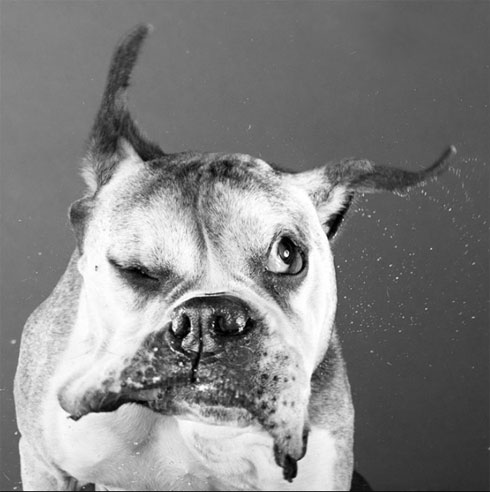
I’m no fan of “cute” canine photography, just as I am no fan of dogs in Halloween costumes. Alright, maybe something minimal like a jester collar with bells but anything more elaborate than that always convinces me that the dog in question is uncomfortable and embarrassed for its owner’s lack of taste. So you’ll never find links with images like that on this site. However, I do believe that dog portraiture can be all that human portraiture is; photographers like Amanda Jones provide ample proof of that, in my opinion.
Today, I’d like to call attention to Carli Davidson, a professional photographer whose work has appeared in Vanity Fair, the Village Voice and Rolling Stone. She’s also an amazing photographer of dogs. I’d like to draw attention to just two of her outstanding photo galleries: Shake with images of dogs (and one cat) shaking off water and Pets with Disabilities. Nothing cute here, just great photography that happens to be about dogs.

How the Dog Became the Dog – Mark Derr
January 12, 2012
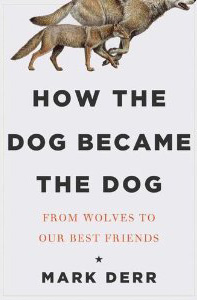 For those of you who follow the ongoing debate about the evolutionary origin of dogs Mark Derr‘s new book, How the Dog Became the Dog: From Wolves to Our Best Friends is essential reading. The take-away is that the latest evidence casts doubt on the previously accepted dates for the emergence of the dog from the wolf. Derr makes the case that there was co-evolution of primitive man and wolf into modern man and domesticated dog. This is the track that Temple Grandin also posits in her recent book, Animals Make Us Human: Creating the Best Life for Animals.
The reasons for this are complex and Derr has a great ability to probe the archeological record and question the assumptions of previous researchers. Every modern book on dog evolution cites the work of Dmitry Belyaev with the Russian Silver Fox. In breeding for “tameness” over many generations for 40 years Belyaev reported physical changes in his foxes: body shapes altered in size and proportion, coats became piebald, tails became curled, ears floppy and increased cyclical rates of reproduction. Wild female foxes mate once a year, their cycle is cued by changes in daylight. Dogs can mate and bear young in any season, and more than once each year.
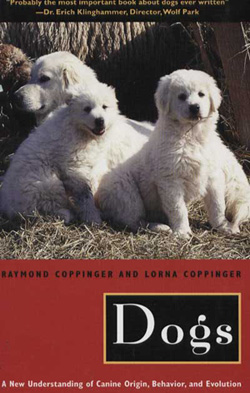
These results are said to make the case for primitive man selecting the tamest of wolves that followed their campsites and slowly transformed them into the domestic dog. Derr explains some of the problems with making this connection and challenges its explanatory power. In this he is making a counter-argument to the ground breaking work of Raymond and Lorna Coppinger in their book, Dogs: A New Understanding of Canine Origin, Behavior and Evolution. I think Coppinger makes an excellent case for his view and also consider his book essential reading, without knowing truly who is right in this debate.
Both would agree, I think, that domestication of the wolf into the modern dog was not an event which occurred only once or in a single location. The facts suggest a more complex and less straightforward process. It may even be the case that we will never know precisely how this all played out after the last of the Ice Ages. But Derr makes a major contribution to the conversation with his new book.
Backwards Ran Sentences: The Best of Wolcott Gibbs from the New Yorker
December 29, 2011
As a lifelong obsessive, compulsive reader it always saddens me when I reach the end of a favorite author’s lifetime output.
It’s satisfying but somewhat melancholy to realize that I’ll never read another piece by – insert names here [Aldous Huxley, A.J. Liebling, Joseph Mitchell, Raymond Chandler, Dashiell Hammett, Dorothy Parker, etc.] for the first time.
How sweet it is, then, to newly discover another writer who may securely lodge in my personal pantheon. Just such a discovery happened late this Fall when I came across a compilation of work by Wolcott Gibbs; six hundred and fifty-three pages of precisely rendered prose from a sensibility as jaundiced as my own.
I offer the short excerpt below as a sample.
__________________________________________________________________________________
Day after day Laura Jean Schanze, a rather sinister little girl in the Clinton, New Jersey public school sat at her desk writing down the mistakes her teacher, a Miss Melick, made in English. Miss Melick said “poopils” when she meant “pupils” and “arn” when she meant “iron;” once in an unexplained crisis she exclaimed, “There ain’t no Chinamens in here!”
In the end Laura Jean’s dark industry was rewarded and Miss Melick was dismissed by the school board. This episode illustrates a quality we have always felt in little girls – something derisive, watchful and colder than the climate on the moon. For some reason it reminds us of a conversation we overheard on the beach the other day. Two young ladies, each perhaps fifteen, lay on the sand and talked of love.
“So,” said one of them, “he told me he was giving up smoking for me. For me, for God’s sake! He thinks I’m worried because he’s stunting his nasty little growth or something.”
“They all do,” said the other, and the baby gorgons laughed together, a silvery music, ancient and terrible.
Talk of the Town, August 27, 1938
from Backwards Ran Sentences: The Best of Wolcott Gibbs from the New Yorker
___________________________________________________________________________________
Great Mac Software Bundles – at Great Prices for a Limited Time
December 15, 2011
MacUpdate is offering a bundle of 12 applications, including the essential repair utility Tech Tool Pro 6. A total retail value of $741 for only $49.99 (a 94% discount, saving you $691). As of this writing you’ve got 6 days to take advantage of this offer.
BundleHunt is also offering 12 applications for $49.99, (95% off a full retail of $1,100). Six are design-oriented and six are general Mac apps. Included are 14 e-books, listed below:
- Mastering CSS for Web Developers
- Professional Web Design, Vol. 2
- Getting the Hang of Web Typography
- Mastering Photoshop for Web Design, Volume2
- Create Selling eCommerce Websites
- Mobile Design for iPhone & iPad
- Mastering Photoshop for Web Design
- Successful Freelancing
- Professional Web Design
- Creative Set for eBook Design
- Book 1: Where Stellar Messages Come From (55-page PDF)
- Book 2: Formatting & The Essentials of Web Writing (54-page PDF)
- Book 3: Headlines, Subheads & Value Propositions (52-page PDF)
- Book 4: Buttons & Click-Worthy Calls to Action (55-page PDF)
Dog News Round Up III
December 8, 2011
Here we go again with another catch-up of links to compelling Dog News links. . .
• An art book of photography of chewed dog toys? Yes, it does exist. See this piece on Chewed in the New York Times.
• The UK Telegraph reports on a study from the journal Learning & Behaviour that shows dogs can instinctively sense a friendly face here.
• The dwindling number of Americans who still have discretionary income are lavishing it on their pets, and not, say, donating to local human food banks, according to ‘For the Dogs’ Has a Whole New Meaning in the New York Times. Another example of how needlessly indulgent and narcissistic many pet owners are.
• Learn Five Surprising Facts about Dog Walking in The Week.
• The eugenics movement and the rise of a middle class the last quarter of the 19th century in England were strong contributing factors in the creation of fixed dog breed standards. Ever since then, breed standards have been, at best, a mixed blessing for our dogs for the same reasons that we prohibit marrying our (human) first cousins.
A fixed or closed gene pool allows negative recessive traits to come to the fore. As an example, our pure bred Lab suffers from hip dysplasia at 9 years old. It’s my belief that we have done our dogs no favors when we breed them to extremes from tea cup Chihuahuas to Great Danes. An excellent piece in the New York Times explores this issue in Can the Bulldog Be Saved? by Benoit Denizet-Lewis.
• Progress on a Birth Control Pill for Dogs is explored in The Week.
• I recently learned that there’s a Patron Saint for Dogs, St. Roche. As an atheist I don’t know if my opinion counts for much, but I see a downside to this. St. Roche is also the patron saint of bachelors, diseased cattle, falsely accused people, invalids, Istanbul, surgeons, grave diggers, tile makers, second hand dealers, pilgrims and apothecaries. What a bizarre assortment to add dogs to; I mean, diseased cattle? Second-hand dealers?
• Pet insurance has never seemed like a good investment to me. Last year I ran the numbers with VPI and found that I would spend more with their coverage than without, a position supported by an article in Consumer Reports. Now a dark side emerges, people abusing their dogs to collect on pet insurance policies. Read about it here in The Week. More proof, to my mind, of Mark Twain’s saying, “Heaven goes by favor; if it went by merit, you would stay out and your dog would go in.”
• An infographic at the website Hunch explores the difference between Dog People and Cat People.
• I’m skeptical about stories of dogs keeping vigil at their owner’s graves. This is not to say that dogs cannot grieve the loss of their human companions, but going without food or water at a gravesite is clearly not normal canine behavior. Theses stories make us feel better but, like the case of Edinburgh’s famous Greyfriars Bobby, when investigated they often fall apart.
Learn about the real Greyfriars Bobby in Jan Bondeson’s excellent Amazing Dogs: A Cabinet of Canine Curiosities. It turns out that the story was an invention designed to boost tourism.
The Huffington Post has a story about a Loyal Dog in China refusing to leave his owner’s grave. But the HuffPo lives and breathes over-hyped and thinly sourced stories, it’s not really news, it’s Fark! The Week has a better write up on The phenomenon of grieving dogs: The ultimate loyalty.
• Tracing Unscooped Dog Waste Back to the Culprit explains how DNA kits are bring used to bring undisciplined dog owners to heel (Sorry) in one apartment complex in Lebanon, N.H., from the New York Times.
• Can dogs used in combat suffer from post-traumatic stress syndrome? Read about it here in The Week.
“Zone One” by Colson Whitehead, A Zombie Novel You Can Read in Public Without Embarrassment
December 7, 2011
“So tentative bureaucracy rose from the amino-acid pools of madness, per its custom.”
– from Zone One by Colson Whitehead
Anyone who knows me well, knows how much I like zombies, as a horror genre. (If they were real, I’d probably turn against them, for purely practical reasons). There are a lot of very low-budget zombie films that are pretty much unwatchable and indefensible, but the genre does contain a few classics and some great, entertaining if decidedly “B” caliber movies.
Why, for example, critics routinely bash the Resident Evil films I will never understand. They deliver exactly what they promise. I do have to admit to great bias here, however. I would watch a movie of Mila Jovovich breathing.
In literature, the pickings are far slimmer. I found a well-regarded short story compilation, Book of the Dead, edited by John Skipp and Craig Spector to be mostly forgettable with the exception of 2 or 3 entries. There were also a couple where gratuitous sex ruined the narrative for me. The implausible double-penetration of a waitress via a zombie father and son in one story made me wonder if the author was 14 years old and had never seen a real lady naked. I mean, Zombie sex? Really?
The Walking Dead: Rise of the Governor by Robert Kirkman and Jay Bonansinga is part of the Walking Dead TV show and comic book franchise. I was an early fan of the comic book and think the AMC show is an excellent adaptation. The book, however, is for completists only. It adds almost nothing to the experience of the comic or the TV series.
And, although it is completely authorized and co-authored by Walking Dead creator Kirkman, there are continuity errors between the book and the comic (the sign outside Wiltshire Estates was one that stuck out for me). Where have all the proofreaders gone, I wonder?
If you want to experience your zombies on the printed page I would recommend Otto Penzler’s Zombies! Zombies! Zombies! a massive 832 page anthology that includes the best stories from Book of the Dead as well as the first reportage in English about Haitian zombies, W.B. Seabrook’s “Dead Men Working in the Cane Fields.”
In the category of novels, there are only two that I think are worth your time: Tony Burgess’ Pontypool Changes Everything from 1998 and 2011’s Zone One by Colson Whitehead.
Zone One has gotten phenomenal reviews from publications that matter like The New York Times Book Review, Los Angeles Times, Entertainment Weekly, GQ, USA Today, Esquire, New York Observer, The Washington Post, Houston Chronicle, Publishers Weekly and more.
However, genre fans are dissing it long and loud on Amazon.com. Not enough red meat for them, I imagine. This is the crowd that Skipp and Spector’s Day of the Dead was compiled for. I disagree with almost every criticism they throw at Zone One.
Whitehead is a well-regarded mainstream novelist and a MacArthur Grant recipient, dipping into the zombie genre for the first time. This fact alone seems to outrage the double-digit IQ crew. There are similar criticisms in the letter pages of The Walking Dead comic whenever the focus stays too long on the living, trying to cope with the post Zombie Apocalypse world.
This is the difference between reading (and thinking) and contemporary porn. In the 1970s era of porno chic, X-rated films had actual plots and attempts at characters, albeit with regular as clockwork hardcore sex scenes. Now porn has gone ‘gonzo’ and it’s all one semi-pneumatic scene after another. The critics of Zone One seem to desire a zombie novel that is simply one gore fest after another. Just give me the ‘good parts’, they demand, and don’t make me think. Just like porn.
Personally, I loved Whitehead’s prose style and the pacing and originality of his storyline. It’s also filled with wonderful lines like the one quoted above. Zone One wasn’t written for the fanboys. Ignore the critics on Amazon. It’s a literary zombie novel for adults with a brain. A big, fat juicy bra-a-a-a-a-in!
Dog News Round Up II
December 7, 2011
I’m still trying to get through a backlog of links to compelling articles about our canine pals, so here we go with Round 2:
DiscoveryNews reports on a piece in the Journal of Personality and Social Psychology describing the health benefits of pet ownership. They include a link to an article about the role of pets in human evolution. For more on this topic, I highly recommend Temple Grandin’s Animals Make Us Human, available in paperback from Amazon for only 6 bucks.
The Dogs of War: Beloved Comrades in Afghanistan.“We consider the dog another Marine,” says Capt. Manuel Zepeda, the commander of Company F, Second Battalion, Sixth Marines. From the New York Times.
I Sniff, Therefore I Am. Are Dogs Self-Conscious? by Robert Krulwich at the NPR Science Blogs. Regardless of the position scientists take on this topic, I have my own opinion. One of my dogs has clearly entered into a pact with Satan and I’m assuming you need to be self-conscious to accomplish this.
A South Korean Dog Farmers’ Association festival to promote the tradition of eating dog meat was cancelled back in June due to protests by activists, as reported by Animal Planet.
Is it possible to make a case for eating dogs, given that millions are euthanized every year while people on Plant Earth go hungry? Read this piece from the Global Post to explore this admittedly difficult topic. On this subject the Global Post’s in-depth article Dog Meat Mafia is required, if unpleasant, reading.
The controversy over the number of required and recommended vaccinations for dogs is examined in Vaccines ‘are making our dogs sick as vets cash in’ from the UK Mail Online. I’m remain uncertain if the science is settled as far as blaming illnesses in dogs on over-vaccination.
The broader subject of human vaccinations is clearly muddled in the public mind these days as life-saving, disease preventing vaccinations for humans are under attack by ignorant celebrities and the anguished parents of autistic children. The lesson here is clearly, don’t take your medical advice from former Playboy playmates.
What’s the harm, you ask? Go to this site and learn: Jenny McCarthy Body Count.
For more facts, see also the books of Dr. Paul Offit, Deadly Choices: How the Anti-Vaccine Movement Threatens Us All and Autism’s False Prophets: Bad Science, Risky Medicine, and the Search for a Cure.
Find out who are the Top Ten Dog of Science in Dogged Research from Scientific American.
Does your dog (or other pet) sleep in your bed? Learn about the potential risks in Warm Nights, Cold Noses from the New York Times.
And all these years I thought Cat Scratch Fever was just a dumb Ted Nugent song.
We should, I think, always remember that pro-gun and anti-drug activist Nugent claims he didn’t know the lyrics to “Journey to the Center of the Mind” – a hit from his first band The Amboy Dukes in 1968 – were about drugs. Sure, I believe that. A rock and roll band singing about drugs in 1968? What a ridiculous claim.
Dog News Round-Up
November 17, 2011
The most interesting articles that have lately accumulated in my saved bookmarks. . .
‘Pet Industry Booming, With Sales of Gourmet Treats’ from The New York Times
‘A Birth Control Pill for Dogs?’ from The Week
A nicely designed infographic from Hunch, Woof vs. Meow, What Our Furry Friends Reveal About Us
Owney the Postal Dog, one of several dogs that traveled on mail trains in the US and England during the great steam engine days, was honored by a ‘forever’ stamp this year. Owney is considered an unofficial Railway Mail Service Mascot. From the Times-Union
‘Dogs can instinctively sense a friendly face’ from The Telegraph
A fine art photobook of chewed dog toys has been published, Chewed by Arne Svenson and Ron Warren. It contains 140 exquisite color photos of “lovingly destoyed canine playthings.” From The New York Times
‘5 Surprising Facts about Dog Walking’ from The Week
Canine DNA is being used to trace owners who don’t pick up after their pets in ‘Tracing Unscooped Dog Waste Back to the Culprit’ from The New York Times
‘The Phenomenon of Grieving Dogs’ An article that demonstrates the truth of Mark Twain’s saying, “Heaven goes by favor; if it went by merit, you would stay out and your dog would go in.” From the The Week
George Plimpton’s Video Falconry and John Hodgman
November 17, 2011
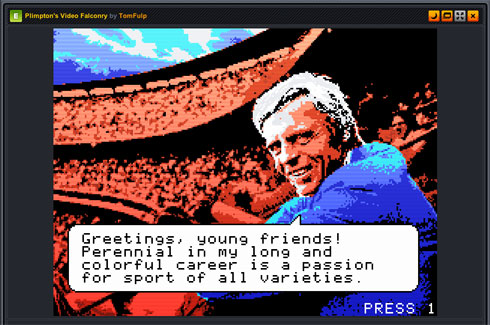
Screenshot of an opening scene in George Plimpton’s Video Falconry.
I’m pretty much eliminating all those people in my life who don’t share my worship of John Hodgman. If you’re asking yourself, who is John Hodgman? There may still be hope for you.
John Hodgman is a minor television personality and author. He was the PC in the “I’m a PC” – “I’m a Mac” commercials for Apple. (Justin Long was the always-triumphant Mac). He makes monthly appearances on The Daily Show with Jon Stewart and shows up a lot on the Rachel Maddow Show. He has a podcast, Judge John Hodgman where he delivers rulings on problems brought before by ordinary, non-famous people. It is hysterically funny.

But I encountered him first as the author of The Areas of My Expertise (2006), a compendium of fake complete world knowledge. This work spawned a sequel, More Information Than You Require (2009) and now, the final book in the continuously paginated trilogy, That Is All (2011).
Here are two opinions on the new book taken from the listing on Amazon’s site:
“Sit in public laugh out loud smile to yourself funny literature.”
“I liked his appearances on the Jon Stewart show, but this book is not one bit funny or interesting. Thanks goodness I ‘acquired’ it at a local library and didn’t buy it.”
Now who can take the opinion of a person who steals books from a local library seriously? Need it be said that I agree with the ‘laugh out loud funny’ review? I didn’t think so.
Anyway, mention was made in the Judge John Hodgman program and the book That Is All of an obscure 1983 ColecoVision videogame, George Plimpton’s Video Falconry.
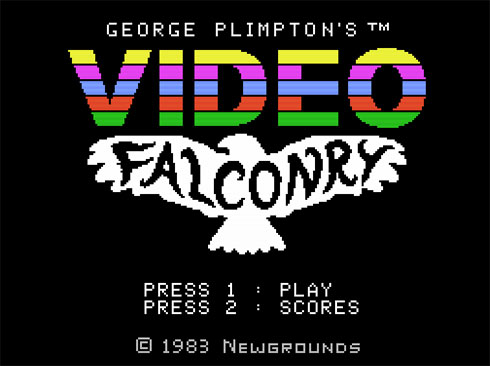
Intrigued, game programmer Tom Fulp took up the challenge to first, locate a game cartridge – it cost $500 – then spend the 31 days necessary to port the game to play in the web browser of your choice. Go here to do that. It’s free and actually fun to play. Claw grab. Beak grab. Claw grab. Claw grab. Claw grab.
It also has one of those monophonic looped 8-bit electronic scores.
If you lived through that era nothing brings you back more vividly than those maddeningly elliptical soundtracks. You can also watch a video and learn the whole twisted story, from George to John to Tom and how a 28 year old video game is resurrected.
In turns out that George Plimpton’s Video Falconry was especially obscure because most of the product wound up being junked due to conflicting endorsement deals Plimpton had made. Only a few cases of the games actually made it onto store shelves.
And that is more information than you require about George Plimpton’s Video Falconry.
The takeaway: these are serious and difficult times and the country cries out to its scores of deranged millionaires, make sense of it all for us. Or if not that, entertain us. John Hodgman is one of the few deranged millionaires to actually take up this challenge. If you have any discretionary income at all, get the economy moving again and buy one of his books.