
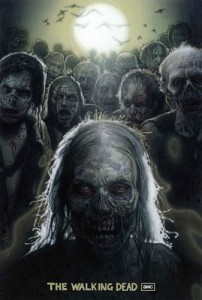
Zombies Worth Over $5 Billion to US Economy
October 31, 2011
24/7WallStreet.com analyzes the economic boon of the walking dead in all media, and comes up with a $5 billion figure.The impressive figures author Jon C. Ogg comes up with are below. And he even thinks these are all low-ball figures!
Regardless of the reason, zombies are worth billions of dollars. The figure that we were able to piece together: $5.74 billion. In all honesty, this tab is grossly undercalculated in each category. By the time you add the money spent in total around the zombie genre, the figure is much higher.
For the detailed analysis of how he derived these numbers, read the complete article here.
Movies > Zombie economy: $2.5 billion
Video games > Zombie economy: $2.5 billion
Comic books, magazines and TV > Zombie economy: $50 million
Halloween costumes > Zombie economy: $500 million (over a 4-year period)
Books and novels > Zombie economy: $100 million
Conventions, events and walks > Zombie economy: $10 million
Merchandise > Zombie economy: $50 million
The digital world > Zombie economy: $10 million
Music > Zombie economy: $10 million
Go here for the Top Ten Zombie Music Videos
Art > Zombie economy: $10 million


New “Dragon Tattoo” Trailer with dialogue
September 23, 2011
Mikael Blomkvist: “What are you doing?”
Lisbeth Salandar: “Reading your notes.”
Blomkvist: “They’re encrypted.”
Salandar: “Please.”
Email is Dead? So say the Pundits, but the Numbers Tell a Different Story
September 14, 2011
I’ve been a big fan of Leo Laporte and his This Week in Technology (TWIT) podcast for years. He’s been so successful that he now has a network of video and audio podcasts covering a wide range of digital topics; This Week in Google, TWIT Photo, Security Now, iPad Today, MacBreak Weekly, Windows Weekly, Tech News Today, All About Android and more. If you don’t already listen to one of these shows, start. It’s simple as that.
However, as a prognosticator he’s come up short a number of times. He predicted failure for things like the iPhone (“that’s not a business Apple should be in”) and Apple retail stores (“Remember Gateway?”). My personal opinion is that predictions are an area of chronic weakness in human intelligence; even the best informed experts have the same success ratio over the long run as a coin-flip. So I don’t really blame him for missing the boat with his guesses; I take them with the customary grain of salt.
But recently he’s been on a tear claiming that Email is Dead, replaced by social media like Twitter and The FaceBook (can you tell I’m not a fan of either?). I put social media in the same category as reality television: the most productive people I know consume very little of either. In the spirit of money talks and BS walks, let’s take look at the numbers in the infographic below.
- There are 3 times as many email accounts as there are Facebook and Twitter accounts combined.
- The total posts on Facebook and Twitter combined add up to 0.2% of all email traffic.
- The total number of searches on Google, Yahoo! and Bing combined equal just 1.1% of all email traffic.
- The total number of all page views on the Internet equal only 25% of the total numbers of email sent.
- Nearly 4 times as many emails are sent each day as the total number of Facebook/Twitter updates, Google/Yahoo!/Bing searches and Internet page views combined.
So, with no disrespect to Leo, the answer to the question Is Email Dead? has to be, not hardly.
This is leading.
Click image for larger size.

“Just My Type” by Simon Garfield: My Favorite Book So Far This Year in Any Category
September 10, 2011
Just My Type by Simon Garfield is a unique book about a subject that is all around us and, except for professional graphic designers, mostly ignored by the general public.
However below the radar the subject of typefaces may be, it is also abundantly clear that they exert an enormous influence on how we perceive the written word. In everything from brand logos, the headlines and body copy of newspapers and magazines and, of increasing importance, in all digital user interfaces from the Web, smart phones to eReaders and tablet computers.
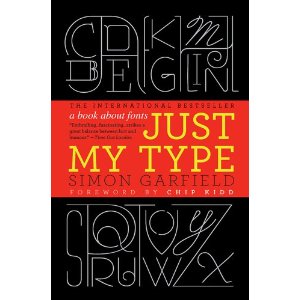
This book is sure to be on this Christmas’ wish lift for every graphic designer you know, but I would argue his real achievement is to take a niche subject and make it thoroughly engaging for the lay reader. Everyone is confronted with a variety of fonts every day, they are literally unavoidable. So I’d make the case that this book can be rewarding to every reader, not just those with a professional stake in the game. Because the story of typefaces is, at its root, also the story of people and communication.
26 letters plus a variety of numbers and symbols (ligatures, accents, fractions and dingbats) yield an almost infinite variety of styles, past, present and future – new typefaces are being designed and released every day. And all more accessible than ever before to the average computer user – even if all you ever type is a business letter – from the drop down menu in your word processor of choice. We can thank Steve Jobs and his college course in calligraphy for the early emphasis on good fonts in the personal computer market.
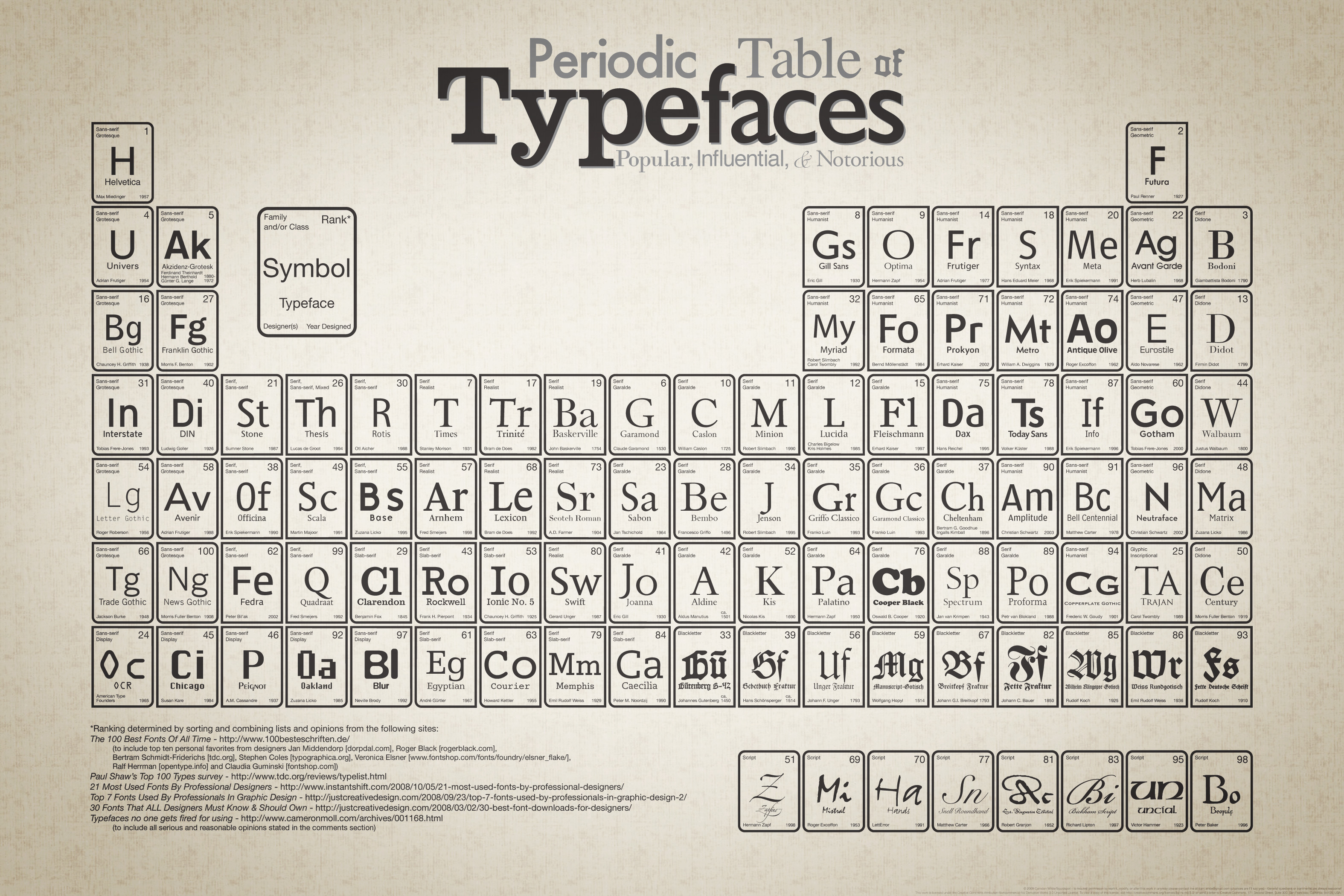
Garfield uses short chapters and abundant illustrations of his subject matter that include both biographic and historic detail that I found fascinating. I learned perhaps more than I ever wanted to know about the personal life of the creator of one of my all time favorite typefaces: who would’ve thought that a book on fonts could include topics like incest and bestiality? (It’s ranked number 8 on the chart below).
The take-away? Just My Type is my favorite book so far this year in any category and carries my highest recommendation. Buy it, read it, give a copy to every graphic designer you know.
Here’s a wonderful chart that’s used as the end papers of Garfield’s book, the Periodic Table of Typefaces – Popular, Influential & Notorious.
Click on image for larger size. Note: Full image is 3150 wide by 2100 pixels high.
CameraSim: Free Web App Demystifys SLR Photography
September 10, 2011
Jonathan Arnold, founder of Tuitive, a user interface design company has created a free browser-based teaching tool called CameraSim that is both simple and brilliant. The goal is to “demystify SLR photography” by showing you what happens when you change various settings on your camera, specifically lighting, distance, focal length, ISO, aperture and shutter speed. A sample image of a young blonde child at a playground with a plastic spinning toy is your photographic target. You change the settings and click the Snap Photo! button to see the result of your modifications.
This is practical teaching enabled through the web that makes it simple and free to experiment to your heart’s content and learn what works best visually. This is, as I wrote earlier, simple and brilliant. It makes me wonder what other sort of educational experiences could be taught this way?
Thank you, Jonathan Arnold for creating this and making it available to everyone with a desire to better their photography.
Click on image for larger size.

Can Dogs Grieve for Lost Owners?
September 3, 2011
 Leao, a dog in Brazil, sits vigil at her owner’s gravesite
after the fatal landslides in January 2011.
There’s some controversy among those who seriously study dogs over the phenomenon of grieving dogs. Certainly there are stories from the past like the famous Greyfriars Bobbythat recent research shows to be almost certainly a Victorian-era publicity stunt crafted to increase the tourist trade in Edinburgh.
But this article in The Week, The Phenomenon of Grieving Dogs – the Ultimate Loyalty gives moving examples of dogs displaying “courageous acts of loyalty.” One commentator on the YouTube video of the two dogs in the aftermath of the Japanese earthquake in March 2011 said what most dog owners earnestly believe: “That dog is a better person than most humans.”
My own view is similar to Mark Twain’s (although I don’t think there’s any reason to believe in an afterlife): “Heaven goes by favor. If it went by merit, you would stay out and your dog would go in.”
Steven Pinker: Language as a Window into Human Nature
August 24, 2011
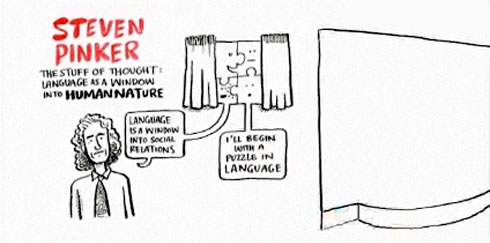
In this animation, Steven Pinker, experimental psychologist, cognitive scientist, linguist and author of The Blank Slate: The Modern Denial of Human Nature, How the Mind Works, The Stuff of Thought: Language as a Window into Human Nature and more, shows us how the mind turns the finite building blocks of language into infinite combinations.
If this short intrigues you, I highly recommend the three books listed above. Fascinating, thought provoking material, exceptionally well-presented for the lay reader. Along with Richard Dawkins and Christopher Hitchens, Mr. Pinker is one of my dream lunch dates. . .
There are No ‘Colors’ There is Only Light
August 24, 2011
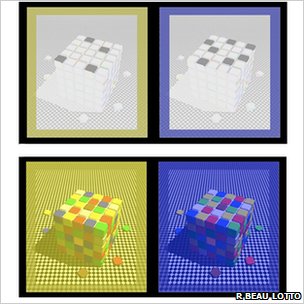
The grey tiles on the left look blue and the grey tiles on the right look yellow. But they are grey in each image.
Beau Lotto is appearing on the BBC’s Horizon show with a program called Do You See What I See? about color perception where he explains that color (or colour) is not in the objects we perceive, but rather manufactured in our brains. The conclusion he draws from this is, I think, wonderful.
So we all see the world differently. Indeed, we have no choice about this because our experiences of the world are necessarily different. None of us sees the world as it is. In this sense we are all delusional, what each of us sees is a meaning derived from our shared and individual histories. This awareness, possibly more than anything else, provides an irrefutable argument for celebrating diversity, rather than fear in conformity. Which is liberating, since knowing this gives you the freedom (and responsibility) to take ownership of your future perceptions of yourself and others.
PETNet Will Track Contaminated Dog Food
August 24, 2011
The Week, a print and online news aggregator that I especially like, has a great article on PETNet, a new system set in place to share information about pet food contamination, a response to the 2007 pet food recall.
PETNet has more than 200 members — federal, state, and territorial government officials from all 50 states, Puerto Rico, and Washington, D.C. They are charged with monitoring pet food safety and animal health, and, if they discover potential contamination or product defects within their jurisdictions, they can post information to the network, immediately alerting other members to potential problems. That sort of speedy, easy communication could prevent future pet food contamination problems from becoming out-of-control epidemics.
For the complete article, go here.
Escher’s Gravity Defying Waterfall: Illusion or Source of Unlimited Energy?
August 24, 2011
When I was in college it was a requirement that you smoked dope, leafed through a book of the amazing print work of Dutch graphic artist Maurits Cornelis Escher and said, “Oh, wow, man.” I don’t know if that remains on the curricula today.
If you are not already familiar with his work, you’ve got an incredible treat ahead of you. His work is a fascinating and unique combination of mathematical ideas, illusions and art.
The video above is an attempt at recreating, in the real world, one of Escher’s most popular images, the endless waterfall. Remember, this is an illusion. Can you figure out exactly how it was done?
Here are two clues: forced perspective, painted shadows. Oh, and a video editing program. See the YouTube channel for creator M.C. Wolles for the full explanation. Well done, Mr. Wolles!