Republican War on Science – Chris Mooney
August 24, 2011
I thought Chris Mooney’s book The Republican War on Science was required reading for anyone who supports a reality-based* approach to the topic of government and science. This is not to say that there aren’t Democrats with equally specious views on scientific issues, but the Republican Party seems to take an anti-scientific view point as, well, as an article of faith.
Here’s an update from Chris on the current presidential race and science.
The future health of the American economy will require a scientifically literate and technologically savvy work force. Just as there needs to be a clear separation of Church and State, there needs to a clear separation of Church and Education in our nation’s school.
You can argue that the Bible can teach you morality and ethics. I’d disagree due to all the rape, slaughter, incest and torture that are such a large part of the Old Testament, but that’s just my opinion. However, it’s certain you can’t learn atomic theory, fundamental biology, neuroscience, or how to create an effective nationwide wireless cell phone network from the Bible. That’s what should happen in publicly funded schools.
Because, believe me, if American students aren’t learning it, there’s a generation of Indian and Chinese students who are.
_____________________________________________________________________
* In an October 17, 2004, The New York Times Magazine article by writer Ron Suskind, Karl Rove, the presidential aide quoted below, explained his view of the Republican take on ‘reality.’
The aide said that guys like me were “in what we call the reality-based community,” which he defined as people who “believe that solutions emerge from your judicious study of discernible reality.” … “That’s not the way the world really works anymore,” he continued. “We’re an empire now, and when we act, we create our own reality. And while you’re studying that reality—judiciously, as you will—we’ll act again, creating other new realities, which you can study too, and that’s how things will sort out. We’re history’s actors…and you, all of you, will be left to just study what we do.”
Web Design Round-Up: Muse from Adobe, HTML 5, Trends & Ideas
August 24, 2011
Adobe has released a free a beta of Muse, a new web authoring software that allows you to produce a high quality web site without writing code. In their promotion for Muse Adobe mentions that you can “focus on design rather than technology. . .as flexibly and powerfully as you do in Adobe InDesign.” So maybe this is neing pitched to print designers (and perhaps the average joe) who don’t want to get under the hood with HTML and CSS? People who want to learn more about web design sometimes decide to pursue online masters degree programs.
Certainly there’s a market for this, as an option for those who don’t need the power and flexibility of Dreamweaver, along with its steep learning curve.
I’ve always been amazed at how much of the functionality of the full Photoshop package that Adobe puts into Photoshop Elements. That’s one of the best bargains around for the non-print professional who wants to makes their personal photos look great. If the same ratio exists re: Dreamweaver to Muse, this could be a great niche product.
______________________________________________________________________

Wesley Fenion wrote a great piece on the Best and Worst Trends in Modern Web Design for the Tested site. I’d label it Highly Recommended Reading. Tested wants to be the site “for clever people who want to buy smarter, tweak better, hack harder and watch us destroy stuff.” Who can resist a Mission Statement like that?
______________________________________________________________________
Smashing Hub has a great piece on 10 Excellent HTML5 overlooked coding tools for creating games, forms, using the Canvas feature, determining browser compatibility and more. If you do web design on any level, you should check these out.
Cancer Sniffing Dogs – New Research
August 24, 2011

It’s been known for some time that dog’s amazingly sophisticated sense of smell can detect established cases of various cancers including melanomas, ovarian, colon, breast and lung cancers. Now Discover magazine has published research that shows that a dog can be trained to alert to the smell of lung cancer on your breath even if you’ve just had lunch or smoked a cigarette! Go here to read the entire article.
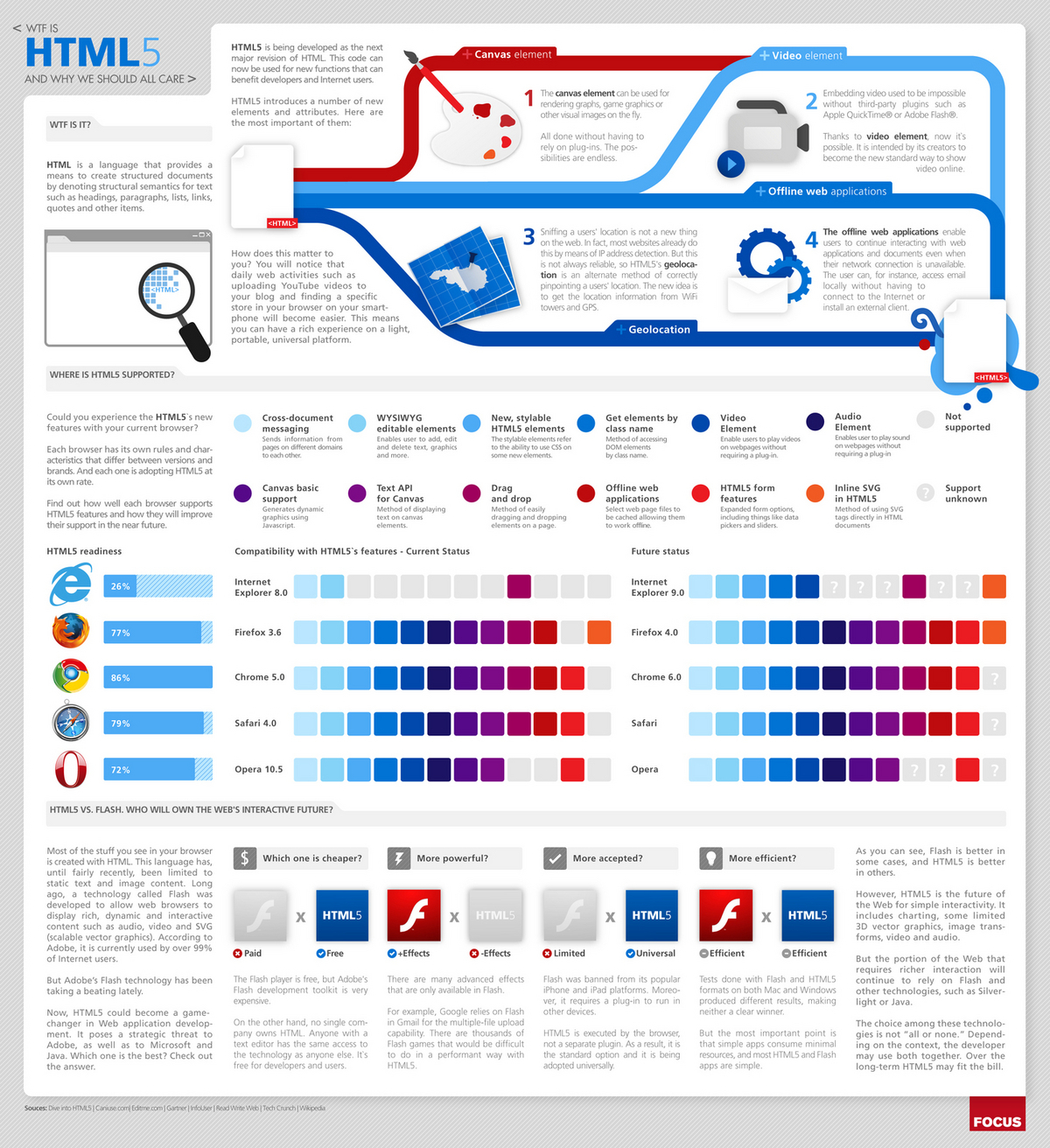
HTML5 vs Flash infographic
August 6, 2011
There’s a battle for animation in your browser that will begin seriously heating up over the next year. Will the video capabilities of HTML5 mean the end of Adobe’s Flash? How badly has Apple’s ban on Flash on mobile devices hurt the program? More than the poor implementations of Flash by web designers who value looks over content?
What about Adobe’s new Edge program; will it cannabilize Flash from within their San Jose headquarters?
My biggest complaint about Flash is that it slows down my access to the content I want to get at in web sites; restaurant sites are one of the worst offenders as a class in this regard. These animations also discourage repeat visits. It’s a very rare Flash animation on the web that bears repeat viewing, in my view.
Here’s an interesting infographic about Flash versus HTML5 (below). It will certainly answer some of the questions you have about the upcoming transition.
Click on image for larger size.
The Orwell vs. Huxley Debate Revisited
July 27, 2011
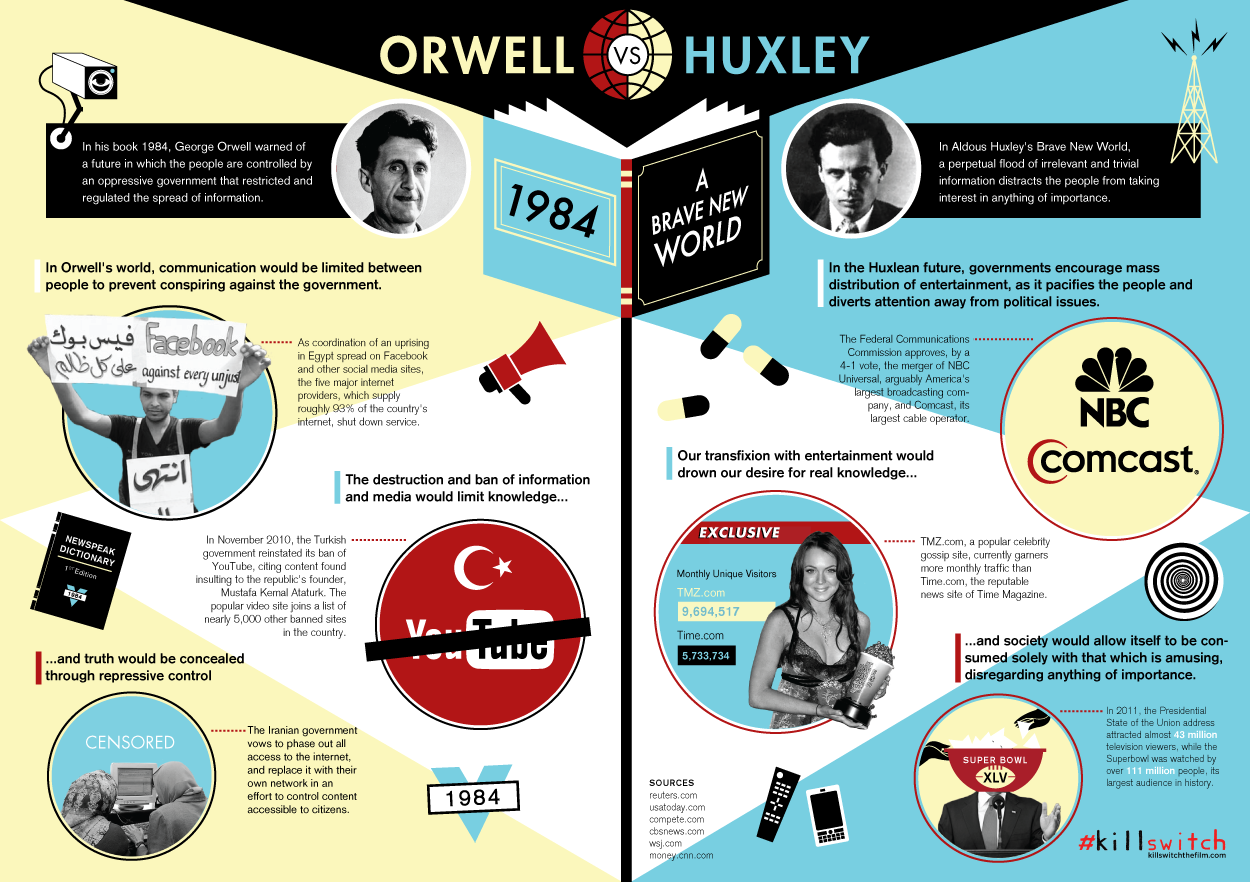
I tend to fall on the side of Huxley as I believe the modern world most resembles his dystopian future rather than Orwell’s. Author Neil Postman made this case in his excellent Amusing Ourselves to Death and you can find a link to a cartoon version of his argument here, from an earlier post on this site. Promoters of the documentary film Kill Switch, about government control of the Internet, revisit this debate with the following infographic.
Click on image for larger size.
Why Are Americans Fat?
July 27, 2011
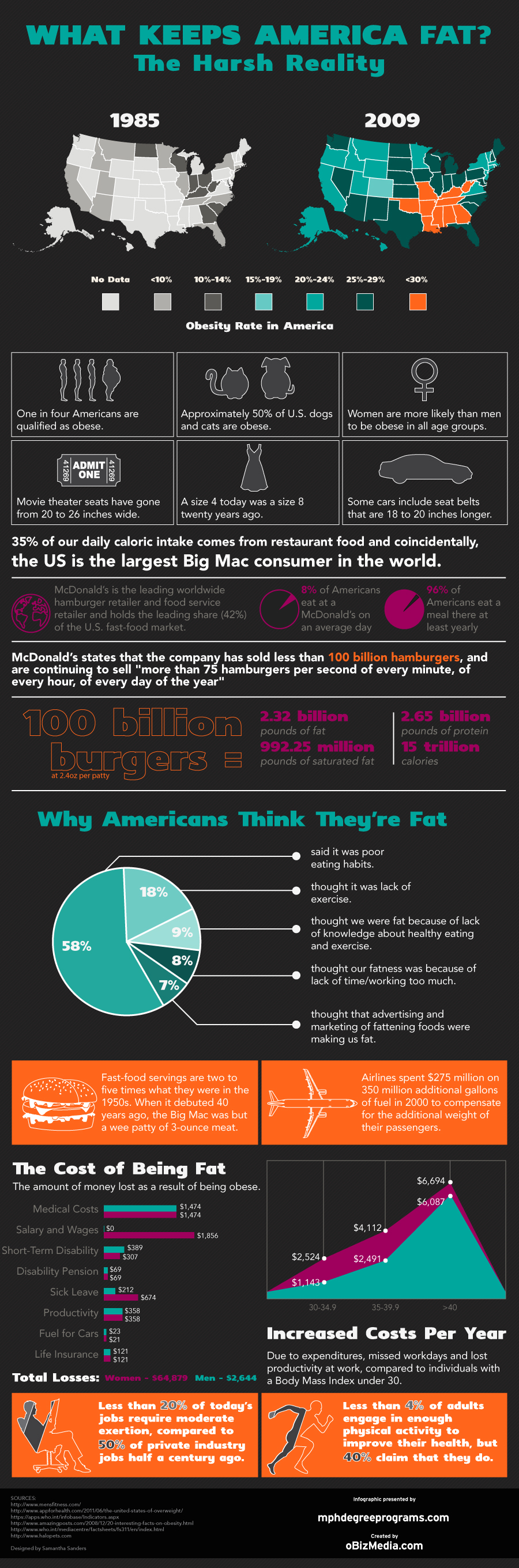
MPH Degree Programs.com, a guide to online programs for Masters in Public Health education offers the following infographic on What Keeps America Fat. It contains what I found to be some eye-opening statistics and (forgive me) food for thought.
Click on image for larger size.
PETA: By The Numbers
July 27, 2011
PETA (People for the Ethical Treatment of Animals) has a more extreme agenda than most casual observers probably realize. Their goal is for no human use of animals of any kind: not for food, not for clothing (leather and wool), not for medical testing or studies, not for entertainment (zoos, circuses, Sea World, etc.), not even as pets.
You have to admire the consistency of their world view, even if you disagree with them. The relationship between man and animal on this planet is largely the story of slaughter and exploitation. They’re certainly correct about that. But coming from a culture of omnivores in a country founded on the extinction of a native people, I wonder if PETA’s approach is viable. We don’t have the best track record for treating human beings, let alone animals and pets.
How many of their 2 million members would give up their own pets for the cause? How many would convert to veganism? Would it even be possible to end all animal farming and still feed the growing global population? Does owning a Labrador and enjoying a steak make one a hypocrite?
The following infographic makes the case against PETA. The controversy will continue, without doubt.
Click on image for larger size.

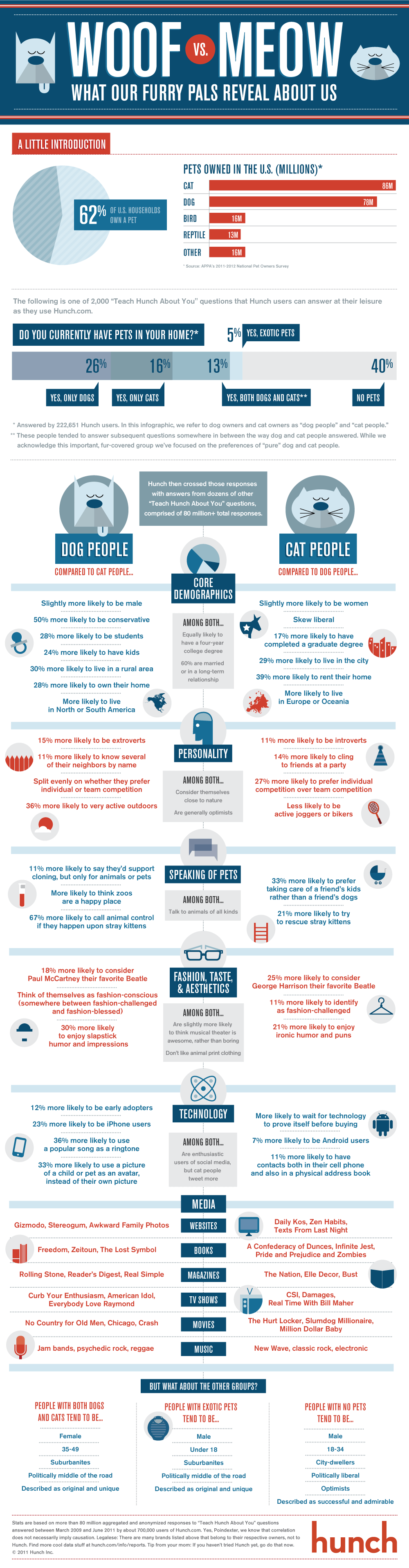
Dogs vs. Cats by the Numbers: What they Reveal About Us
July 27, 2011
Hunch.com is a site that “provides personalized recommendations from people you follow and makes customized predictions based on your interests” according to their home page.
I’m not certain I understand this mash-up of social, information and commerce but the following infographic is said to be based on over 80 million aggregated and anonymized responses to Hunch questions from 700,000 of its users. So that is a lot of data points, anyway. Just don’t take it too seriously.
Click on image for larger size.
Where Does Your Data Live?
July 27, 2011
The folks at Mozy, who offer online, off site “cloud” based storage for the data that lives as ones and zeros on your hard drives, MP3 players, SSDs, external drives and network back-ups have created an infographic that shows where your information is stored geographically (along with other interesting statistics). Fascinating stuff, I think.
Click on the image for larger size.

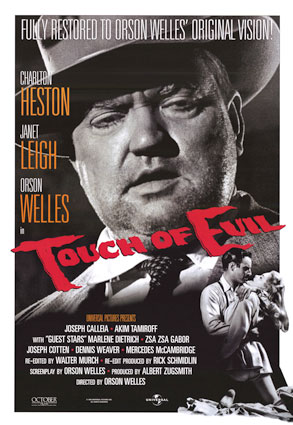
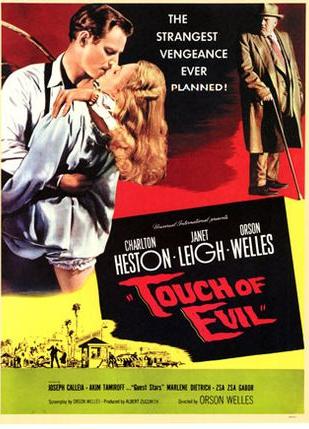
“Touch of Evil” – Opening Crane Shot
July 21, 2011
If you’ve never seen this late noir classic directed by Orson Welles, you’ve got a real treat in store. This post was inspired by a site that recently claimed to compile the 100 best scenes in American cinema.
Of course, anything like that is wildly subjective and open to serious debate. Let’s just say that my own list does not include Tom Cruise shouting, “Show me the money” or Sharon Stone’s crotch shot from Basic Instinct.
But one sequence on this list that would be not only in my personal top 100, but my personal top 5, too, is the opening of Touch of Evil. It’s brilliant technique and great visual storytelling. It’s the kind of thing that can only be done in film. And it’s one of the reasons true film geeks will always revere Welles.
Touch of Evil was edited without Welles’ consent priot to it’s original 1958 theatrical release. He wrote Universal a 58 page memo to correct these unwanted changes. In 1998 a ‘restored’ version was released that attempted to follow Welles’ memo. The opening sequence (above) had the film’s title’s removed and the original soundtrack restored, integral to being able to follow the movement of the car with the bomb.