
Rin Tin Tin: Cinema’s Second Great Dog Star
October 5, 2008
The life of Rin Tin Tin would be completely unbelievable if you saw it in a film, and is worth telling here again. It’s also the perfect example of Mark Twain’s famous line from Pudd’nhead Wilson’s Calendar: “If you pick up a starving dog and make him prosperous, he will not bite you. This is the principal difference between a dog and a man.” No other dog in history ever went from a more frightful beginning to such a prosperous end.
Not only is Rinty’s story fact, but this incredible German Shepard was rescued from a battlefield, discovered by Darrell Zanuck, became a star after his first film, saved a fledgling film studio on Hollywood’s ‘poverty row’ from bankruptcy and died in the arms of Jean Harlow. His name is a registered trademark. At his peak, the studio reported he received 10,000 letters a week from fans. Even given a publicist’s natural tendency for hyperbole and exaggeration, it is certainly true that Rin Tin Tin was one of Hollywood’s top stars and top earners (at $1,000 a week) during his career.
It begins on September 15, 1918 when American Corporal Lee Duncan investigated a bombed-out war dog kennel in Lorraine, France. A German Shepard mother and her five puppies were the only survivors of the assault. While the rest of the battalion took the mother and three of the 10-day old pups, Duncan chose one male and one female. He gave them names based on the tiny puppets given by French children as symbols of good luck to American soldiers, Nannette and Rin Tin Tin. Soon after the mother, Betty, and the other pups perished. One can imagine the difficulty of maintaining a new litter amidst the carnage of the battlefronts of World War One.
After the war, Duncan went back to work at a California hardware store. Nannette had died of distemper in New York after her journey by sea from France so only Rin Tin Tin was left from the original litter. Impressed by the breeds’ ability to learn Duncan worked with Rin Tin Tin in his spare time, training him and taking him to local dog shows.
It was at one particular show in 1922 that a film entrepreneur named Darrell Zanuck, who would go onto found 20th Century Fox, saw Rinty make an amazing 13 1/2 foot jump. He gave Duncan $350 to film his German Shepard in action for the sake of testing a new camera. At this point in the story Zanuck exits the scene but the concept that Rinty could become a canine action star was now firmly planted in Duncan’s mind. He wrote a script called Where the North Begins and began making the rounds of Hollywood’s studios. Everyone who saw the dog or looked at the script turned him down.
It was when Duncan came across a film crew working for a struggling low budget outfit called Warner Brothers, trying unsuccessfully to shoot a sequence with a wolf that he, and Rinty finally got their break. He walked up and told the frustrated moviemakers that he had a dog that could do the scene in a single take. Of course, he was told, less than politely, to mind his own business. Still, Duncan would not give up and, since they were having no luck with the recalcitrant wolf, one crewmember thought it would be easier to try a take than to keep arguing with Duncan.
And, just as a hackneyed screenwriter might type it between eye openers of Kentucky’s finest distilled spirits and a blue cloud of Lucky Strike’s tobacco, a Star was Born. Rinty performed the scene flawlessly; Duncan and his wonder dog were kept on for the filming of the otherwise forgettable Western by director Irving Cummings Man from Hell’s River. To everyone’s amazement the modest film was a hit with the public and those who saw him on the screen fell in love with the noble, heroic dog that had been scooped out of war torn France four years earlier. Third-billed Wallace Beery played the heavy as Gaspard, the Wolf, while Rin Tin Tin played ‘himself.’
He would go on playing himself in a total of 26 pictures for Warner Brothers. Rinty went on radio in 1930 as ‘The Wonder Dog’ providing his own dialogue. Though there were a dozen stand-ins and stunt doubles available, Rinty, like Jackie Chan in his prime, did almost all his own stunts. He was capable of remaining motionless for up to 30 minutes at a time in order to complete his scenes during camera and lighting changes. His last picture was completed when Rinty was 13, the equivalent of 94 in human years. Rinty died on August 10, 1932 his head cradled in the arms of the screen’s original ‘blonde bombshell’ Jean Harlow (who, sadly, would only outlive him by five years). She had been visiting Lee Duncan and Rinty in the yard of his Beverly Hills home.
Rinty’s descendents and Lee Duncan would go on to help train over 5,000 dogs and handlers during WWII and provide one of the most sought after blood lines in the breed and star again, in films like 1947’s The Return of Rin Tin Tin with Robert Blake (as Paul, the Refugee Lad), The Challenge of Rin Tin Tin (1957), and ABC-TV’s in The Adventures of Rin Tin Tin 1954-1959. Lee Duncan died on September 20, 1960 while the lineage, both blood line and cultural, that this 10 ten-day old rescued war dog began lives on.
We look forward to one of our favorite writers, Susan Orlean’s upcoming book on Rin Tin Tin, to be released in 2009 by Little, Brown.
The First Great Cinema Dog Star: Strongheart
October 5, 2008
The first great cinema dog star was Strongheart (1917-1929) a German Shepherd Dog who was originally trained in German as a police dog. Laurence Trimble and his wife Jane Murfin, filmmakers who originally worked with Jean, the Vitagraph Dog, brought Strongheart to the United States where he made several highly successful movies, including an adaptation of Jack London’s White Fang in 1925.
Most of Strongheart’s films are believed to have been lost, though his lineage continues to the present day. The Return of Boston Blackie is one film known to have survived. During the course of filming a scene in 1929 Strongheart was burned when he fell against a studio light. This burn led to a tumor that eventually killed him. He was also the subject of a 1939 book by Robert H. Sommer, Letters to Strongheart. He has a star on the Hollywood Walk of Fame and a line of dog food still produced today by Simmons Pet Food, Inc. is named after him, Strongheart Dog Food.
The Dog Days of Summer
October 5, 2008
“When Sirius parches the head and knees and the body is dried up by reason of the heat, then sit in the shade and drink.” The Greek poet Hesiod wrote these lines 3,000 years ago referring to that stretch of summer that came to be known as the ‘Dog Days.’ Sirius is the brightest star in the constellation Canis Major (the Big Dog) and its name comes from the Greek word for “scorching.”
Sirius is more than three times the size of our sun and is the brightest star in the night sky, even at 9 light years distance. The Dog Star is so bright that the ancient Romans believed that the Earth was heated by it at night.
In the summer months Sirius rises and sets with the sun. During late July Sirius is in conjunction with the sun and they believed that the combined heat of the Sun and the Dog Star created this stretch of uncomfortably hot weather. The Romans named this period, from 20 days before conjunction to 20 days after, the Dog Days.
Of course, today we understand that the heat of the mid-summer season is a result of the Earth’s tilt towards the sun, not from the added ‘heat’ of the Dog Star. Due to the ‘precession of the equinoxes,’ the positions of the constellations have drifted over time; the stars are not in the same place as they were in the night sky in ancient Rome. Today the Dog Days are specifically July 3 through August 11. But this sense has been loosened in popular usage to refer to any stretch of hot, humid weather in the summer.
“We were told they were nothing but dogs.”
October 2, 2008
“We were told to rough up Iraqi’s who wouldn’t cooperate. We were also told they were nothing but dogs. Then all of a sudden you start looking at these people as less than human.”
— Sgt. Ken Davis
372nd MP Company
Abu Ghraib
“Taxi to the Darkside”
Winner 2008 Oscar
Best Documentary
Animals Communicating After Death: The Evidence?
September 25, 2008
BOOK REVIEW: Dog Body, Dog Mind: Exploring Canine Consciousness and Total Well Being by Dr. Michael W. Fox
Dr. Michael Fox has a nationally syndicated column, “Animal Doctor” and is the author of at least 15 books about dogs, cats, pet foods, bioethics, ethology, genetically modified foods, therapeutic touch and massage for animals, among other topics. His bio says that he’s authored over 40 books in total.
His most recent book on dogs is Dog Body, Dog Mind: Exploring Canine Consciousness and Total Well Being (2007). He’s educated, experienced, obviously cares deeply about all animals. There’s a lot of good material in Dog Body, Dog Mind. For solid information on correcting behavioral problems, the existence of emotions and consciousness in dogs, diet and health care this is an excellent reference. I especially liked the final chapter, Chapter 22: In Praise of Mutts, which should be required reading for all members of the purebred dog fancy.
Unfortunately, it is also packed with pseudoscientific claptrap.
It boggles the mind to consider how a deeply intelligent vet can write and, apparently believe, some of the silliness in this book.
In this regard, his book is much more dangerous than some of the outright nonsense written by pet psychics and others on the lunatic fringe of pet care and advice. Those can be dismissed entirely. But Dr. Fox’s work requires more careful dissection.
Let’s take a look at a few chapters from the middle of his book to show precisely what I mean.
Chapter 8: “Psychic” Animals and their Super-Senses
First, and most importantly, I must remind Dr. Fox that the plural of anecdotes is not data. His most outlandish statements are backed by stories he has received from his large audience of readers. There is no attempt by Dr. Fox to make any independent verification of the information he receives (at least none that he sees fit to mention in his book).
If you write to Dr. Fox, your truthfulness and accuracy are never questioned. He accepts your story uncritically even when you make extraordinary claims. And we all know that extraordinary claims require extraordinary proof, don’t we? There are no footnotes or sources listed, just an index. We have to take it on faith that Dr. Fox is accurately reporting what he’s been told and that his correspondents are correct in their interpretation of their experience.
You’ll find this device used over and over again in the chapters under consideration. Example: a woman from Florida writes him about her 55 year old father whom she says had no known major health problems. Her father’s dog displays a new habit of placing a paw on his chest, looking at him “straight in the eyes.” It’s not made clear how long this behavior went on, but sometime later the woman’s father dies in his sleep in the middle of the night. The cause of death is stated as “chronic lung disease.” She concludes that her dad’s dog knew what was wrong with him, while no one else did.
Dr. Fox declares this an instance of the dog’s “prescience.”
For anyone versed in logical fallacies this is clearly a case of retrofitting the conclusion to make surprising what is, after all, a common sort of behavior for a dog. One of my dogs has recently started resting his head on one of my feet. Should I rush to a podiatrist to confirm my Labrador’s obvious diagnosis of impeding bunion trouble?
First, let’s look at this story logically. Do you believe her account that a middle-aged man died of chronic lung disease and showed no symptoms whatsoever prior to his death? I’d say that’s highly unlikely. If he even had shortness of breath, this alone might have drawn his dog closer to him, sensing his distress. Let’s also note that “chronic lung disease” is a vague, catch-all phrase, not a medical diagnosis. Just what exactly did this man die of?
And how does she know that the paw on the chest proves that the dog “knew” of his master’s lung disease? Maybe the dog was actually diagnosing pending heart failure and got the whole thing wrong. Stupid dog.
Here’s another example of retrofitting (or creative interpretation) from earlier in Dr. Fox’s book. He tells the story of two animals who “brought themselves to us for treatment” at the Animal Refuge in South India that he operated for many years in India with wife. They were a dog with a broken back and pelvis and a water buffalo dying from a severe screw worm infestation. “Neither of these animals had ever been near our refuge before, yet somehow they knew it was a place where animals were cared for and healed” (my emphasis). This is a case of counting the hits and ignoring the misses.
Isn’t the explanation much more likely that instead of somehow knowing about this place of healing, these sick and injured animals just happened to wander in their pain and disorientation near the South India Animal Refuge? Ignored in this example are all the other sick animals who wandered around and died of their illnesses or injuries and never got anywhere near any sort of refuge.
Next Dr. Fox relates a few anecdotes about pets separated from their families who find them in places the pets have never been before. He tells of a “documented case” of a cow and a calf sold at auction in England, sent to separate farms. The cow is found the following morning at the farm where her calf is, many miles away. It may be documented, but Dr. Fox fails to provide any way for his readers to check up on that documentation.
Dr. Fox calls this phenomenon “psychic trailing” and cites the work of parapsychologist J. B. Rhine of Duke University. Dr. Fox should’ve done a little research to find out how thoroughly discredited Rhine’s research is before using him as an authority.
But wait, in the next section of this chapter Dr. Fox goes completely off the rails. You’ve got to read this in his own words to see how nonsensical his ideas are:
Simply put, we are all connected psychophysically with the sun, moon, Earth, the stars and with each other through the realms of the senses and the emotions. It is the emotional connection with his owner or family that forms a point in the space-time continuum, that enables the animal to re-orient from his home-base and find his family. I propose that the animal’s internal sun-time clock and geomagnetic compass are used, like a directional feeling-sensitive antenna, once the animal has aligned himself towards the emotional field of its owner/family. This field, which I call the empathosphere, makes the space-time continuum a unified field.
Next he claims that Albert Einstein theorized the existence of this new concept, the empathosphere, but failed to express it mathematically. Stupid Einstein. I’d like to ask Dr. Fox for the precise reference in Einstein’s work that supports this claim. He goes on to state that this existence of this field “in which all things are interconnected and interdependent” has been demonstrated by the “modern sciences of ecology and quantum mechanics.” I must not have gotten that memo.
Now I will admit that my understanding of quantum mechanics is very limited. But I propose that Dr. Fox has no understanding whatsoever of this very complex theory for him to cite it as proving the existence of this “empathosphere” idea of his. Quantum mechanics deals with the strange behavior of sub-atomic particles and does not scale to the realm of ordinary human-sized interactions. QM is falsely cited by many practitioners of New Age and CAM (complimentary and alternative medicine) as offering support for their bogus theories.
Excuse me, I’ve got to brush all these protons off my keyboard before I can continue typing.
Dr. Fox states that we who live in Western industrialized societies have lost touch with these “supra-sensory” powers. He claims these powers were demonstrated by the aboriginal peoples of pre-colonial Australia and used for healing and “living in harmony for health’s sake.” Aside from the vagueness of this last statement, he offers no support for these “supra-sensory” powers. Citations, Dr. Fox?
Chapter 9: Entering the Deep Heart’s Core: The Empathosphere
“When it comes to evaluating animal prescience and remote sensing—what is commonly regarded as psychic communication or clairvoyance—an open mind is called for. Let the facts speak for themselves. . .”
I agree absolutely with Dr. Fox on this point. He is quite right. Unfortunately, the chapter that follows these introductory lines contains not a single fact, just “my own observations and the anecdotal data of others.”
Again, not to nitpick but let’s be clear that anecdotes are just that, and not data. In science there is no such animal as “anecdotal data.” There are thirteen unverified accounts sent to him by readers. Some of them are wonderful, deeply emotional stories, but they are not the facts that should be speaking for themselves.
Still Dr. Fox believes that these stories lay “the groundwork for launching into the next chapter, which explores the profound realm of animals’ ‘extraterrestrial’ or afterlife communication and manifestation from beyond the grave. . .” Cue the spooky organ music.
Chapter 10: Animals Communicating After Death: The Evidence
Now just suppose that dead animals could communicate and even manifest themselves physically (or, according to Theosophists, as an etheric double or astral body) to their human companions still living on the plane but grieving their departure terribly: What if this communication and manifestation could be verified? Would this not upset the apple cart of the nihilists, rational materialists, and those who think only humans have immortal soles and are special? The impact would be as profound as would the arrival of intelligent life-forms visiting us from outer space.
You’re darn right it would, Dr. Fox. I’d also think you’d be a strong candidate for a Nobel Prize or a MacArthur “Genius” grant (or at least a slimed copy of the Ghostbusters DVD). Ah, but here’s that old caveat: “. . .the following letters provide irrefutable proof” (my emphasis).
If you really had irrefutable proof, Dr. Fox, instead of 17 letters from grieving pet owners telling of various manifestations* your book would have been the publishing event of 2007, you’d be besieged with interview requests from the major media and a host of scientists and skeptics would be clamoring to review your evidence for themselves.
Dr. Fox, you could’ve been on Oprah!
And talk about burying the lead! You’ve got “irrefutable proof” of the existence of consciousness and personality after death (even just for canines) and you put it in Chapter 10 of a 22 chapter book? I have to conclude that Dr. Fox is either not serious about this momentous claim or he understands perfectly well that what he presents does not rise anywhere near the level of “irrefutable proof.”
Back in the prehistory of the 1970s there was a magazine published by pornographer Bob Guccione called OMNI which mingled science fact with science fiction. I had a friend who hated this combination on the grounds that the presence of the fiction polluted the facts. As many hard science fans are also into sci-fi I thought his position was a little extreme. At least the fiction was labeled as such. But in Dog Body, Dog Mind there are no disclaimers and outright nonsense is mixed right in with solid scientific information. By doing so, Dr. Fox does a great disservice to his readers, many of whom will unquestioningly swallow this mixture whole.
*And one photo of a dog with a semi-transparent patch of white above it that Fox concludes is a manifestation of “a fine, amorphous energy field of light, that could be one of the ways by which deceased animals may communicate to the living.” Obviously, Dr. Fox has never read any of Joe Nickell’s excellent work on photographic frauds and misinterpretations.
NOTE: A copy of this review has been emailed to Dr. Fox for his response. If he replies, I will append his comments to the review.
9/26/08: Dr. Fox has responded. Here is what he wrote (in total) “Joseph—you need a good dog. michael.”
I’d like to point out that this is, in effect, an ad hominem attack. He does not address even a single point I raised and assumes that my problem is, I don’t have a “good dog.”
It is the equivalent of telling a feminist you disagree with that what she needs is “a good. . .uh, man.”
Dr. Fox, I have two wonderful Labradors and have also been involved in breed rescue groups and at my local shelter. My wife and I are responsible for saving the lives of 40 dogs over the past 5 years, fostering 23 of them in our home. This is, obviously, just a drop in the bucket given the pet over population problem in America today but, hey, we all do what we can.
It is not my lack of “a good dog” that is at issue here. It is the quality (and the truthfulness) of his thinking and beliefs that I have a problem with.
Dogs are amazing creatures and worthy of our respect and admiration without tarting them up with silly metaphysics, psychic abilities and ‘beyond the grave’ manifestations.
The $10,000 Dog – www.SearchDogsUSA.org
September 13, 2008
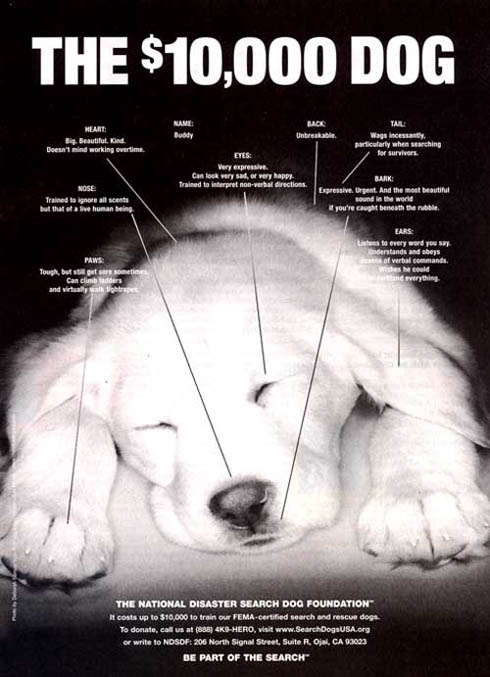
The $10,000 Dog
Name: Buddy
Heart: Big. Beautiful. Kind. Doesn’t mind working overtime.
Nose: Trained to ignore all scents but that of a live human being.
Eyes: Very expressive. Can look very sad, or very happy. Trained to interpret non-verbal directions.
Back: Unbreakable.
Tail: Wags incessantly, particularly when searching for survivors.
Bark: Expressive. Urgent. And the most beautiful sound in the world if you’re caught beneath the rubble
Ears: Lisitens to every word you say. Understands and obeys dozens of verbal commands. Wishes he could understand everything.
Paws: Tough, but still get sore sometimes. Can climb ladders and virtually walk tightropes.
It costs up to $10,000 to train our FEMA-certified search and rescue dogs.
The National Disaster Search Dog Foundation
www.SearchDogsUSA.org
A great ad for a worthy cause, IMO. If you’ re swimming in dough, splash a drop or two their way.
How to Communicate with a Dog
July 9, 2008
Dog Trainer Diane Canafax says many people intimidate dogs without even knowing it.
- The mistakes made are natural to the way people communicate face-to-face; however, canines, which are ventrally oriented, communicate with body language.
- For example, when people meet they look each other in the eye and shake hands or embrace. People take this same approach to meeting dogs, often leaning over to pet them, trying to show affection.
- “When you watch dogs, they approach each other from the side or back,” she said. “Direct eye contact is a challenge to them. When a dog leans forward they are insinuating an attack.”
The best way to approach a dog is to turn to the side with a hand outstretched and let the dog approach you, she said.
Physical differences also play into how dogs communicate.
- Canines, which are more than four times as sensitive to sound than people are, can hear 80 feet away. People on average can only hear at a 20-foot radius, she said.
- Canafax said when a dog doesn’t respond right away it could be tuning in to something outside of peoples’ hearing range.
- Because of this yelling at a dog can lead to fear, while a whisper or high pitched “baby-talk” can insight a playful will-do attitude.
Sometimes Canafax will even put her forearms on the ground, copying her dogs “play bow” to get him to come.
“I use it as recall and communicate on their level,” she said. “It works beautifully.”
Dorothy Parker’s Dogs
June 14, 2008

Dorothy Parker in April 1953 with Misty,
photographed by Roy Schatt at his Murray Hill studio, NYC.
(from the book, A Journey into Dorothy Parker’s New York by Kevin C. Fitzpatrick)
I love Dorothy Parker. I once had a hard drive named for her (Dot). A friend’s wife dismissed her by complaining that there was too little Parker to read.
I countered and said there’s just enough Dorothy Parker to suit me. Putting down Mrs. Parker because her output has not deforested the nation like Stephen King’s made me suspect every judgment made by my friend’s wife. (They divorced).
Here is a partial list of dogs owned by Dorothy Parker:
- Amy—mutt
- Bunk—Boston terrier
- C’est Tout—poodle
- Cliché—poodle
- Cora—Bedlington terrier
- Daisy—Scottish terrier
- Flic—Boxer
- Fraulein—dachshund
- Jack—dalmation
- Limey—poodle
- Misty—poodle
- Nogi—Boston terrier
- Poupée—poodle
- Rags—Boston terrier
- Robinson—dachshund
- Scrambles—mutt
- Timothy—Dandie Dinmont terrier
- Troy, aka Troisiéme—poodle
- Wolf—Bedlington terrier
- Woodrow Wilson—Boston terrier
Financial Pinch Affects Pet Care for Many
June 9, 2008
Here are some options to pursue if a coping with a medical condition affecting your dog is beyond your budget in today’s tight economy.
Dogs have limited “Theory of Mind” from the Telegraph, UK
May 15, 2008
I’m always careful not to needlessly anthropomorphize the dogs I encounter. But clearly the dog owning experience teaches us that they do have emotions, they do think, they dream. . .but how just far can we go along this path? Dogs showing an aversion to inequity?
Read these related posts from the British Telegraph here and see if their conclusions match your own. The comments below the article are also interesting. . .