
Foreclosure Pets: to adopt your next dog, please go local
April 8, 2008
The current housing crisis has added another unwanted phrase to the national lexicon: foreclosure pets.
Even in good economic times there’s a significant percentage of people who move and leave their pets behind. Most local shelters have a standing policy of not accepting “owner surrendered” pets for fear of being overwhelmed.
This doesn’t prevent these abandoned dogs and cats from ending up in shelters; the most common technique is to remove the dog’s tags and collar and set it loose two towns away. The idea is that before the dog could find its way back to familiar turf, it will be spotted, reported and picked up by animal control. And believe it or not, these people are giving their dogs a better chance than most. Too often families move and leave their pets behind; tied up in the yard, locked in basements and closets.
The most common reason given for surrendering a family pet is “We’re moving.” Now shelters are starting to hear: “I lost my house.”
While going through the stress of losing their home and figuring out the next step for themselves, families often forget the obligation they undertook when the got their pet. Some may believe (wrongly) that local officials or the bank that has taken over their property will shelter and provide for the dog they left behind. Or perhaps a neighbor.
There are also people who consider their pets disposable, like so much else in Today’s Modern World.®
In almost every state pets are considered personal property. They have no rights granted them or inherent protection. While it may be admirable to try and save these animals, shelter them, feed them, treat them for medical conditions and try and re-home them, there is generally no legal requirement to do so.
In most towns as long as there aren’t roving packs of feral dogs loping across Main Street at noon, they consider the canine problem well-managed.
Abandoned dogs face some pretty stiff odds. If they’re locked in the house when the owners depart they may die of dehydration. A dog, like a man, can go longer without food than without fresh water. If they’re left outside they may be leashed or tied where they are open to attack by local predators. They may also injure themselves trying to break free. Once free they are still prone to attack by predators, car strikes, starvation, and disease.
I saw a pit bull once whose neck was shaved completely around, a four-inch wide swath. Running around at the center of this stubbled skin was a bright red gash — it marked the place where a rope had been tied around its neck. The rope became embedded in the dog’s skin. The pit had been found tied to a porch at an abandoned house. On his journey from the vet’s office to the local shelter I was asked to take care of this dog, briefly.
As I sat near him I felt all the things that make people afraid of this breed. This dog was clearly powerful, heavily muscled, and easily 100 pounds. There was that wide jaw, rightly feared for its ability to lock in place and refuse to release once bitten. There was no leash or collar, so I really had no way to control the dog or keep him near me, if he chose to leave. Or to protect myself. I was sitting on a wooden bench, and this unfamiliar pitt bull was sitting in front of me, with his back to me, between my legs, and panting rapidly. A dog, I was starting to think, that had been severely neglected, and probably abused, by people. People just like me. If I was him, would I be suspicious of me? Might I want to show this stranger just how tough I am? If he did attack me, I could easily justify it in several ways from his point of view.
Just as I was starting to get a bit concerned, he turned his head over his shoulder and smiled at me, baring all his teeth and a little drool. At least I chose to interpret it as a smile. I curled in the fingers of my right hand and slowly offered the back of my hand for him to sniff.
Of course, you know the end of this story by now: he licked my hand and in another moment I was happily scratching him around his ears, just as if we was old pals.
What I take from this experience (and others) is that dogs, even though they have been horribly treated by humans, are almost always ready to give us a second chance; to begin a relationship, to offer companionship. A child treated the way this pit bull had been would never completely recover from the experience. It might even turn a child into a small, amoral monster. I’ve seen that happen, too.
I’m humbled by the fact that the canine race seems so willing to forgive the human race our cruel treatment of them.
So if you are looking for a dog right now, please go to your local animal shelter first to see if they might have the dog of a lifetime for you. If you strike out there, go to the next town over and then the town after that. If you’re lucky enough to have a county facility, try there.
At this moment, the sub-prime mortgage crisis means that there are thousands of great dogs flooding into the local shelter system. The odds for most of them being re-homed are narrow. Make a difference. To adopt your next dog, go local.
Give a great dog a second chance.
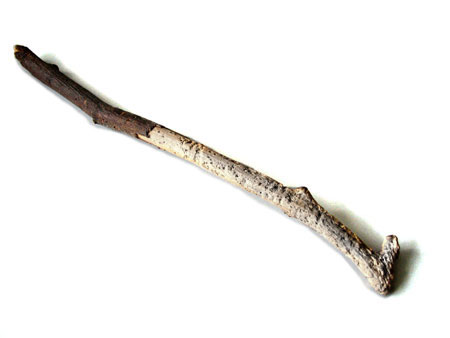
Huxley’s First Stick, half-chewed (circa 2002)
April 6, 2008
Now held in secure storage in the doggie closet, source of kibble and treats.
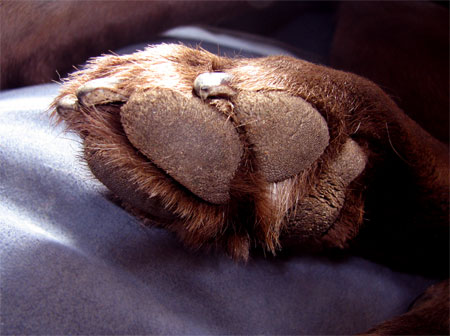
Huxley’s Paw at 6 Years Old
April 6, 2008
Dogs as Livestock in South Korea
April 3, 2008
The Australian Herald Sun is reporting that the Seoul city government is trying again to classify dogs as livestock in a bid to legalize, license, and regulate the industry and raise health standards for consumers.
Estimates of somewhere between 2 and 4 million dogs are eaten in South Korea each year; in Seoul alone there are about 500 dog meat restaurants. Other estimates say that nationwide there are 6,000 restaurants serving dogs and they are enjoyed by 10% of the population. Since there is no current regulation the market is underground. Almost all of these dogs are slaughtered and processed in less than pristine, sanitary conditions, making dog meat a somewhat risky entree for diners.
If this proposal is made law and effectively enforced, it could produce a rise in consumption as restaurant goers grew more confident that the dog meat they were ordering is ‘safe,’ that is, free of pathogens and other contaminants.
There is local opposition. Lee Won-Bok, president of the Korea Association for Animal Protection said, “It’s horrible to imagine dog meat on display next to beef and ham at supermarkets. It would also be nauseating to see roasted dog meat on the menu of your restaurant.”
However, Won-Bok’s statement seems to ignore the fact that dog meat is already consumed in fairly large quantities nation wide and is currently on many restaurant menus. Keeping this industry underground invites abusive and inhumane treatment.
The ethics here seems quite clear: if you are going to serve dog meat, consumers should be protected by making sure that meat is processed under sanitary conditions.
I wonder what the status of bestiality laws are in South Korea? Is it illegal to have sex with dogs but OK to roast and eat them?
Research science tells us that dogs and pigs rank very close to each other on scales of intelligence and gentleness. If you arrived from another planet and observed conditions in a factory farm that raises and slaughters pigs and then saw how some people are practicing Yoga with their companion dogs, you would be quite appropriately confused.
The distinction drawn here is simply cultural and not based on biology.
As a consumer of pork and a platonic, non-sexual lover of dogs, I recognize the weakness of any moral outrage I might muster over this dichotomy. No one likes to accept the fact that their moral position is arbitrary and based on locale and not any set of hard facts.
But to pretend otherwise is a lie.
Dogs and Autistic Children
April 2, 2008
Here’s a story we’d like desperately to believe is true: the benefits of service dogs assisting parents raising autistic children.
The evidence so far is anecdotal but heartfelt and persuasive; we’d love to see a double-blind study back up these wonderful stories with some hard data.
Parents claim that specially trained service dogs help make their autistic children “calmer, more social and more comfortable in the world.” The problem with self-reporting like this is that the parents are hardly disinterested parties and they’re not trained observer’s to boot.
The wife of a friend who works with autistic children has told me how eagerly they call her to report some sign of progress. But when she had her next session with the child the ‘breakthrough’ was just. . . a misinterpretation, wishful thinking, something you want so badly that you convince yourself you’ve seen it even though it was never there.
I must admit that I’m not a disinterested party either. I would very much like this be true. Helping a severely disabled child and giving rewarding work and love to a canine, what’s not to like. But we must be careful not to impose our wishes on reality. A case in point is the Facilitated Communication fiasco of a few years back.
The story here was that acutely disabled people, mostly children, could communicate if a trained person helped move their hand where they intended it to go on a keyboard or another surface with multiple options. It turned out to be wishful thinking and self-delusion when subjected to properly controlled conditions. Unconsciously, the facilitators were the ones providing both the intelligence and communication, not the subjects.
There’s something called the ideomotor effect, the kind of phenomenon that is behind such things as dowsing rods and Ouija boards. Your motor control is influenced without your awareness and the only information thus obtained comes from the user, not their environment or the Spirit World.
So the fact that I want this to be true makes me call all the more strongly for independent verification. College of Veterinary Medicine at Cornell University, are you reading this?
You know, instead of buying a hand-embroidered suede lounge cushion “Lotus Bed” for your dog (see previous post “Doga: Dog Yoga”) I’d ask you to please send that money to 4 Paws for Ability.
Their mission is to enrich the lives of people with disabilities by training and placing service animals to provide companionship and promote independent living.
Your dog doesn’t need a luxury Lotus Bed (trust me on this one), and these good folks could use your support to help make a real difference in people’s lives.
Unless you think that buying a Shanti stick inscribed with the mantra of Peace for your pooch is a better deal.
Doga: Dog Yoga — Indulgent, Self-Deluded Owners Waste Money on Latest Stupid Fad
April 2, 2008
There is nothing beyond the capacity of some loving dog owners to convince themselves is the Next Great Thing to do with your dog. Even in a recession there are still many Americans with too much time and money on their hands and product pimps only too happy to relieve them of some it.
You can read about it in the credulous article Bring Your Mat, and Man’s Best Friend: Yoga for Dogs is Becoming Increasingly Popular Around the World on the ABC News Nightline site, here.
If you’ve simply got to burn off your disposable cash why not piss it away on a stylish velour Yoga sweat suit with these amazing claims: “it stretches” and “it keeps them warm,” says Susan Bing of Trixie and Peanut in NYC.
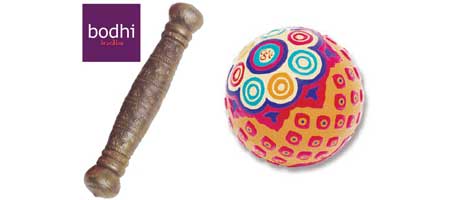
You can also buy chew toys “inspired by Indian art and philosophy” like squeaky Mendhi balls decorated with lotuses and leaves; Shanti sticks inscribed with the mantra of Peace; an Om Ball with a recording of the mantra OM by a yogi whose name you’ll never read again, Bhagavan Das; or a hand-embroidered suede lounge cushion that you can tell people is actually a Lotus Bed. These are based on the classic yogic principles of Om. Bliss. Play! and can be found at Bohdi Toys.
The other option, of course, is just to pile your money in a corner of your yard and set it on fire.
Animals in the Womb: Amazing Photography by National Geographic
April 2, 2008
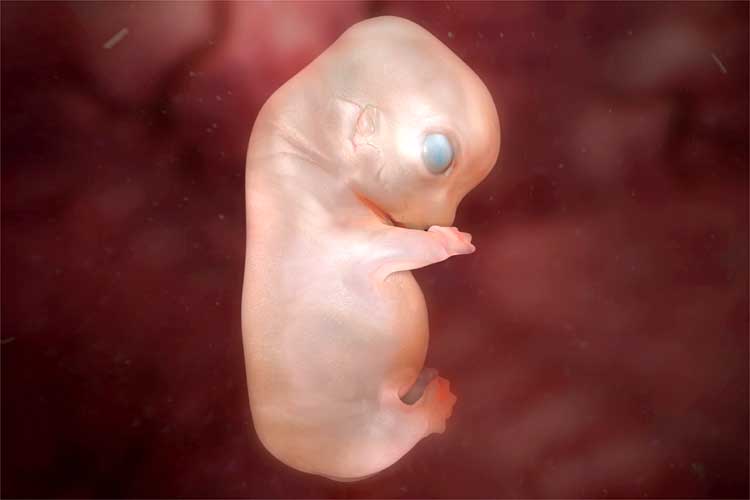
These photos of dog embryos in various stages of development are from a series done in 2006 for National Geographic called Animals in the Womb. Here’s a link to a gallery hosted by Der Speigel Online with 12 incredible images: photo gallery.
Please click on the thumbnails below for larger images.


Security Dogs Poisoned in South Africa by Peanut Butter-Covered Batteries
April 1, 2008
The South African Daily News ran a piece on the a current wave of dog and pet poisonings. For the complete article, go here.
It appears as if this may be related to burglary attempts as the targeted dogs appear to be large breeds used as guard dogs and security for homeowners. The two methods mentioned were meat laced with rat poison and batteries covered in peanut butter. Most large dogs would swallow these whole.
Once the battery is ingested, it begins to break down in the stomach and the battery acid is released, killing them. It also has the sad advantage of ingredients that are cheap and readily available.
This struck me particularly because I know that our two Labs would gobble up anything smaller than a car battery if it were slathered in peanut butter.
If you have dogs on Long Island or Why Col. Sanders is like Hitler
March 29, 2008
Newsday has a nice piece on living on Long Island with your dog, complete with videos. For the compete article, go here.
Although I have to cringe at reporter Corris Little’s opening line, “For some, dogs are the new kids.” To conflate the roles of parenting human children with being the owner/guardian of a dog is an abuse of language and genetics.
Dogs are not substitute children; children are not replacements for dogs. Anyone who says that they would run into a burning building and rescue their dog first and leave their child behind to die an agonizing death, should be contacted by Child Protective Services immediately for a fitness evaluation.
Can you even imagine such a scenario?
Local TV news reporter: “Mr. Morrison, it looks like your house has been totally destroyed by this spectacular blaze. How do you feel right now?”
Homeowner: “Well, Cyndy, the important thing is I was able to rescue Margarite, our little Chow-Chow.”
Local TV news reporter: “But your wife and three children died horribly in the inferno.”
Homeowner: “Cyndy, a house can be rebuilt. I can always get married again and have more children. But how could I ever replace this sweet little snookums? Here, she wants to give you a kiss. Isn’t that sweet?”
Oh silly me, of course, that’s not what Corris meant at all. What Corris meant to say is that chickens are equal to human children; Col. Sander’s is their Hitler and KFC is their Auschwitz.
What I object to here is the sloppy thinking behind this very wide-spread notion. And I say this as someone who both loves his dogs and considers them a part of our family.
I think it devalues both children and dogs to consider them in the same class of beings. You have absolutely no genetic investment in your dogs, but all of your children carry half your genes. Which is why, genetically, it makes sense for a woman to rescue her children from a disaster and leave her husband behind.
Given how most of our history with canines is the story of utility and horrific abuse, I think it a terrible mistake to swing the pendulum the other way and elevate dogs into “fur kids.”
“Meet the new boss, same as the old boss.”
I knew a woman who considered herself a feminist and an intellectual and would substitute the word “Goddess” in place of “God.” When I tried to explain to her that replacing one gendered fantasy figure with another was hardly progress, she told me, “Of course, you can’t understand. You’re a man.” Here all along I had mistakenly thought my brain (and not my specific genitalia) was responsible for any thinking I was likely to do.
My point is simply that words and language do matter and we should be careful about how we label things. And if you don’t agree with me, my personal God, who is presently incarnated as the Duff Beer Man on The Simpsons, will make you chug-a-lug Duff Lite until you do.
OT: As far as feminism goes, I’d align myself more with Camille Paglia than Gloria Steinem. Steinem once compared Paglia to Hitler and her seminal work, Sexual Personae to Mein Kampf. Steinem is also against pornography, transsexualism and so-called ‘snuff films,’ a non-existent genre that allegedly features the torture and actual murder of women on screen.
The term first arose in connection with the Charles Manson ‘family’ murders and in the almost 40 years since not a single actual snuff film has ever been found. But it doesn’t have to exist for Gloria Steinem to oppose it, I guess. Just like the wide spread sexual abuse of children in day care centers and ritual Satanic abuse panics that Steinem was convinced were real in the mid-1980s to early 1990s.
I’ll let the transsexuals defend themselves, but as far as porn goes, Americans spend $2.6 billion to $3.9 billion a year on it, based on Forbes magazine’s 2001 estimate, so that’s a lot of voting with their pocket books going on. (When was the last time you saw a copy of Ms. magazine on a newsstand?).
I was always taught to judge people by what they do, not what they say. And you can’t go far wrong in any field if you simply follow the money.
I wonder if the porn industry is recession-proof in the way that economists traditionally say women’s make-up and children’s toys are? Let’s put those Freakonomics guys to work on that one.
Leather Leashes vs. All Others – Part 1
March 27, 2008
I’ve always found that a six foot leather leash — nothing fancy, but something well made with brass fixings and reinforced stitching — is my favorite, as many times as I’ve used other leashes.
I never thought I would be one of those dog owners with an extendo-leash, the kind that has a hard rubber or plastic shell with a hand grip and a tough woven fabric 16 foot leash like the Flexi Soft Grip Comfort 1 retractable Cord Leash.
I’d see other people using them, or misusing them, barely keeping their dogs under control, and I formed a prejudice against ’em. These people were not ‘managing their dogs.”
It’s a line that has been drilled into my head by my favorite dog trainer, “Manage your dog.” I’m responsible for my dog’s safety and well-being. I should teach her good, polite behaviors and enforce them whenever we are outside or when company arrives. Any failure, any slice of wanton household destruction, any breach of protocol that puts my dog in jeopardy IS MY FAULT because I’m not properly Managing my Dog.
We recently added a new pooch to our permanent pack, Luna, a black female American style Labrador. Huxley, our chocolate Lab will be 6 this year. Our best guess about Luna is that she’s somewhere between 18 months and 2 years. After several months it became clear that her presence was having some effects on Huxley.
There were two noticeable behaviors: he began drinking exclusively from ‘her’ water bowl. And when we made the trip from out side door to our back yard – essentially the width of our one-car garage — he began asserting his independence by wandering down the drive way to pee over by our over-sized Christmas tree.
Next he’d saunter over to our 90 year old neighbor’s house across the street, position himself in the middle of her front lawn, squat and take a huge dump for all the passersby to see. He loves our neighbor Peg and she loves him and he wanted the world to know he was leaving her a brown token of his affection. Worse yet was when he’d lope across Prospect Drive and obliviously put himself in the path of mini-vans & SUVs.
There could not be a more public demonstration of my failure to Manage My Dog. And Huxley, is, by general consensus, a well-trained, polite canine. My analysis: He knows his behavior is transgressive and he persists because I believe it is status-related. She has to go right into the back yard to do her business while I, being senior, have more freedom than her! This independence is a part of Huxley’s character, he’s not your velcro-dog type at all.
But when this recently led to Huxley nearly getting hit by a van, I was totally freaked out, heart pounding, breath coming in short hyperventilating bursts — and resolved to get back to leashing him AT ALL TIMES!
Fortunately, the circumstances were all in our favor that morning. It was broad daylight, I was a few feet behind Huxley with a leash and a treat, yelling his name. The driver clearly saw both of us and slowed to a stop as I rushed passed, yelled jumbled apologies and gratitude over my shoulder, and continued after Huxley.
I was clearly Not Managing My Dog. I was failing spectacularly to Manage My Dog, in fact. This was my well-trained, polite Labrador? The one who never before was adamant about refusing to take that short walk across our drive way in the back yard, the fenced and secure and happy back yard? This starts happening when it becomes clear that Luna is here to stay and not another one of our many foster dogs; clearly her presence must be the triggering factor? Robert Park, author of the terrific Voodoo Science would say my belief engine is going into over drive here.
***
Disclaimer: I cringe when people anthropomorphize their dogs, but find that it is an impossibility for me to to completely avoid. All such statements should be understood in this context. It helps me to parse my beast’s behavior in terms that I can understand.
This interpretation is my own invention and may or may not correspond with the internal analytics going on in my dog’s brain. That it’s useful for me does not equate with its accuracy for representing Huxley’s thinking. I do think Huxley is thinking. I’m convinced of it.
I’m equally convinced that our mental syntax is so different, canine to primate, that all my interpretations of his internal mental states should be offered only as heavily qualified guesses.
***
But we talking about leather leashes and extendo-leashes, weren’t we? We now own two extendo-leashes and I’ve learned how to operate them without slicing off my own (or anyone else’s) fingers and extremities or causing blindness to anyone. Yet. These are some of the actual cautions from the packaging. Seriously, you wouldn’t want to be on the receiving end if your dog’s collar came loose and the ribbon and metal clasp were speeding rapidly back to you.
They do certainly give your dog more freedom to explore further away from you. But you have to pay attention and anticipate when you want to draw your dog nearer because she is always more than an arm’s length away. These extendo-leashes can be used properly, even if many people operate them at the far end of the safety spectrum.
But for control and all around functionality give me the dead animal skin every time.
More to Come