
Dogs in China: Pets and Cuisine or “To Animals, all People are Nazis.”
March 18, 2008
Nobel Prize winner Isaac Bashevis Singer put his own feelings into one of his characters when he wrote: “In relation to [animals], all people are Nazis. For [them], it is an eternal Treblinka.”
The International Herald Tribune has an article on dogs in China, as pets and cuisine, here.
Once considered decadent and restricted by the Communist Party leadership, pet ownership in China is now expanding along with its huge middle class. Dog ownership used to be seen as ‘Western,’ politicly incorrect and license fees remain extremely expensive. To have a pet dog in China today is to make a statement: “I have enough abundance that I can conspicuously waste some on a pet (see Veblen below the fold, text beginning “The dog has advantages in the way of uselessness. . .”).
To Western eyes this throws into greater relief the distinction the Chinese see between canines as pets and canines as food. Large, mixed breed dogs are preferred for the kitchen, while small dogs are the current companion animal of choice. About 120 restaurants in Beijing offer dog on their menus.
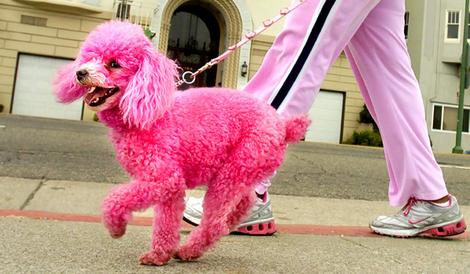
–Associated Press Photo
“In Beijing, there’s a huge market with pitiful dogs waiting in cages to be sold as meat, and literally a few yards away standard poodles dyed in all colors of the rainbow,” said Jill Robinson, chief executive of Animals Asia Foundation, an animal welfare charity based in Hong Kong.
If we are shocked by this Chinese double standard, consider how we American’s treat the domestic pig. Viet Namese pot-bellied pigs are highly intelligent, some claim even smarter than dogs. They are said to be impeccably clean by nature, personable, curious, and playful. These pigs can be trained to the equivalent of basic dog training: house trained, leash trained, even learning a few tricks.
Yet almost no Americans have pigs as pets because we love to eat crispy fried bacon, Virginia ham and pulled-pork sandwiches. So instead of sharing our homes with them, we raise them in factory farms under horrifying conditions.
The thought of raising dogs in such conditions makes me ill; it’s the stuff of nightmares. It would be worse than any puppy mill in existence, and those are pretty bad places. But only because I’m conditioned by my culture to accept the agony of pigs. So how I can I pass judgement on the Chinese for eating what to their eyes are ugly, unwanted, yet tasty dogs? Around 300,000 a year are raised, killed, cooked and served; generally roasted, or in a stew or casserole.
The traditional Chinese belief system has many negative associations with dogs; they are synonymous with the dregs of society, or seen as pawns, boot lickers, and bound servants. There is no Chinese Lassie.
There is one positive folk belief concerning eating dog: that it has medicinal benefits. Such as improving blood circulation to allegedly keep you warmer in winter (a nice conflation of magical thinking and the warmth of a ‘three dog night’).
Despite all the attention being paid to the worldwide growth of Muslim fundamentalism, the meat with the largest growing demand from global consumers is pork. The reality is that to meet this demand the factory farming of pigs will have to increase exponentially. Hundreds of millions have been killed and hundreds of millions more will die instead of being personable, curious, and playful.
Is it unfair to call this an animal holocaust? It would certainly qualify for me, if it was dogs instead of pigs.
Michael Vick, PETA and the Canine Victims: Rehab or Destroy?
March 12, 2008
The New York Times has a piece today that highlights the difference between groups that define themselves as animal rights activists and animal welfare groups, “Vick Case Exposes Rift Among Animal-Rights Advocates.”
PETA’s position is that the pit bulls that were trained to fight by the Bad Newz Kennels financed by Michael Vick, the former Atlanta Falcons star quarterback should be killed. As the Times says, “The folks at Best Friends Animal Society argued that the fighting dogs had been forced to lead brutal lives and should not receive death sentences.”
PETA says Best Friends is “an expensive Camelot.” Could they be more wrong? I don’t think so.
“These dogs have been through very traumatic experiences. These dogs have been abused by humans, yet they still love us, they still look to us for guidance. They still want us to be a part of their lives and they’re happy to see us every single day,” said John Garcia, Assistant Manager of Dog Care at Best Friends Animal Society.
I am not a fan or a supporter of PETA and believe they throw more heat than light on any issue they engage. I do admire the consistency of their view as ‘animal rights’ activists “. . .animals are not ours to use for food, clothing, entertainment, experimentation, or any other purpose. . .”
However, I believe that their’s is an extremist position that, if it were more widely understood, would not be supported by most Americans.
There was a great exposé on PETA done by Penn & Teller in their Showtime series, Bullshit and I recommend seeking it out if you’d like a primer on the arguments against PETA.
Taken to it’s logical conclusion, the world population would have to turn vegan, (a diet that bans meat, fish, milk, & eggs); no one would be allowed any sort of animal pet; all hunting and fishing would be banned; the use of wool, silk and leather for clothing would be banned (in addition to their well-known condemnation of wearing fur) and most medical research would have to be stopped to satisfy the constraints desired by PETA.
PETA founder and co-director Ingrid Newkirk believes that pet ownership is equivalent to slavery. I find this comparison incredibly offensive in a world where actual human slavery and trafficking still exist. My two Labs, Huxley and Luna also take issue with this definition.
She also thinks the production of both milk and honey involves the ‘exploitation’ of cows and bees. And, of course, she’s right, but I think most people would reject her use of the loaded term exploitation to describe the process. As far as developing drugs to battle Alzheimer’s Disease or the production of insulin for diabetics is concerned, her anti-science bias is crystal clear:
“If abandoning animal research means that there are some things we cannot learn, then so be it. . .We have no basic right…not to be harmed by those natural diseases we are heir to.”
One can agree that there are horrific abuses of animals world wide without accepting PETA’s simplistic black and white, good or evil model. Just as one can be a supporter of going ‘green’ without endorsing the eco-terrorism of groups like the Earth Liberation Front or support animal rights without endorsing the Animal Liberation Front.
Just to be clear, the ELF has been designated a terrorist organization by the FBI and has received direct financial support from PETA. They gave $1,500 to the ELF in 2001 and $45,200 to the Rodney Coronado Support Committee. Rodney Coronado was convicted of arson in federal court for the 1992 firebombing of a Michigan State University research lab.
Remember that as a non-profit organization your tax dollars help support PETA whether you donate directly to them or not. Should an organization that supports violence have their tax-exempt status yanked? I think so. But then again, I’m a ‘slave’ owner. Now you’ll have to excuse me, I’ve got to go feed my ‘slaves’ their kibble.
The Pet Psychic: $300 an hour for a phone consultation? Sadly, Yes.
March 11, 2008
Robert Todd Carroll, author of the excellent The Skeptic’s Dictionary: A Collection of Strange Beliefs, Amusing Deceptions, and Dangerous Delusions and the Skepdic.com website, recently posted an expansion of his article on “Animal Quackers” that’s must reading for all dog owners.
Carroll defines an animal quacker as someone “who applies quackery to animals, such as holistic massage therapy for dogs and horses; reiki and therapeutic touch for pets; and acupuncture, aromatherapy, Ayurvedic medicine, homeopathy for animals of all sorts, and either the ability to communicate psychically with pets or to do scientific tests that prove the psychic ability of dogs.”
Read about Sonya Fitzpatrick’s incisive, revealing consultation for the Cleveland Plain Dealers‘ Dog Lady columnist, Monica Collins, plus a good collection of links to the explore the topic further.
Fitzpatrick, a former model with no credentials in animal behavior or nutrition, uses her psychic readings to push her line of pet food, Sonya Fitzpatrick’s Omega Natural and HealthGUARD Dog vitamins, was once visited by St. Francis of Assissi, assures you that via reincarnation your beloved pets can return to you, and can do a psychic reading of your dog from a photograph.
That last part I completely agree with: Sonya’s “reading” whether from an in-person, or in-pet interview, or from a blurry snap shot will have precisely the same accuracy and value. (I’m thinking of a round number here, are you psychic enough to read my mind? Why, yes, you’re absolutely correct: Zero!).
For extra credit, send an email to the Pet Parent’s Network and request the clinical trials that support their claims. Two that I found especially amusing were “Encourages Eye Development” and “Promotes Alertness and Brain Function.” How exactly were these results measured? Oh, and of course, their supplements will boost your dog’s immune system, though I defy you to find a single “nutraceutical” supplement that doesn’t make this specious claim.
” . . .the whole notion of ‘immune-boosting’ is seriously flawed: your immune system isn’t a muscle that you can strengthen by exercise or diet. The only remotely plausible step you can take to strengthen immunity is to get vaccinated.”
This is from Steven Salzberg’s blog entry, Boost your immune system?Why should you take his word over Sonya Fitzpatrick’s?
Well, Salzberg is a Professor at the University of Maryland studying bioinformatics, genomics, and evolution. He’s also the Director of the Center for Bioinformatics and Computational Biology. His Ph.D. is from Harvard University and his bachelor’s and master’s degrees are from Yale University.
Then again, although a handsome guy, Steve was never a model, so Sonya’s one up on him there.
The FURminator – Over-Priced but Believe the Hype
March 5, 2008

There’s a relatively new product on the market for dealing with one the commonplaces of dog ownership – shedding hair. Of course, most people don’t brush their dogs as often as they should which would help tremendously with the problem.
The FURminator is really not a “new” concept to anyone who’s familiar with the traditional curved shedding blade. But it is an effective and ergonomic variation on the previous styles of blades and coat combs. Of course, it is hideously over-priced at $60 for the large FURminator.
However, it does work very well and if you’re only going to brush your dog once a month or so, this is the tool to use. It doesn’t cut your dog’s hair but works by pulling out the undercoat. I have to admit that it does this better than any of the shedding blades I’ve used in the past.
They claim it will reduce shedding by up to 90% (I’ll report later on my own long term experience with it). That’s like the dishwasher soap that leaves your dishes ‘virtually spotless.’ Another way of expressing the same thought is, this soap leaves some spots on your dishes.
The FURminator folks also sell shampoos and lotions that they claim work with their tool to even further reduce the amount of shedding your dogs does. I’m very skeptical of this claim. If you believe that any lotion or potion or soap or shampoo by itself will reduce shedding in a breed prone to it, you probably click on those emails for breast and penis enlargement, too.
Bottom line: it works. I got an incredible amount of hair off my two Labradors, similar to the examples shown on their website, www.furminator.com. But I think the price should be one-half of what it’s currently selling for.
You can, I believe, achieve the same results by using a $10 shedding blade once a week, as you can by using the FURminator once a month. I gotta admit they came up with a great name and a handle that looks very high-tech and is comfortable to use, too. But $60? C’mon, guys give us a break.

How Much is that Doggie in the Window?
March 4, 2008
I think most people would be shocked when they add up the expenses and the time involved in dog ownership. I find myself actively discouraging people from adopting dogs without first getting a real sense of how much time and money is involved.
Potential owners who underestimate the cost and time inevitably wind up with under-exercised, under-trained dogs who, naturally enough, exhibit behavioral problems (excessive barking, destructive chewing, inappropriate elimination habits) and then wind up abandoned or in shelters.
A recent posting on the Fosters & Smith Pet Education site details the expenses involved over the life of a 50 pound dog over 14 years in the Midwest. The low number? $4,242.00. The middle number, which I consider to be closest to the true average cost? $12,468.00. The high end number? $38,905.00.
Surprised? Then you should read the entire article, here.
These totals are pretty shocking aren’t they? And remember, this is the cost for a 50-pound dog that lives in the Midwest. It is not uncommon to see some of these numbers double or triple in places like New York, Los Angeles, Miami, and Dallas. Now granted most people do not end up spending $40,000 on their dog, but some spend a whole lot more. A dog with hip dysplasia or severe allergies can have significantly higher veterinary expenses and I routinely see people who spend over $2,000 on a single veterinary problem. Chances are your costs will be similar to those I incur, but even with the minimum required care, it is still over $13,000.00.
Alien Intelligence: UFOs or Dogs?
February 15, 2008

According to a poll reported in the New York Times in 2003, there are three million Americans who believe they have had some kind of encounter with an alien.
My opinion is that if Americans wanted to have an encounter with an alien intelligence they probably have one sleeping on a rug right in their own home. I submit that the family dog possesses a mind that is is at least as alien to most dog owners as any “grey” with huge black almond-shaped eyes and an unsettling tendency to probe human orifices.
My interest is to explore the canine mind and leave the extraterrestrial brain to the province of science fiction and needy fantasists.
People who claim they’ve met aliens, been aboard their space craft or given birth to alien-human hybrid babies are 1.) suffering from a delusion and 2.) have no understanding of the size of the universe.
How can I so easily dismiss the multitude of reports by millions of otherwise sane and sober folks? Let’s take a look at how big a place this universe is anyway.
Physics tells us that it is impossible to achieve speeds greater than that of light itself. The commonly used denominator light year is defined as the distance light travels in one Earth year, approximately 6 trillion miles. Let’s assume that we could actually build a ship capable of sustaining life that matches the speed of light.
Leaving Earth we pass the Moon in 1 1/2 seconds. Venus flies by us in 2 1/2 minutes. The recently down-graded Pluto would take us 5 1/2 hours. So far so good. It will now take us several months at this speed to leave behind the gravitational influence of the Sun and escape our solar system. To get to the closest star, Proxima Centauri we’ve got to travel for more than four years.
Here comes the problem. To get to the center of our own galaxy, one of billions observable by the Hubble Space Telescope, will take us 25,000 years. To get to the outer edge of the Milky Way requires 50,000 years at the speed of light. Wait, it gets worse. The closest galaxy to us is Andromeda. To get there we’d need to travel for 2.5 million years.
The farthest objects we can see with the HST would require a journey of 12 billion years. For comparison the age of the universe is currently believed to be 14.8 billion years.
So while the odds certainly favor the possibility of intelligent life out there among the stars, the distances between us and them are almost incomprehensibly vast. Which makes the thousands of reports of alien ships seen or boarded since 1947 seem highly unlikely. Instead, E.T., the greys and the rest of the intergalactic menagerie come from that universe between our ears, the human brain, than from the one we see when we gaze into the night sky.
In future posts we’ll explore the genuine mysteries and complexities of the canine mind; the alien at our feet.
Source: Hubble: the Mirror on the Universe, Robin Kerrod & Carole Stott, Firefly Books, 2007. (Above) A cluster of galaxies 2.2 billion light years from Earth. Photo from Space.com, the Best Hubble Images,
Dogs in Danger.com
February 11, 2008
DogsinDanger.com is a new non-profit organization devoted to saving the millions of dogs who are running out of time in local shelters all across the country. No one group, or single approach can stem this tide of killing abandoned dogs. But this is certainly a step in the right direction.
James Serpell, author of the excellent book In the Company of Animals estimates that we euthanize less than 5% of the US canine population each year. So while the percentage is small, the absolute number is still unconscionably high.
The truth is we are doing better today than we were in the 1970s and 1980s when the estimates were around 13 million dogs killed a year. But we must drive this number down further. Dogsindanger.com is one way to do that. Check them out if you are interested in adopting a dog and saving a life.
–from their website:
WHO ARE WE
DogsInDanger.com is a nonprofit national shelter outreach program at the forefront of a grassroots movement trying to help shelters save the lives of millions of innocent dogs.
A NATIONAL TRAGEDY
We are a nation of dog lovers. Then why is it that the shelters that are expected to provide these animals with a second chance at life are instead being forced to euthanize them?
Shelters are the last line for millions of innocent dogs. The public has no idea of the magnitude of this national tragedy. The sad reality is that over four million dogs are killed each year in shelters. Why, in a country of dog lovers, are so many dogs homeless?
Because their families abandon them, for reasons like job change, divorce and new baby… and most shelters don’t have the necessary programs to get the dogs the exposure they need to find new homes. Shelters find homes for many dogs, but millions are euthanized. For far too long we have been told there is no other way.
AND A REASON FOR HOPE
DogsInDanger.com believes in the power of compassion, and that Americans would do more to help and adopt shelter dogs, if only they knew how many dogs shelters were forced to euthanize. We also believe that shelters don’t really want to euthanize dogs, if they had any other option. Simply put, we have chosen a path of technology as a means of connecting these scared, abandoned shelter dogs with the loving homes they deserve. As a nonprofit organization, we seek no other gain except for the happiness we see in the face of a dog as he faithfully walks out through the shelter doors, in perfect step with his loving new family.
It may be uncomfortable for some to see lists of names and photos of dogs scheduled to be euthanized, but, the truth is uncomfortable. By making it personal, we believe more people will be compelled to help these dogs. Thus dogsindanger.com refuses to present a sanitized version of the truth. Our ultimate goal is to see a day where healthy and treatable animals are no longer killed by their most trusted friends.

Pet Food: A Dog’s Breakfast – Canadian TV documentary
February 7, 2008
–from the CBC web site

Do we really know what we’re feeding our pets? In the Spring of 2007, pet owners across North America were devastated when upwards of 50,000 of their beloved pet dogs and cats fell seriously ill after eating tainted pet food. Many of the animals died. Menu Foods of Toronto, the manufacturer, initiated the biggest recall of pet food in North American history.
In the wake of the scandal, the trust pet food makers so carefully nurtured with pet lovers has been severely shaken, and the $16 billion dollar pet food industry has come under public scrutiny as never before. Pet owners and governments are asking: Is pet food both nutritious, and safe? Does it live up to the claims of its makers? Is the industry adequately regulated?
Yap films’ new documentary, PET FOOD: A DOG’S BREAKFAST, investigates, and discovers that a ‘dog’s breakfast’ may be just that.
This exposé takes viewers inside the world of pet food manufacturing and is essential viewing for every pet owner.
PET FOOD: A DOG’S BREAKFAST features critics of the industry, foremost among them Dr. Elizabeth Hodgkins, a California vet, and insider who used to work in the pet food industry. She says the recall of food made by Menu Foods of Toronto is a sign of larger problems. “Unfortunately the pet food industry is cutting corners, is not doing the testing it says it’s doing, is not using the quality of ingredients it wants pet owners to believe are in that bag and can, and is not forthcoming with pet owners about those facts. It is not a truthful industry.”
PET FOOD: A DOG’S BREAKFAST profiles three pet owners who say their pets have been made ill or died as a result of eating tainted food. They are plaintiffs in class action lawsuits seeking to recover not only money spent on vet bills, but also compensation for the emotional trauma they have suffered. One of the owners, Jovanna Kovacevic of Toronto, says, “You get very close to a cat. It’s not just an animal, it’s a member of your family. One of her cats died after eating food that was later recalled. Another is still sick and needs ongoing, and ruinously expensive, veterinary care. “It’s not my fault”, she says, “so you want them to pay for their mistakes. You’re angry.”
As Vancouver class action lawyer Lucianna Brasil explains, the claim for emotional damages indicates how our view of pets has changed over the past decades. Animals used to be thought of as companions. Now they are more like members of the family – like substitute children. In fact, about two thirds of pet owners are childless. Even though under the current law, pets are considered ‘property’, the pet food industry strongly promotes the view that pets are family members and markets its products on that basis.
Critics also say there is a big gap between how the companies want consumers to perceive their product and what it actually is. Pet food commercials and labels show fetchingly presented ingredients that humans would be happy to eat. The pet food industry often refers to its products as “human grade’. But Elizabeth Hodgkins says this kind of marketing is misleading. “I think many pet owners would be very surprised to learn about the ingredients that are actually going into the can or the bag of food that they’re feeding to their pet. They would be shocked.” Hodgkins goes into the kitchen to reveal the secrets of what’s actually in your pet’s food and how it’s made.
Dr. Meg Smart, of the Western College of Veterinary Medicine in Saskatoon, says that expensive pet foods labelled ‘premium’ are often no better or different than cheaper food. The program tests that assertion in a feed testing lab. And Smart also brews a strange concoction, made of old leather boots, wood shavings and motor oil, which in theory could pass one of the minimum standards for pet food, even though it’s inedible. Smart – an educator of veterinarians – also warns that many vets don’t know as much about pet food as consumers think they do. The program offers advice for those wondering what they should be feeding their pets.
As seen in PET FOOD: A DOG’S BREAKFAST, there is a growing call among consumer activists for greater regulation that will bring the pet food industry to heel. Your pet’s life may depend on it.
PET FOOD: A DOG’S BREAKFAST is produced by yap films in association with the Canadian Broadcasting Corporation
Hitler and Blondie
February 2, 2008
Hitler loved his dog Blondie. A dog trainer had schooled Blondie so well that Hitler was in awe of the precocious canine’s discipline and intelligence. What particularly amazed him — and he delighted in showing this to guests — was how Blondie would sing on command. He’d say, “Sing, Blondie,” and the dog would emit a yodel-like howl. But that is not all. He would then say, “Lower, Blondie,” and his beloved four-legged friend would drop an octave and “sing” in a deep tone “like Zarah Leander.”
All who surrounded Hitler knew of his pride and affection for Blondie. He bragged on the tricks she could perform. He kept her by his side most of the time. She even slept in his bedroom in the bunker. Then, as the Russians closed in, Hitler fed Blondie cyanide. He killed his dog not to spare her from any of the ravages which might follow defeat, not to spare her from hunger or deprivation or disease. Rather, he had begun to suspect that the cyanide Himmler had supplied for Hitler’s own suicide might be fake. So the Fuhrer, who had already sacrificed his entire nation to his own vanity, killed his dog to make sure that his supply of suicide tablets would work when the time came.

— testimony of Traudl Junge from the documentary, Im toten Winkel – Hitlers Sekretärin (Blind Spot – Hitler’s Secretary) 2002, directed by Andre Heller and Othmar Schmiderer. This documentary won top honors at the Berlin International Film Festival and the Chicago International Film Festival.

Are Pet Owner’s Healthier? Maybe Not. . .
February 2, 2008
Fuzzy Science
By January W. Payne
Washington Post Staff Writer
Tuesday, January 16, 2007
People spend billions annually on their pets — feeding, grooming, even clothing their animals. They play with them, sleep with them, approve surgery for them and mourn for them, much as they would for people.
But does owning a pet make people healthier? Popular assumptions notwithstanding, science is still out on that question.
A new study out of Finland suggests the answer may be no. Pet owners, the study finds, smoke cigarettes more but drink alcohol less than those without pets. They also have a higher body mass index (BMI), a ratio of weight relative to height. Pet owners spend slightly less time playing organized sports than non-owners but take part more often in such activities as hunting, fishing and boating. Pet owners are also less likely to report having good health than non-owners.
The findings point in a different direction from many previous studies, which have suggested that pet owners enjoy such health advantages as lower cholesterol, triglyceride and blood pressure than non-owners, even after accounting for such variables as exercise. Previous studies also have shown that owning pets may relieve feelings of loneliness and encourage pet owners to exercise more, spend more time outdoors and socialize more, according to the Centers for Disease Control and Prevention.
But this area of research is filled with inconsistencies, with one study’s findings often contradicting another’s.
And because many of the studies are of poor quality and not much funding goes to finding new answers, said James Serpell, director of the Center for the Interaction of Animals and Society at the University of Pennsylvania School of Veterinary Medicine, “much of this is speculation”– meaning more research needs to be done to find definitive answers. What seems most promising, he said, is the idea that pets offer social support — something that can affect how people deal with stress, which is known to impact health.
“At some level it seems obvious to me [that pets are] providing exactly the same types of support as” other social networks, including family and friends, Serpell said. Still, “while we like our friends and our family, they’re likely a source of conflict, but most animals are not. Most animals give but don’t take much.”
Gold-standard evidence of pets’ benefits to human physical and mental well-being may be scant, but examples of their use for health purposes are not. For decades, household animals have been used to assist patients with medical conditions such as blindness or seizures, as well as to relieve depression and social isolation. But when the National Institutes of Health last thoroughly explored the health benefits of pet ownership 20 years ago, its experts hedged.
“Persuasive evidence was presented to conclude that pets are likely to be medically beneficial to some people’s health,” they wrote in a consensus statement. “However, much is to be learned about many of these relationships before broad generalizations of medical benefit can be made.” No comparable group of experts has since been convened to reexamine the question.
The health differences found between pet owners and non-owners in the Finnish study, published in December in the online medical journal PLoS ONE, were small and may not apply to Americans, the authors say. What’s more, the study found a “difference only in the proportions of people reporting ‘good perceived health’ and not in the proportion reporting ‘bad health,’ ” said lead study author Leena Koivusilta, a researcher at the University of Turku, in an e-mail interview.
“We wanted to report the slight differences” between the pet owners and non-owners who both reported good perceived health “but, at the same time, to make sure that no ‘larger than life’ interpretations could be made,” Koivusilta said.
Her analysis was based on a survey of more than 21,000 Finnish people who responded to a questionnaire as part of a 15-year health and social support study. Eighty percent of those who had pets reported good perceived health, compared with 82 percent of those without pets. Twenty-eight percent of pet owners smoked regularly, compared with 23 percent of non-owners; 33 percent of pet owners smoked occasionally, compared with 32 percent of non-owners; and 39 percent didn’t smoke, compared with 45 percent of non-owners.
But overall, pet owners in the study also were less educated than non-owners, suggesting that any health benefits observed might be due to socioeconomic status rather than pet ownership, the researchers said.
“The grand message of the study could be that pets provide us all with a vast potential for health promotion as has been shown previously,” Koivusilta said. “Walking your dog makes you feel better, for your sake and for your hairy friend’s sake, and perhaps also helps you to lose some weight.”
Some research has suggested that pets offer social support that acts as a stress reliever, which affects health. One such study, published in 2001 in the journal Hypertension, found that pet owners had lower blood pressure readings when undergoing mental stress than people who did not own pets.
A 1995 American Journal of Cardiology study reported that dog ownership by men was associated with decreased risk of death within one year of a heart attack, compared with those who didn’t own dogs. A 1999 Journal of the American Geriatric Society study found that men and women who owned a pet scored better on a scale that measures the ability to complete daily tasks — such as bathing and dressing themselves, preparing food and walking several blocks — than peers who didn’t own a pet.
In 2005 BMJ (formerly the British Medical Journal) published a review examining studies that helped popularize the idea that pet ownership positively affects human health. The review found that while some studies reported pet-owning benefits such as better physical and psychological well-being in the elderly and reduced risk of cardiovascular disease, many later studies failed to confirm these findings.
Given this inconsistency, the BMJ review suggested that researchers focus less on whether owning a pet offers measurable health benefits and instead on how pets affect individual quality of life and how humans are affected by a pet’s death.
Future research also should tackle more specific questions, gleaned from what’s already known. “If pets are another form of social support, [then] we should start to ask more directed kinds of questions about the kinds of people who would be more likely to benefit from having a pet — maybe the kinds of people who don’t have a strong social support network,” Serpell said.