
Heroin Puppies
February 2, 2008
Heroin Traffickers Used Puppies to Smuggle Drugs Medellin-based Organization Surgically Implanted Packets of Heroin in Pure-Bred Dogs
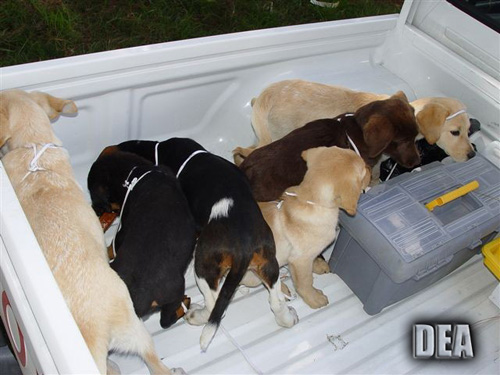
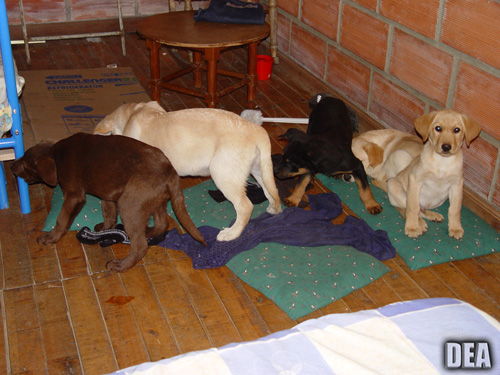
Feb. 3, 2006: The DEA arrested 22 heroin traffickers based out of Medellin, Colombia, who used puppies to smuggle drugs. The drug traffickers surgically implanted packets of liquid heroin into purebred dogs. All of the puppies who survived were adopted by local families and are still doing well today.
DEA has received numerous calls concerning the fate of the puppies who survived the horrific deeds of drug smugglers. Many of the callers expressed interest in adopting the dogs. We are pleased to report that all of the puppies have been taken in by Columbian families and are in great health. The public reaction to this story has been overwhelming. We thank you all for your interest.
— from the DEA’s website

PETA Killed 97 Percent of ‘Companion Animals’ in 2006
February 2, 2008
Death toll up to 17,400; overdue report describes PETA’s deadliest year ever
WASHINGTON, Jan. 10, 2008 /PRNewswire-USNewswire/ — An official report from People for The Ethical Treatment of Animals (PETA), submitted nine months after a Virginia government agency’s deadline, shows that the animal rights group put to death more than 97 percent of the dogs, cats, and other pets it took in for adoption in 2006. During that year, the well-known animal rights group managed to find adoptive homes for just 12 pets. The nonprofit Center for Consumer Freedom (CCF) is calling on PETA to either end its hypocritical angel-of-death program, or stop its senseless condemnation of Americans who believe it’s perfectly ethical to use animals for food, clothing, and critical medical research.
Not counting animals PETA held only temporarily in its spay-neuter program, the organization took in 3,061 “companion animals” in 2006, of which it killed 2,981. According to Virginia’s Department of Agriculture and Consumer Services (VDACS), the average euthanasia rate for humane societies in the state was just 34.7 percent in 2006. PETA killed 97.4 percent of the animals it took in. The organization filed its 2006 report this month, nine months after the VDACS deadline of March 31, 2007.
“Pet lovers should be outraged,” said CCF Director of Research David Martosko. “There are thousands of worthwhile animal shelters that deserve Americans’ support. PETA is not one of them.”
In courtroom testimony last year, a PETA manager acknowledged that her organization maintains a large walk-in freezer for storing dead animals, and that PETA contracts with a Virginia cremation service to dispose of the bodies. In that trial, two PETA employees were convicted of dumping dead animals in a rural North Carolina trash dumpster.
Today in Southampton County, Virginia, another PETA employee will face felony charges in a dog-napping case. Andrea Florence Benoit Harris was arrested in late 2006 for allegedly abducting a hunting dog and attempting to transport it to PETA’s Norfolk headquarters.
“PETA raised over $30 million last year,” Martosko added, “and it’s using that money to kill the only flesh-and-blood animals its employees actually see. The scale of PETA’s hypocrisy is simply staggering.”
To speak with a spokesman, contact Tim Miller at 202-463-7112.
For more information about PETA’s massive euthanasia program, visit http://www.PetaKillsAnimals.com
http://www.consumerfreedom.com/
Balthasar and the Night Janitor
February 2, 2008
“Dogs are even able in old age to develop lasting and deep attachments if their love and bonding are reciprocated. . .One very sweet mutt, Balthasar, escaped from his new master three times and came back to us at the university, and so we were stuck with him. We thought he bonded with us so strongly that he was unable to develop new attachments. Thus, Balthasar became the watchdog at the Göd research Station, which made everybody, including him, very happy. One day, when he was twelve years old and had to be considered a rather old dog, the research station hired an elderly person as night janitor and superintendent. One day I was looking for Balthasar in vain. My colleagues told me that recently he started to leave in the mornings with the night janitor, only to return to ‘job’ at night. I learned from the group that Balthasar and the old janitor got to like each other quite a bit. “Just think,” they said, “they sleep together and he even buys Balthasar hot dogs.” Unfortunately, this relationship lasted only a few months, because the night janitor became ill, had to be hospitalized, and eventually died. In spite of this, Balthasar would disappear from time to time, particularly in the mornings. We tracked down what he was doing during his absences, and found that he would cross the busy highway, got to his adoptive master’s old house in the village, and sit in front of it for hours.”
– from If Dogs Could Talk; Exploring the Canine Mind by Vilmos Csányi, translated by Richard E. Quandt, North Point Press, Farrar, Straus and Giroux, New York, NY, 2005. Originally published in 2000 by Vince Kiadó Kft., Hungary
Descendants of Wolves
February 2, 2008
Professor Robert Wayne of the University of California plus and eight-person research team. Took mitochondrial DNA samples from 162 wolves and 140 dogs North America, Europe, Asia and the Arabian peninsula. Mitochondrial DNA is inherited from mother to child. It is especially suited to analyze genetic lines that result from mutation over long periods. Dog and wolf DNA differ by only 12 mutations; dogs and jackals and prairie wolves differ in 22 places. This proves that contemporary dogs are descended from wolves exclusively. The split between dogs and wolves occurred around 135,000 years ago, about the same time as our own species appeared, Homo sapiens. However canine varieties that had a skeletal structure different form wolves show up around 14,000 to 20,000 years ago. The belief today is that the pre-canine ‘tame’ wolves differed at first only behaviorally from their counterparts in the wild.
– from If Dogs Could Talk; Exploring the Canine Mind by Vilmos Csányi, translated by Richard E. Quandt, North Point Press, Farrar, Straus and Giroux, New York, NY, 2005. Originally published in 2000 by Vince Kiadó Kft., Hungary
How is your Dog’s Mind Activated?
February 2, 2008
“I believe that it is characteristic of the minds of dogs that they can think only about something that we activate in their minds: a ball, a leash, a few words, and the dog’s mind goes to work full steam. If everybody is busy with something else, the dog lies down, snoozes, and its mind just flickers at its lowest setting. I believe that dogs have taken the first step towards a more enduring wakefulness, and this is underscored by the fact that they easily learn rituals, because the elements of rituals assist in the activation of the mind. They have also developed a keen sense of time and it is easy to teach them a ritual that has to be carried out at a particular time.”
— from If Dogs Could Talk; Exploring the Canine Mind by Vilmos Csányi, translated by Richard E. Quandt, North Point Press, Farrar, Straus and Giroux, New York, NY, 2005. Originally published in 2000 by Vince Kiadó Kft., Hungary
The AKC Canine Good Citizen Test: the details
February 2, 2008
Owning a dog has certainly become more complicated in the past twenty years. “Anti-dog legislation” prohibiting ownership of specific breeds in certain municipalities, no pets housing and the proliferation of “NO DOGS ALLOWED” signs in public places are just a few of the hurdles to be overcome by those who wish to own a canine companion.
In an effort to promote responsible dog ownership, The American Kennel Club conducts the Canine Good Citizen program to demonstrate that dogs, as companions of man, can be respected members of the community. The goals of the program are to educate dog owners about the benefits of well-behaved pets and demonstrate to the general public that dogs can be upstanding members in the community.
The Canine Good Citizen Program consists of a ten-step test which reproduces everyday situations which might be encountered by a dog and owner. The test is not competitive–each dog and owner team are individually assessed on a pass/fail basis for each of the steps. Dogs passing all ten steps receive a certificate from the AKC and are officially awarded the Canine Good Citizen title which gives the owner the right to use the letters “CGC” after his/her dog’s name.
Here is an outline of the CGC Test steps:
1. Accepting a Friendly Stranger
This test demonstrates that the dog will allow a friendly stranger to approach it and speak to its owner in a natural, everyday situation. The evaluator and owner will shake hands and exchange pleasantries. The dog must show no sign of resentment or shyness and must not break position or try to go to the evaluator.
2. Sitting Politely for Petting
This test demonstrates that the dog will allow a friendly stranger to touch it while it is out with its owner. The evaluator pets the dog and then circles dog and owner. The dog must not show shyness or resentment.
3. Appearance & Grooming
This practical test demonstrates that the dog will welcome being groomed and examined and will permit someone other than his owner to do so. It also demonstrates the owner’s care, concern and responsibility. The evaluator inspects the dog, then combs or brushes the dog lightly, examines the ears and each front foot.
4. Out for a Walk (on a loose leash)
This test demonstrates that the owner is in control of the dog. The dog must be on the left side of the owner, but need not be in the heel position. There must be a left turn, a right turn and an about turn with at least one stop in between and another at the end.
5. Walking Through a Crowd
This test demonstrates that the dog can move about politely in pedestrian traffic and is under control in public places. The dog may show some interest in the strangers, without appearing over exuberant, shy or resentful.
6. Sit and Down on Command/Staying in Place
This test demonstrates that the dog has training, will respond to the owner’s command to sit and down and will remain in place commanded by the owner. The owner may take a reasonable amount of time and use more than one command.
7. Coming When Called
This test demonstrates that the dog will come when called by the handler. The handler will walk 10 feet from the dog, turn to face the dog, and call the dog. The handler may use encouragement to get the dog to come. Handlers may choose to tell dogs to “stay” or “wait” or they may simply walk away, giving no instructions to the dog as the evaluator provides mild distractions (e.g. petting).
8. Reaction to Another Dog
This test demonstrates that the dog can behave politely around other dogs. Two owners and their dogs approach each other from a distance of about ten yards, stop, shake hands and exchange pleasantries, and continue on for about five yards. The dogs should show no more than a casual interest in each other.
9. Reactions to Distractions
This test demonstrates that the dog is confident at all times when faced with common distracting situations. The dog may express a natural interest and curiosity and may appear slightly startled, but should not panic, try to run away, show aggressiveness or bark.
10. Supervised Separation
This test demonstrates that the dog can be left with a trusted person, if necessary, and will maintain its training and good manners. Evaluators are encouraged to say something like, “Would you like me to watch your dog?” and then take hold of the dog’s leash. The owner will go out of sight for 3 minutes. The dog does not have to stay in position, but should not continually bark, whine or pace unnecessarily, or show anything stronger than mild agitation or nervousness.
The story of RCA’s Nipper: His Master’s Voice
February 2, 2008
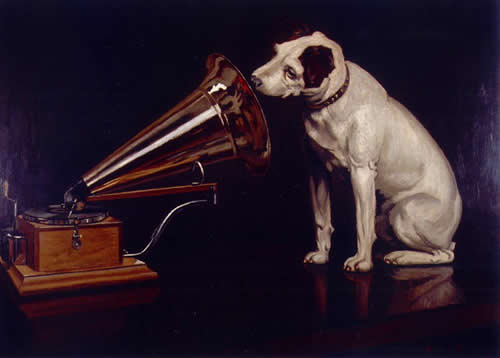 Nipper, (1884-1895) the fox terrier on His Master’s Voice label (RCA) was the dog of an English painter, Francis Barraud (1856-1924). His painting, and the rights to reproduce it, was sold for one hundred pounds. Click on painting for larger view.
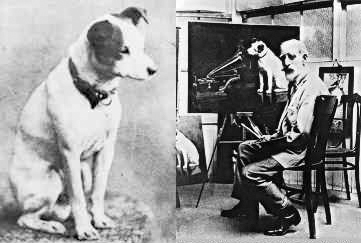
The only known photograph of Nipper (left) and Frances Barraud (right) working on one of the 24 copies of “His Master’s Voice” that were commissioned by the Victor Company.
— from The Difficulty of Being a Dog, by Roger Grenier (translated by Alice Kaplan), The University of Chicago Press, Chicago, 2000.
Nazis, Jewish Prisoner of War and a stray dog
February 2, 2008
“Emmanuel Levinas, captured by the Germans in 1940 and sent to a forest work detail with other Jewish prisoners of war, realized that in the eyes of his guards, and even of passersby, he and his fellow prisoners no longer belonged to the human race. Then a stray dog came and joined them: ‘For the dog, there was no doubt we were men.’ ”
from The Difficulty of Being a Dog, by Roger Grenier (translated by Alice Kaplan), The University of Chicago Press, Chicago, 2000.
Gaston Febus de Foix-Béarn, “Book of the Hunt” (1387)
February 2, 2008
“The dog is loyal to his master and with good and true love. The dog is of good understanding and great knowledge and great judgment. The dog has force and goodness. The dog has wisdom and is a true beast. The dog has a great memory. The dog has a great sense of smell. The dog has great diligence and great power. The dog has great valor and great subtlety. The dog has great lightness and great perception. The dog is good for giving orders to, since it learns everything just as a man does when taught. Much frolicking is in a dog. So good are dogs that rare is the man who doesn’t want to have one, either for one job or for another.”
–Gaston Febus de Foix-Béarn
from The Difficulty of Being a Dog, by Roger Grenier (translated by Alice Kaplan), The University of Chicago Press, Chicago, 2000.
Maurice Maeterlinck on dogs
February 2, 2008
“Amid all the forms of life that surround us, not a single species , except for the dog, has made an alliance with us. . .He is the only living being that has found and recognizes an indubitable, tangible, unexceptionable, and definite god. He knows what to devote the best part of himself to. He knows who it is, above himself, the he gives himself to. He does not have to seek a perfect, superior and infinite power in the darkness, amid successive lives, hypotheses, and dreams.”
–Maurice Maeterlinck
from The Difficulty of Being a Dog, by Roger Grenier (translated by Alice Kaplan), The University of Chicago Press, Chicago, 2000.