
George Bernard Shaw on dogs
February 2, 2008
“A Native American Elder once described his own inner struggles in this manner: Inside of me there are two dogs. One of the dogs is mean and evil. The other dog is good. The mean dog fights the good dog all the time. When asked which dog wins, he reflected for a moment and replied, “the one I feed the most.”
–George Bernard Shaw
Tellington Touch: “It’s Important to Believe that You’re Really Doing It.”
February 1, 2008
Toby was a young, enthusiastic dog. He had a hard time focusing and was reactive to all kinds of things, including other dogs, and unresponsive to training. His owners were frustrated. When Debby Potts first met Toby, she made note of the fact that his tail had been docked.
She began working on him, using different TTouch techniques. When she started to work on his “phantom tail” – the space where his tail used to be – he turned around to look at her as if he were curious about what she was doing. Potts did TTouches on the existing stump of the tail, and then continued beyond the physical tail into the air where the tail would be had it not been amputated.
“It’s amazing how many dogs with docked tails really clamp it to their body,” says Potts. She recommends gently working with all docked tails, even if there is just one vertebra, to ease the tension. Over and over she has seen noticeable changes in dogs, in their bodies, movement, and demeanor after working with their existing and phantom tails.
After Toby’s session, he was more focused, able to stand in balance, and less likely to pull on his leash. “It’s not uncommon for a dog to act more balanced after this kind of work,” says Potts. She does add that she hasn’t ever just worked on the tail or other amputated part of an animal, but regularly sees a clear reaction from dogs when working on their phantom parts, such as how Toby responded by looking at what she was doing.
This can look a little odd, Potts admits. “When I teach people how to work on their dog’s phantom parts, I usually suggest they do it in the privacy of their own homes!” She adds that it’s important to believe that you’re really doing it and can “see” the tail as if it were there. Just moving the hand and fingers around the area doesn’t have the same impact, she says.
The Whole Dog Journal
Debby Potts,TTouchInstructor/Practitioner,Licensed Veterinary Technician,The Integrated Animal, Portland, Oregon integratedanimal.com (503) 704-7499
Have you heard about the Zombie Dogs?
February 1, 2008
Science marches on. What would you think of a process that drains the blood from your dog, replaces it with an artificial fluid, then returns the blood and has that same dog fetch some brains for you?
The Zombie Dogs of Pittsburgh. It sounds ghoulish or like someone’s idea of a sick joke, especially given that this is the hometown of George Romero, whose most recent film was Land of the Dead. But the Zombie Dogs are real. Sort of.
“It’s so unfair and so bizarre,” Dr. Patrick Kochane, of the Safar Center for Resuscitation Research in Pittsburgh said. “Somebody must have thought the title ‘zombie dog’ would be a catchy phrase.” But the researcher adds, “That is the farthest thing from what we are doing.” It sounds like a complete denial that science is crossing the line into the unholy Black Arts and seeking to create an army of unstoppable canine zombie warriors. Cool as that might be. . .
The point is to save human beings who have suffered cardiac arrest or massive blood loss. As they have for centuries medical science has turned to the dog for experimentation. We get to do this since we are King of the Jungle. The calculation has always been that if a few dogs die helping conquer human disease, this is a price we’re willing to have dogs pay for us.
Given that some 4 million cats and dogs a year are euthanized in the US and their deaths don’t assist our research at all. (But some of them come back as pet food).
It works out that a cat or dog is put to death every 8 seconds in our animal shelters. The cost of this is around $1 billion dollars a year, (and you know that Animal Control Officers are never the highest paid municipal employees).
We’re actually doing a lot better these days, in the new millennium and some 10 years or so after the rise of “Dog Culture.” In the 1970s it is estimated that the kill rate was 13.5 million a year. And we had to listen to disco music, too.
The figures from 2006 are that there are 50 million US households that have a total of 73 million dogs in them. Proof that we live in a cruel and indifferent universe, there also are 90 million ‘owned cats.’
From the dog’s perspective, let’s consider what’s called ‘clinical death.’ Your heart stops beating, you stop breathing and all brain activity ceases. That’s what these Zombie Dogs were revived from, clinical death. Creepy, right? The 24 dogs in this experiment had their circulatory systems flushed with an ice-cold salt solution that would bring their core body temperatures down to 50 degrees from a normal 102 degrees.
Our Zombie Dogs were in a state of suspended-animation (just like Buck Rodgers). The difference being that if you are revived intact, it was suspended-animation. If not, it’s just an extra salty clinical death.
The big news out of the Safar Center for Resuscitation Research in Pittsburgh was that they had set a new duration record: 3 hours! They achieved this by adding tiny amounts of glucose and dissolved oxygen to the cold saline solution. They were revived by pumping warm blood back into their bodies and giving them a small electric shock. Told of the findings, Keith Richards expressed immediate interest.
The report says the dogs emerged without brain injury. So these dogs were clinically dead for three hours and came back. . .normal. Not hungry for brains, for instance.
The goal is to get this procedure to a stage where it can be tried on humans, as a way of stabilizing someone who’s seriously injured so doctors can, for example, locate bleeding sites and repair them. Suspended animation for even a short duration would have a major impact. Thus, people who before would have bled to death before medical intervention could take place would now have a much greater chance of survival. Then they’ll have to put up with a lot of Zombie-related ribbing.

George A. Romero’s fifth entry in his zombie series, Diary of the Dead opened on Feb. 15, 2008. Click here for the New York Times review.
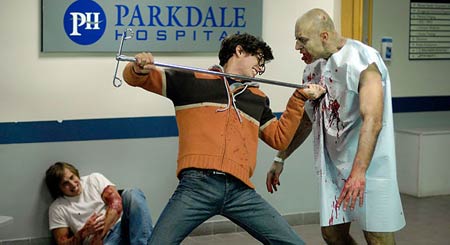
It’s a good time to be a fan of zombies.
Zombies are making a huge come back these days in films and popular culture. People go on organized Zombie Walks. Max Brooks’ two books The Zombie Survival Guide and World War Z strike just the right tone and are darkly hilarious. Max was a writer for Saturday Night Live and is the son of Mel Brooks and Anne Bancroft. If you haven’t read ’em, buy ’em today! Tell them necessity sent ya’. World War Z has been optioned for the movies and should be filmed like a Ric Burns’ documentary. The straighter this material is handled, the better.
The Zombie costume is now featured along side your Freddy Krueger’s, your Frankenstein’s monster, your Sexy Witch in all the Halloween catalogs. There’s a great comic book about zombies being published by Image, The Walking Dead.
Of course, Pittsburgh’s George Romero will always be known as the creator of the modern-day zombie conventions. You really do have to overlook the skilion or so low-budget zombie horror exploitation flicks. Zombies are among the cheapest monster effects in film, so it makes sense that this theme would be exploited by filmmakers with limited budgets. There are only a handful of ‘straight’ zombie pictures that are worth your time. The four Romero films, certainly: Night of the Living Dead, Dawn of the Dead, Day of the Dead and Land of the Dead.
You’ll get some nit-picking over details (fast moving zombies vs. their classic shuffling walk or the victims of rage plague vs. the truly undead) but I would include 28 Days Later, the remake of Dawn of the Dead in 2004 by Zack Snyder, the Resident Evil series with the incomparable Milla Jovovoch and Carnival of Souls on the list. This last one will send the fan boys over the edge.
There really aren’t zombies in COS, just the undead who keep popping in for inopportune visits, though they do fit under the low-budget make-up rule. The actors playing the ‘souls’ wear little more than white pancake make-up to indicate their status. And they are in constant pursuit of the heroine, a beautiful blonde church organist. At one point in the film she plays some ‘unholy music’ (could it have been Ina Gadda Da Vida by Iron Butterfly? No, that was a Simpson’s episode: “Hey Marge, remember when we used to make out to this hymn?” ).
Afterwards, she is remonstrated by a priest.
There’s also a distinction between stories where animals can be affected, as with Resident Evil’s undead dobermans and crows and zombie worlds where only humans are involved like the excellent comic book series The Walking Dead, written by Robert Kirkman.
The reason I find a good zombie film satisfying is probably part of the same paranoid thinking that leads me to identify with all the screen versions of Invasion of the Body Snatchers and The Thing (from Outer Space). Because in my own delusional way, this is how I see the world. There are a (very) few awake and thinking people, who need to band together for protection, surrounded by an ocean of soulless consumers and sheep who want to make us behave just like them. And in a zombie film the ‘monster’ is everyone around you; neighbors, family, strangers from two towns over. This also seems to be the case in the alleged ‘Real World.’ We echo Dr. Kochane here: “It’s so unfair and so bizarre.”
Source: “Pitt scientists resurrect hope of cheating death” by Jennifer Bails
PITTSBURGH TRIBUNE-REVIEW, Wednesday, June 29, 2005
Dog Photography
February 1, 2008
Please click on the thumbnails for larger images.

Cynodictis, the ‘Dawn Dog’
January 28, 2008
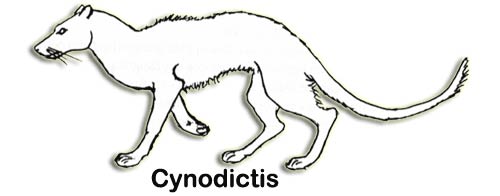
Cynodictis, or “in-betwen dog” is the name given to a number of dog-like animals known from the late Eocene and early Oligocene of Europe (France and Germany), the late Eocene of Mongolia, and the Oligocene of North America (about 20~40 million years ago). The type species of Cynodictis, C. lacustris, is a member of the Amphicyonidae, but several fossil species that originally made up the genus have since been distributed among the genera Cormocyon, Cynarctoides, Phlaocyon, and Rhizocyon, all of which belong to the subfamily Borophaginae of the family Canidae.
Cynodictis are carnivorans that descended from Miacids, and are of the type that could be considered related descendants of a lineage that were ancestral progenitors of modern dogs, but their exact phylogenetic relationship is still not clear. Cynodictis may have given rise to two other species branches, one in Africa and the other in Eurasia. The Eurasian branch has been called Tomarctus.
Cynodictis had a long muzzle and a low-slung body. It had carnassial scissor teeth for slicing chunks of meat off carcasses. It lived on the grassy plains of North America, but researchers think it may have climbed trees in search of prey. It was about 30 cm in length – a small, carnivorous, dog-like mammal that could run very fast and dig efficiently. It used its speed to chase down rabbits and small rodents, but may also have been able to dig them out of their burrows. Cynodictis lived on open, emi-arid plains that were crisscrossed by rivers.
Using its digging skills, Cynodictis would make itself dens in steep riverbanks, which it would line with mouted fur and vegetation. In here the female Cynodictis would give birth to a litter of around five pups, which she would feed and protect for several months, suckling them at first, then later bringing them food. Unfortunately, the dens would sometimes be destroyed by flash floods that killed all the animals inside, but preserved them as fossils.
–from Wikipedia, Cynodictis