
Fake Science
January 18, 2011
While its my firm belief that nothing ever sent by a ‘friend’ via email that’s meant to be a ‘laff riot’ is even mildly amusing (unless your threshold for entertainment includes shiny objects and the concept of object permanence (‘peek-a-boo’) is new to you) the InterWebs are not a completely humor-free zone. Unlike, say, the Humor bookshelves in most chain bookstores.
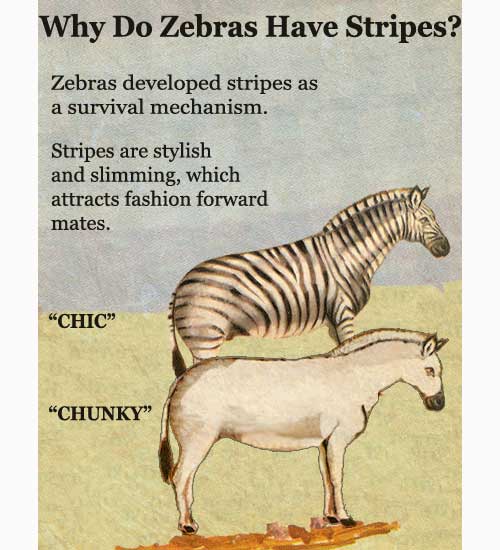
There is funny material on the web that is not just video clips of The Daily Show, The Colbert Report, Conan O’Brian or David Letterman. For proof of this argument I offer you Fake Science. Below are a few examples. If you don’t find these funny, then simply head back to LOLCATS and knock yourself out. And yes, you can has cheezburger.


Sleights of Mind: What the Neuroscience of Magic Reveals About Our Everyday Deceptions
January 15, 2011
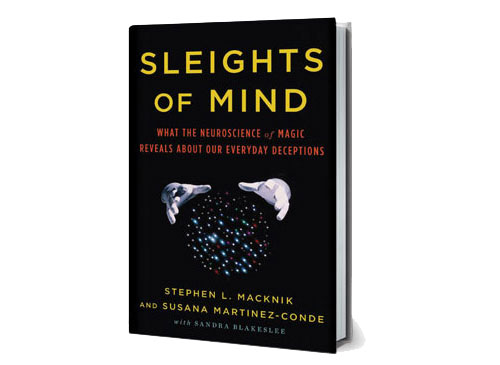
I’ve just finished a wonderful, extremely original book, Sleights of Mind: What the Neuroscience of Magic Reveals About Our Everyday Deceptions that combines magic and cutting-edge cognitive neuroscience that explains not only the ‘secrets’ behind some unusual magic tricks but why the work, given how our brains process information.
You’ll learn why techniques like ‘the illusion of choice’ work on stage with a deck of cards, with sales people at your local mall and in the arguments made by political commentators. Once you understand how we perceive the world, you’ll see the shortcuts and tricks that can be used by anyone to focus our attention just where it will be most profitable (or entertaining). The old saw, ‘the hand is quicker than the eye’ is simply not true: magic, like all deception, is based on how poorly (for the most part) our brains process information.
Husband and wife authors Stephen L. Macknik and Susana Martinez-Conde, along with science writer Sandra Blakeslee, have put together a great deal of information in a thoroughly engaging way. I think no one who’s read it would argue that it’s the most entertaining way to learn about brain science between two covers.
(I would also highly recommend Phantoms in the Brain: Probing the Mysteries of the Human Mind by V.S.Ramachandran and Sandra Blakeslee and The Body Has a Mind of Its Own: How Body Maps in Your Brain Help You Do (Almost) Everything Better by Sandra Blakeslee and Matthew Blakeslee.
To read an excerpt and learn more on the subject, there’s no better place to go then the Sleights of Mind website, www.sleightsofmind.com.
Chrysler Motors at the 1939 New York World’s Fair
January 4, 2011
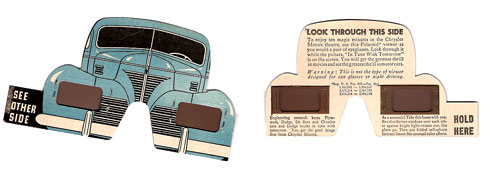
I’ve had an interest in the 1939 New York World’s Fair ever since as a child I came across a paperweight that my grandmother had depicting the Trylon and Perisphere that were the inescapable symbols of that fair. The Trylon was narrow triangular 610 foot tall tower that sat next to the round Perisphere, 185 feet in diameter. I’ve read books about it and even a DVD of silent color film footage taken there (more than anything else this gives you the feeling of what it was actually like to stroll along the broad avenues that housed the various exhibit halls.
There’s another reason for my interest and that’s because this World’s Fair introduced a polarized, Technicolor, stop-motion animated 3D movie, directed by John Norling. The film was called “In Tune with Tomorrow” and it was a centerpiece of the Chrysler Pavilion. In 15 minutes you watched a 1939 Chrysler Plymouth being assembled from parts that – without human intervention – danced and hopped into place. (The 1939 version was in B&W, for the 1940 edition it was color and the name was changed to “New Dimensions”). A 2D version used to be available online but has been removed. For more details check out the Iowahawk web page here.
Periodically, 3D seems to surface due some specific technical advance, briefly capture the attention and imagination of the public and then slip off the radar again, derided as just a ‘gimmick.’ Right now it seems we are in the midst of the biggest 3D revival the world has yet seen with mainstream Hollywood films, animated and live action, being produced, 3D capable television sets and video game consoles for sale, along with the first twin-lens 3D digital cameras for consumer use (the Fuji W1 and W3).
While stereoscopic 3D imagery will always be interesting to me, it remains to be seen if the current passion for 3D becomes a permanent evolution in mass media, or will once again fade out of the mainstream and become a niche interest of a small number of dedicated hobbyists.
3D from the Museum of Fine Arts, Boston
December 26, 2010
• Click on any image to enlarge in Lightbox mode.


These images are from a recent afternoon spent in the Museum of Fine Arts, Boston. I recognize that not all of these images are stereoscopically correct, according to best practices. So if some are admittedly ‘wrong,’ I present them this way because I like them better, not out of ignorance. Honest.
Helpful Websites for Dogs with Behavioral Problems
December 15, 2010
 Too many dogs are surrendered to shelters or simply abandoned due to behavioral problems. This, along with the sometimes suspect ‘I’m moving and can’t take my dog,’ are the top two reasons Animal Control Officers all across the country hear from people who are giving up a dog.
I believe an awful lot of these problems could’ve been dealt with before they got to the abandonment stage if owners would use consistent, positive training methods. If there aren’t qualified dog trainers in your area, there’s a wealth of information online. I’ve compiled a list of a dozen free resources below.
Yes, some behavioral problems may be beyond your ability to cope with. But all too often owners give up with only minimal attempts to bring about positive change. Almost any behavioral problem can be improved, whether it can be modified enough to solve the issue or bring relief to the harried owner is the question. Don’t give up too soon!
Virtual Pet Behaviorist created by the American Society for the Prevention of Cruelty to Animals
Certification Council for Professional Dog Trainers
How to Stop Agressive Dog Behavior
Rescue Dog Behavior Problems from the National Animal Interest Alliance
Dr. P’s Dog Training Library Scroll down to Header VI (Potential) Behavior Problems
Dogstar Daily – Behavior Problems
Dog Training and Behavior Articles from 4Paws University
Dog Problem Solving from Pet Expertise.com
Inside of a Dog: What Dogs See, Smell and Know
December 14, 2010
 I’ve been reading the excellent Inside of a Dog: What Dogs See, Smell and Know by Alexandra Horowitz. If you haven’t already, run out and buy this book! I’d give it my highest recommendation.
Since Ms. Hororwitz takes a scientific approach in fulfilling her subtitle you’ll learn a lot about your dog’s senses. About how sound and smell are more important than sight, for example. She also makes the point that of all the domesticated animals, dogs are the only one who regularly look us in the eye. Traditionally, the Window to the Soul, should you chose to believe in souls or spirits. Certainly, a window into another consciousness.
It’s true, of course, that a hard stare between two dogs can be read as aggressive and could be the prelude to a fight. But most of can easily tell the difference between and aggressive, challenging stare and the soulful gazing that occurs between primate and canines.
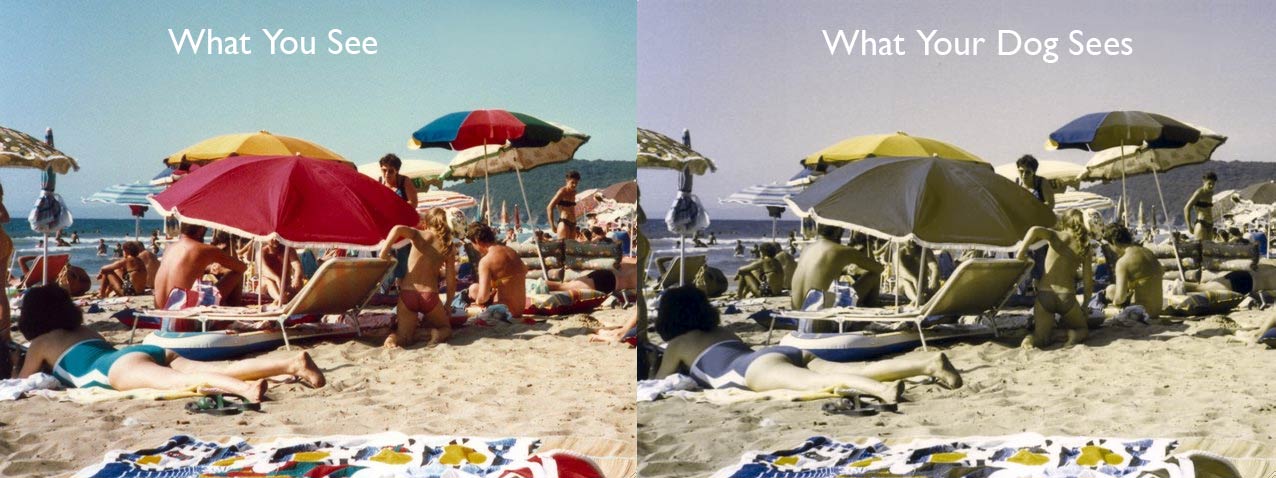
Visually dogs are dichromats having receptors for two color values (blue and yellow) as compared to humans who are trichromats with three (blue, blue-green, yellow-green). There’s a cool piece of Mac software called Sim Daltonism that’s a Color Blindness Simulator. If you select protanopia, (in humans we call this condition red-green color blindness) you’ll get an idea of what the world looks like to your dog. Click on the image below for larger size.
Dog DNA Database Used to Convict Murderer in England
December 3, 2010
The Times of London reports on a case where the use of a new companion animal DNA database helped place a murderer at the scene of his crime and led to his conviction. This is believed to be a world’s first. Read the complete article here.
In South London, as elsewhere, gang members routinely own aggressive dogs, sometimes referred to as “weapon dogs” or “status dogs.” While the penalties for committing a crime with a knife or a gun normally lead to a mandatory jail sentence, the law is much more lenient when to comes to convicting dog owners for the behavior of their charges. Yet an aggressive dog can do as much or more damage than a knife, and their very presence is intimidating.

The dog in this case was a Staffordshire Bull-Terrier, one of three related breeds (in the molosser group) we lump together and usually call pit bulls. Pit Bulls were bred at one time for bear baiting, an ‘entertainment’ that originated in England under Queen Elizabeth the First.
A bear would be staked in a pit and a group of dogs would be set up it, a ‘blood sport’, just as cruel and vicious as contemporary dog fighting rings.
In the same London neighborhood you could drink, hook up with a painted strumpet in a brothel or attend an original performance of The Winter’s Tale. The connection between these business was multi-layered: actors and theatrical impresarios like Philip Henslowe and his son-in-law, Edward Alleyn also owned bawdy houses where a man might catch the ‘French Welcome’ (syphilis). The most famous exit line in all theater is in The Winter’s Tale – just before the death of the character Antigonus, “Exit, Pursued by a bear.” Shakespeare was making a joke that his actors and audience would understand.
“Amazing 3D Comics” – Best of 1950’s 3D Comic Books edited by Craig Yoe
November 12, 2010
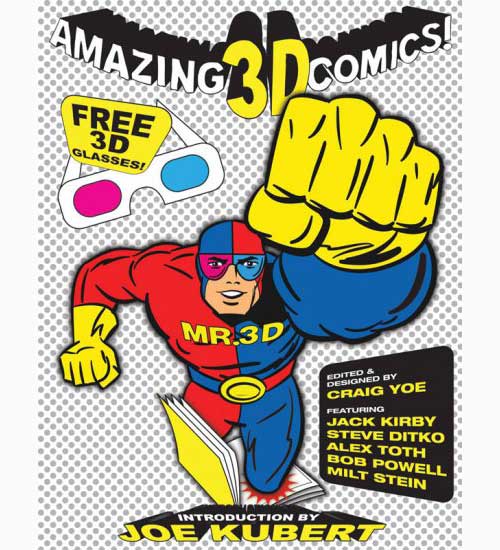
Oh, yeah – this is gonna be sweet! Eisner Award winner comics expert and designer Craig Yoe collects the best of 1950s 3D comics by such legendary talents as Jack Kirby, Steve Ditko, Alex Toth, Russ Heath, Al Jaffee, Bob Powell, Milt Stein and puts them between hard covers.
Re-mastered and restored, these works represent every genre: superhero, jungle adventures, horror comics, science fiction, funny animals, satire, western and romance! With a behind-the-scenes introduction by the mastermind behind 3D comics himself, Joe Kubert. Includes rare art and ephemera and a 3D lenticular cover.
Publication date: Feb. 1, 2011. Available for pre-order now from all the usual sources.
Classic Firesign Theatre Live Radio Shows Streaming on WFMU
November 11, 2010
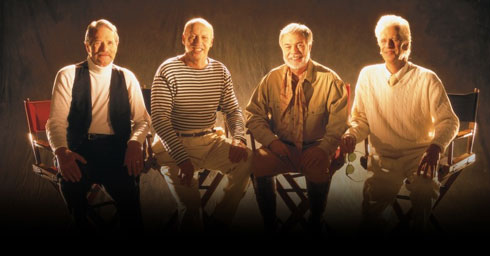
For the uninitiated, the Firesign Theatre – Philip Austin, Peter Bergman, David Ossman and Philip Proctor – is a comedy group that began on the radio in 1966 and remains together to this day (after several break-ups and re-groupings) producing their unique blend of surreal and silly audio delights.
Now, like worms out of hot cheese log, WFMU 91.1 FM in NYC, is rebroadcasting 16 hours of the Firesign’s work from 1970-1972, re-mixed and re-mastered for your edutainment and delight at http://wfmu.org/playlists/FT.
Even more exciting is the news that a reissue package of the Firesign Theatre’s complete broadcast history from 1970-1972 is being prepared for release. Gimme two! Sorry, only Tub per family. That’s Whole Beef Halves–We Deliver. Everywhere. Offer not good after curfew in sectors R and N.
The Firesign Theatre’s ‘classic’ period is judged by most to be 1968 to 1974 during which they released 8 LP albums on the Columbia Records label (on vinyl for you youngsters, see list below). They also appeared on four radio programs, Radio Free Oz, the Firesign Theatre Radio Hour Hour, Dear Friends and Let’s Eat. At their best the result of their collaboration results in a densely layered audio ‘movie’ both topical and self-referential, laced with pointed satire and a high order of wordplay.
For ‘A Not-So-Brief History’ of the group through 2002 see Frederick C. Wiebel, Jr.’s piece here.
Most of their commercially released material has been re-issued on CD’s, some is available for digital download on iTunes. But obtaining copies of their live radio work has long been the ‘holy grail’ for devoted Fireheads. It was from their improvised, free form radio work – incorporating found texts, short scripts and random music and sound effects – that many of their themes and albums developed.
So fellow kids, let’s give thanks to WFMU and everyone involved in reviving and re-broadcasting these classic FST radio programs.
Waiting for the Electrician or Someone Like Him January 1968
How Can You Be in Two Places at Once When You’re Not Anywhere at All July 1969
Don’t Crush That Dwarf, Hand Me the Pliers July 1970
I Think We’re All Bozos on This Bus 1971
Dear Friends January 1972
Not Insane or Anything You Want To October 1972
The Tale of the Giant Rat of Sumatra January 1974
Everything You Know Is Wrong October 1974
X-Ray Pin Ups? Actually, Digital Creations for EIZO Monitors Promotion
November 3, 2010
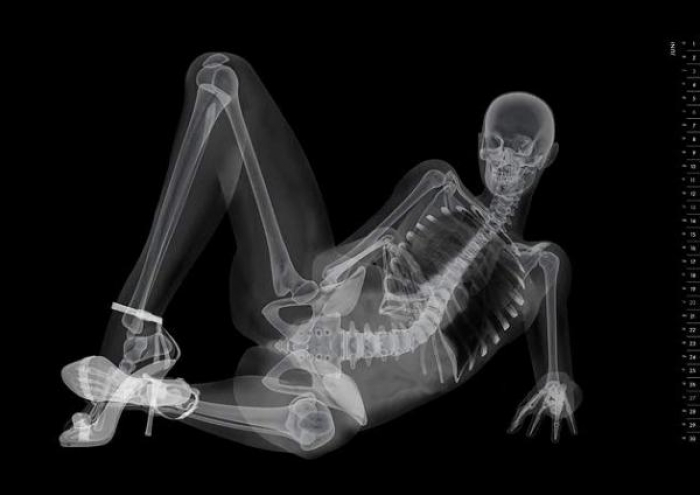
You may have seen these around the web recently and thought they were real X-Rays of pin-up models, something like the fantastic work of Nick Veasey. But they are actually completely digital creations by CGI Illustrator Carsten Mainz of the German advertising agency Butter for their client EIZO monitors. Check out the WIRED piece for a complete explanation, here. Click images for larger size.
