Your Tax Dollars at Work: Federal Agency’s $2.5 Billion Art Project
September 6, 2012
What do you get for $2.5 billion these days? A 360˚panorama of an actual alien world.
The site, panoramas.dk also has some amazing panoramic images of sights like Gondolas in Venice, Monument Valley and Versailles. One of my favorites is Elves Chasm Grand Canyon, Colorado River Rafting. Simply stunning. You can click on the image below for a larger size, but don’t bother with that. Just go to the site.

Apple’s iPhone is Five Years Old – NEVER Believe the Expert’s Opinion
June 29, 2012

Steve Jobs unveiled the iPhone on January 9, 2007 and it was available for purchase five months later.
What Did the Experts Say?
Microsoft CEO Steve Ballmer: “There’s ‘no chance’ the iPhone will get a significant share of the market. ‘No chance.’ ”
Bloomberg Business: “The iPhone’s impact will be minimal and appeal only to ‘a few gadget freaks.’ ”
PC Magazine: “The iPhone is deeply flawed. Apple will sell lots at first and then sales will plummet.”
Marketwatch: “The ‘one phone fits all’ concept is ridiculous. Apple needs to roll out many variations, or the iPhone will immediately become passé.”
Wedbush Morgan Securities: “The iPhone won’t affect the handheld gaming industry.”
Capital Group: “The Motorola RAZR is a great phone at a great price (free). There’s no way the overpriced iPhone can compete with it.”
Leo LaPorte, TWIT Network: “This isn’t a business Apple should be in.”
BusinessWeek: “The iPhone will never be a threat to the BlackBerry.”
RIM CEO Jim Balsillie: “The iPhone’s impact on our business will be minimal.”
Quotes from Business Insider.
FIVE YEARS (and $150 billion in revenue) LATER
Apple’s iPhone business is bigger than all of Microsoft.
Dell and HP are reeling.
Palm, Nokia and RIM are toast (RIM’s stock price is down 89%).
Apple’s stock price has almost quintupled.
Apple has created hundred’s of thousands of jobs for App developers.
The lesson? Opinions and predictions are worthless. Try and remember that, OK?
Social Media: What is it Really – Threat or Menace?
May 30, 2012
And hey, Charley, I think about you
Every time I pass a fillin’ station
On account of all the grease
You used to wear in your hair
I’m a social media skeptic and find it hard to fathom the valuations of the giants in this arena. So, of course, I’m attracted to the disconfirming story. Like the one that Olga Kharif reports on in Bloomberg Business Week, “Lifejacking’: Spammers Hit Social Media.”
How about a guy who sells anti-spam software claiming that 40% of the accounts on the social media titans Facebook, Twitter and Pinterest are created by spammers? So says Mark Risher, CEO of Impermium, who knows about a company that has just the right solution for your self-diagnosed problem.
I just wished there’d been some effort to independently source his 40% estimate.
I used to live across the street from a barber shop on Ninth Street, right above a dirty bookstore off Euclid Avenue, and the owner there thought 85% of the men he saw in the street needed a haircut.
As one commenter asked: Can you imagine how many megawatts are wasted every day in server farms all across the world handling all of this social media crap? Why aren’t the climate-commies, green-weenies and Occupy pukes protesting that?
Don’t sugar-coat it, pal. Tell us how you really feel. This is in the grand old comedy tradition created by Steve Allen, who would read particularly incensed letters from the New York Daily News in the 1950s and 1960s. The construction of “climate-commie, green-weenie, Occupy pukes” is just masterful.
If I had written it I would have gone more rhythmically with “greenie-weenies” and that would have been a bridge too far, certainly.
And I still have that record
of Little Anthony & the Imperials
But someone stole my record player
Now how do you like that?
Or, for your consideration, from the site Guyism, the slide show 7 Ways You Didn’t Realize the Internet Was Eating Your Privacy. I think this is info that’s not just for guys.
And let’s not even mention Henry Ford and his 1920 publication, The International Jew: The World’s Foremost Problem. “If fans wish to know the trouble with American baseball, they have it in three words—too much Jew,” wrote Henry Ford on May 22, 1920. I guess he’d like the current line-up better? It’s certainly not dominated by the Sons of Abraham.
I said, let’s not even mention that!
The Commercial Limits of the Internet – “The Facebook Illusion” by Ross Douthat in The New York Times
May 27, 2012
“There were two grand illusions about the American economy in the first decade of the 21st century. One was the idea that housing prices were no longer tethered to normal economic trends, and instead would just keep going up and up. The second was the idea that in the age of Web 2.0, we were well on our way to figuring out how to make lots and lots of money on the Internet. The first idea collapsed along with housing prices and the stock market in 2007 and 2008. But the Web 2.0 illusion survived long enough to cost credulous investors a small fortune last week, in Facebook’s disaster of an initial public offering.”
Of course, I’m not on Facebook and I’m no fan of social media in general, so I’m primed to seek out disconfirming evidence of its success. (And let’s be honest, a company started by a 19 year-old in his Harvard dorm room in 2004 that made a billion dollars a year in 2011 is, by any measure, a success – whatever its future prospects).
For those reasons I tend to fall under the sway of the sort of arguments made by Ross Douthat in The New York Times “The Facebook Illusion.” Read his piece and see what your take is. It confirms my prejudices so I think it’s clearly correct and expertly reasoned. Obviously, Facebook is Evil. Remember, you read it here first.
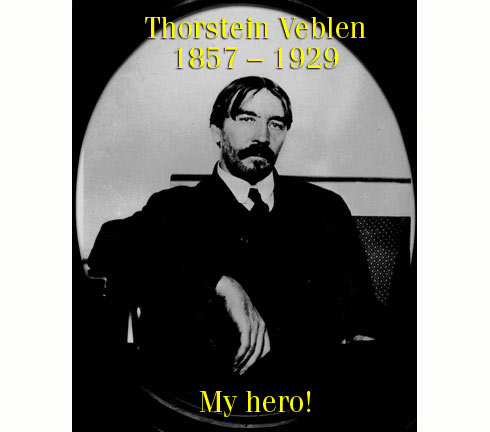
I’m also a huge fan of Thorstein Veblen’s seminal work The Theory of the Leisure Class. So I just love stuff like this:
“. . .leisure is clearly the basis of the Internet. From the lowbrow to the highbrow, LOLcats to Wikipedia, vast amounts of Internet content are created by people with no expectation of remuneration.”
Bejaysis, ye can look up all kinds o’ shite now – Mick O’Pedia
May 26, 2012
I think this is hysterical – a linguistic “skin” that overlays Wikipedia and transforms it into stereotypical Irish slang, Mick O’Pedia. Here’s an example, the entry on St. Patrick’s Day:
Saint Patrick’s Day or the Feast of Saint Patrick (Irish: Lá Fhéile Pádraig, “the Day of the bleedin’ Festival of Patrick”) is an oul’ cultural and religious holiday celebrated on 17 March. Here’s a quare one. It commemorates Saint Patrick (c. AD 387–461), the most commonly recognised of the patron saints of Ireland, and the feckin’ arrival of Christianity in Ireland. Be the holy feck, this is a quare wan.
It is observed by the feckin’ Catholic Church, the Anglican Communion (especially the oul’ Church of Ireland), the bleedin’ Eastern Orthodox Church and Lutheran Church. C’mere til I tell ya. Saint Patrick’s Day was made an official feast day in the early seventeenth century, and has gradually become an oul’ celebration of Irish culture in general. Be the holy feck, this is a quare wan.
The day is generally characterised by the feckin’ attendance of church services, wearin’ of green attire, public parades and processions, and the bleedin’ liftin’ of Lenten restrictions on eatin’, and drinkin’ alcohol which is often proscribed durin’ the oul’ rest of the bleedin’ season. Stop the lights!
Saint Patrick’s Day is a bleedin’ public holiday in the bleedin’ Republic of Ireland, Northern Ireland, Newfoundland and Labrador and Montserrat. It is also widely celebrated by the bleedin’ Irish diaspora, especially in places such as Great Britain, Canada, the bleedin’ United States, Argentina, Australia, and New Zealand, among others, that’s fierce now what? Today, St. Jesus, Mary and holy Saint Joseph. Patrick’s Day is probably the feckin’ most widely celebrated saint’s day in the oul’ world. Me head is hurtin’ with all this raidin’.
“Just One More Game. . .” – NY Times Article on Video Games is Also, Itself, a Video Game
May 23, 2012
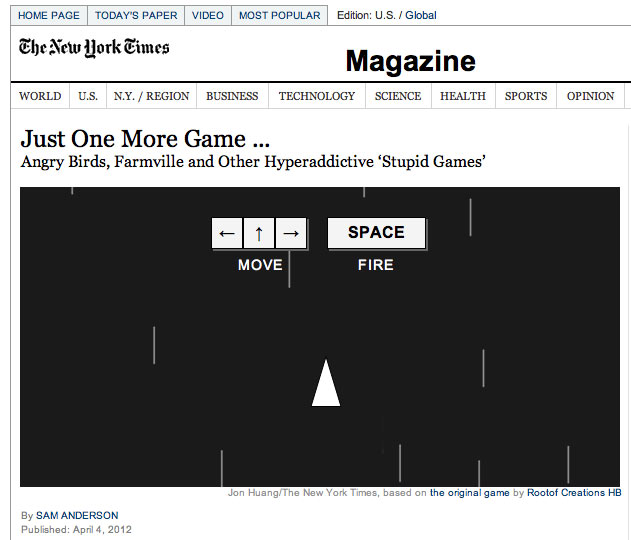
Sam Anderson of the New York Times gives us an overview of mobile gaming as it exists today in the iPad and iPhone era, The Hyperaddictive, Time-Sucking, Relationship-Busting, Mind-Crushing Power and Allure of Silly Digital Games. The Times then worked out a way to make the article itself a video game much like the 80’s arcade classic Asteroids.
Using your cursor keys to move a white triangle around the page, you can zap objects like sidebars, thumbnail photos and other page elements and make them disappear. The text of the article remains immune to this satisfying eradication taking place on the Times‘ web page. How very meta- of them. And how totally cool.
The Growth of Hate Groups in America – ABC News
May 23, 2012
“This is not the country my Christian White forefathers built. We’ve got to take this country back!”
You may have read recently that we’ve reached a tipping point in our population: more minority children are being born than white children. Demographics are the future. In 2050, given current trends, non-Hispanic whites will no longer be the majority ethnic group in America. And nothing, short of an apocalyptic race war, will change this fact.
Right wing extremist militia groups have risen from 150 to 1,274 during the first three years of the Obama presidency according to Mark Potok, of the Southern Poverty Law Center. For more information on this development, please check out Hate Groups Grow as Racial Tipping Point Changes Demographics by Colleen Curry of ABC News.
Maybe this is one reason why the Republican Party has swung so far to the right in recent years?
They are the conservative party whose position is reflexly against change. But “Life is Change, how it differs from the rocks,” as Grace Slick sang in 1968.*
Historically, Republicans have opposed Social Security, Medicare, Medicaid, Unemployment Insurance, the Civil Rights Act of 1964, Public School Desegregation, Minimum Wage laws, Women’s Suffrage and almost all social welfare programs.
“The thing I think to understand is that the radical right is not entirely composed of people who are insane. These are people reacting to real changes in the real world around them.” – Mark Potok
The only problem is that their reaction is to oppose the inevitable, rather than adapt to it. I believe this is the wrong strategy and destined to fail. See you in 2050. . .
___________________________________________________________
* “Crown of Creation” was written by Paul Kantner and inspired by the book The Chrysalids by John Wyndham.
Highest Resolution Single-Shot Photo of the Earth by Russian Weather Satellite
May 23, 2012
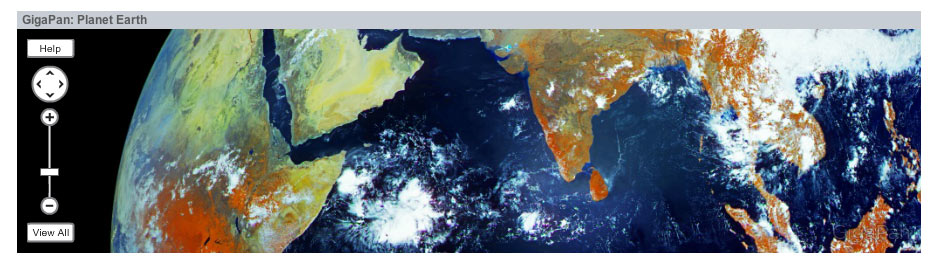 NASA scientist Robert Simmons sniffs, “They’re not any better or worse than NASA images, but they show different things.”
That sounds like sour grapes over this amazing image of Planet Earth captured by a Russian weather satellite, Electro-L. The satellite is in orbit 22,369 miles above the equator and takes a picture every 30 minutes at a resolution of 121 megapixels.
The picture displayed above was taken in a single snap shot. NASA’s wonderful, inspiring shots of the Earth are generally composites of several images. Click here for a scalable image and a video version of this cutting edge off-the-planet photography.
“In 3-D: How Mariano Rivera Dominates Hitters” – The New York Times
May 23, 2012

As a child of the 1960s I understand that there are no sacred institutions in American life and no matter how they strive to do good work, things sometimes go horribly wrong. There was an age, long ago, when The New York Times was considered the national newspaper of America and its coverage believed, by most, to be definitive.
But institutions are made up of people, and so can fail prey to all the standard human weaknesses, demonstrated by the Jayson Blair plagiarism/fabrication scandal of a decade ago. Also, given the explosion of media and content provided by the InterWebs the former dominance and power of individual newspapers, magazines and broadcasters has been eroding. I’m no futurist but it’s clear to everyone that journalism must change to accommodate these new realities.
Still, I would say that the Times gets far more things right than they do wrong. I’ve often linked to their articles in the past and will continue to do so. Today I’d like to show a little love to Times for exploring new ways to inform their readers. Take a look at this 3D anaglyph video breaking down the technique of New York Yankee’s pitcher Mariano Rivera’s “Cut Fastball” by Graham Roberts, Shan Carter and Joe Ward. (You’ll need red-cyan glasses to view it). It’s an example of how information can be delivered to an audience that was never before possible in the context of daily journalism. Click on image for larger size.
Americans and their Social Media: Infographic
April 29, 2012
I remain a skeptic about the true value of Social Media to their many users. Collecting all that personal data about us is quite valuable to the Dark Overlords of the Interwebs – I’m looking at you, Mr. Zuckerburg – and, obviously, governments.
It seems to me that a week doesn’t go by without news of someone losing a job, alienating friends, getting caught for criminal activity, or wrecking a marriage or relationship by ‘over sharing’ on Facebook. It also seems just plain sad that so many people have redefined ‘social’ as typing on their keyboards, instead of actually going out of their homes and interacting in the ‘real world.’
Didn’t the Grateful Dead sum this problem up in their November 1970 release, “Truckin'” ?
Most of the cats that you meet on the street speak of true love,
Most of the time they’re sitting and cryin’ at home.
One of these days you know they better get goin’
Out of the door and down on the streets all alone.
Then again, I think most television is an absolute waste of time and – Good Lord! – we Americans seem to spend a third of our lives watching TV. Here’s an infographic that details American usage of Social Media platforms. I’m appalled but your reaction may be different. . .
Click on image for larger size.